IMDb RATING
6.3/10
9K
YOUR RATING

Pasolini's artistic and always vividly cinematic retelling of eight of Chaucer's famous tales.Pasolini's artistic and always vividly cinematic retelling of eight of Chaucer's famous tales.Pasolini's artistic and always vividly cinematic retelling of eight of Chaucer's famous tales.
- Director
- Writers
- Stars
- Awards
- 1 win total



Orla Pederson
- Pilgrim
- (as OT)

Derek Deadman
- The Pardoner
- (as Derek Deadmin)

George Bethell Datch
- Host of the Tabard
- (as George B. Datch)


- Director
- Writers
- All cast & crew
- Production, box office & more at IMDbPro
6.38.9K
1
2
3
4
5
6
7
8
9
10
Featured reviews
Scatological film that vies more towards the crass
Continuing his 'Trilogy of Life' cycle exploring medieval literature, The Canterbury Tales by Pier Paolo Pasolini, delves into some of the tales weaved within Geoffrey Chaucer's famous stories. It explores the myriad sexual depravities and allusions with bawdy gusto, featuring almost every perversion known, from voyeurism, flagellation, homosexuality, to even the "love" of a watermelon. The disparate, prurient tales are interwoven with Pasolini plays Chaucer here at his writing desk, imaging his lasciviousness upon villagers. There is even a strange comic interlude paying homage to Charlie Chaplin, in the form of Pasolini regular, Ninetto Davoli.
Whilst the visual style is similar to The Decameron (1970 - Dante Feretti again is art director), the stories do not intertwine as well here, which could create some confusion in the viewer. With a largely British cast (including Tom Baker, Hugh Griffith, Jeeny Runacre, and even Robin Askwith), the film film sometimes feels like a slightly less repressed 1970's British sex comedy (Carry On Canterbury, if you like). With its delight in sexual promiscuity and perversion, it is certainly one of Pasolini's less than intellectual affairs, and even fails to humour. Unless of course your funny bone is easily pleased by fart jokes.
With a bizarre finale set in hell (its visual design clearly inspired by the painting of Hieronymus Bosch), we see an over-sized Satan shitting out some plebeian folks, to the obscene delight of those scattered round the pits. Whilst this incredibly short ending is disgustingly joyous, it fails to save a very scatological film, that vies more towards the crass than the enlightening.
www.the-wrath-of-blog.blogspot.com
Whilst the visual style is similar to The Decameron (1970 - Dante Feretti again is art director), the stories do not intertwine as well here, which could create some confusion in the viewer. With a largely British cast (including Tom Baker, Hugh Griffith, Jeeny Runacre, and even Robin Askwith), the film film sometimes feels like a slightly less repressed 1970's British sex comedy (Carry On Canterbury, if you like). With its delight in sexual promiscuity and perversion, it is certainly one of Pasolini's less than intellectual affairs, and even fails to humour. Unless of course your funny bone is easily pleased by fart jokes.
With a bizarre finale set in hell (its visual design clearly inspired by the painting of Hieronymus Bosch), we see an over-sized Satan shitting out some plebeian folks, to the obscene delight of those scattered round the pits. Whilst this incredibly short ending is disgustingly joyous, it fails to save a very scatological film, that vies more towards the crass than the enlightening.
www.the-wrath-of-blog.blogspot.com
The weakest link.
It is the second part of Pasolini's "trilogy of life" and IMHO,the weakest :part of the reason can be found in the fact that it's merely more of the same ;after" Il decameron' the sensation of surprise has disappeared.Bawdiness,bawdiness and bawdiness,and a good dose of scatology.Besides,the stories,adapted from Chaucer are less interesting than in "IL decameron" ;the only good really good segment,as far the script is concerned ,is the one with the students and the miller's family:the mistaken identities are hilarious.But what remains is never really exciting.The scene in which a gay is literally "fried " is downright disturbing,coming from a director like Pasolini;the sequence is treated seriously ,almost without humor-unless the donuts seller counts-.
No one can argue the splendor of the cinematography;most of the times,it looks like pictures at an exhibition:the moist misty landscapes -particularly in the students' sequence- sharply contrasts with the mediterranean overcome by the heat ones in "il decameron";and the score,which includes old English traditionals is first-rate too.Ninetto Davoli,Pasolini's favorite actor,does his usual (almost silent) stint,in the grand tradition of Charlie Chaplin,which almost seems supernatural in this context;One should add that Josephine Chaplin is also part of the cast:some kind of double tribute.
The script is the Achille's heel of the movie."Il fiore della mille e una notte" will set the record straight and redeem Pasolini,for it's without a doubt the peak of the trilogy of life,with its numerous stories " à tiroirs".
No one can argue the splendor of the cinematography;most of the times,it looks like pictures at an exhibition:the moist misty landscapes -particularly in the students' sequence- sharply contrasts with the mediterranean overcome by the heat ones in "il decameron";and the score,which includes old English traditionals is first-rate too.Ninetto Davoli,Pasolini's favorite actor,does his usual (almost silent) stint,in the grand tradition of Charlie Chaplin,which almost seems supernatural in this context;One should add that Josephine Chaplin is also part of the cast:some kind of double tribute.
The script is the Achille's heel of the movie."Il fiore della mille e una notte" will set the record straight and redeem Pasolini,for it's without a doubt the peak of the trilogy of life,with its numerous stories " à tiroirs".
Best Italian film ever
When I was going to see "Canterbury Tales", I knew Pasolini was infamous director who made crazy films, that weren't for everyone's taste.When I saw it. It was one of those movie experiences that change the way you see films. It's not that I loved this film, I don't see how I can use word "love" here. It's just that from the beginning to the end I couldn't believe my eyes. Sequence after sequence, the movie became one of the most original films I ever seen in my life. Wife having sex standing on her husband's shoulders, woman farting in the face of the young boy who loves her, drunken man, p***ing on dining people, giant ass, that defecates with demons, it's shocking, yes, but it's not the point. The point is,we believe every single thing we see on the screen. Of course, it's because Pasolini uses natural lightning, unprofessional actors, and partly because when there is fucking on the screen, it's not simulation, it's real f**king (what other film can be classified as "porn", and also have Oscar-winning costume designer in its credits?). But it's not the reason. I always admired Pasolini, because he was one of those people, who make others respect them, who have remained hip even twenty years after they are dead. And being this incredibly fascinating person, he could put part of the magic that made him the person he was into his movies.
Interesting but not Chaucer
If you watched this movie in order to get a crib of Chaucer's Canterbury Tales, you'd be out of luck, and missing the point. Chaucer's underlying anti-clerical and pro-love-and-life philosophy may be there, but the substance is very different. Pasolini's 14th century England lives and dresses more like 16th Century Italy.
The Miller's Tale is much grimmer when brought to the screen than Chaucer would have intended. "And Nicholas is branded on the bum, And God bring all of us to Kingdom Come" in Coghill's cheerful popular translation, becomes something more like the execution of Edward II. Not just on, but in. And the execution of a sodomite too poor to bribe his way off the griddle seems drawn out just to make a bad joke about the seller of "griddle cakes" (frittelli) plying his trade in the crowd.
He is one of the more than fair share of handsome young men in the film, and there's more than a fair share of closeups of their middle regions, front and back, in tight-fitting breeches (not that I'm complaining).
One feature that is almost entirely absent is any sense of pilgrimage. The storytellers appear only at the beginning and end of the tale. Instead we cut back to Chaucer himself (Pasolini himself, and very handsome he is too), writing the tales at a snail's pace. There are also long (by 2006 standards) tracking shots over indifferent scenery. Yet other scenes jump disconcertingly, the start of one tale used to mark the end of the previous one.
The Miller's Tale is much grimmer when brought to the screen than Chaucer would have intended. "And Nicholas is branded on the bum, And God bring all of us to Kingdom Come" in Coghill's cheerful popular translation, becomes something more like the execution of Edward II. Not just on, but in. And the execution of a sodomite too poor to bribe his way off the griddle seems drawn out just to make a bad joke about the seller of "griddle cakes" (frittelli) plying his trade in the crowd.
He is one of the more than fair share of handsome young men in the film, and there's more than a fair share of closeups of their middle regions, front and back, in tight-fitting breeches (not that I'm complaining).
One feature that is almost entirely absent is any sense of pilgrimage. The storytellers appear only at the beginning and end of the tale. Instead we cut back to Chaucer himself (Pasolini himself, and very handsome he is too), writing the tales at a snail's pace. There are also long (by 2006 standards) tracking shots over indifferent scenery. Yet other scenes jump disconcertingly, the start of one tale used to mark the end of the previous one.
Superb Film
I'm rather bemused by some of the negative comments above. This film - in my humble opinion - is one of the greatest ever made, and my personal favourite of all P.P. Pasolini's. Pasolini brings life to Chaucer in a way my poor teachers at school could never have dared. In the film, Pasolini casts himself as Chaucer; daydreaming, laughing at his own tales, being berated by his wife. And therein lies the clue to this film. It's not just an interpretation of the Canterbury Tales, it's a portrayal of its author. For all claims of "smut" (see above), I can honestly say that your imagination must be pretty dull not to laugh at certain earthy, dream-like scenes. Absolutely non of the scenes in this movie can be branded as bad-taste. They're absolutely accurate. Pasolini showed deep understanding of the English psyche throughout; the examples are too numerous to mention. If you're looking for an explanation of The Canterbury Tales, you won't find it in this film. But if you're looking for how to go about interpreting it for yourself, you'll find no better. This movie is one that I will keep, and you can bet my kids are going to see it when they get a little older too.


Did you know
- TriviaRemarkably, this is the only major cinematic take on Geoffrey Chaucer's classic tales.
- GoofsSome of the women have tan-lines from bikinis.
- Quotes
The Wife from Bath: There's nowhere in the Gospels that says we ought to stay virgins. Anyway, tell me, what were the genital organs made for at the creation? Not to lie dormant I suppose. And nobody's going to tell me they were just put there to piss through. Mark you, I use it for that as well. And every man must serve his wife in wedlock...
- Alternate versionsThe original UK cinema version was cut by the BBFC with edits to anal sex shots, a man being whipped, and Rufus urinating on the crowd during the 'Pardoner's Tale' segment for an 'X' certificate. The cuts were fully restored in 2001 and the certificate downgraded to a '15'.
- ConnectionsFeatured in Playboy: The Story of X (1998)
- SoundtracksThe Old Piper
written by Carl Hardebeck in 1912
performed by Frank McPeake
Played over the opening credits and sung frequently by Perkin the Reveler in the Cook's Tale
- How long is The Canterbury Tales?Powered by Alexa
Details
- Release date
- Countries of origin
- Official site
- Languages
- Also known as
- Los cuentos de Canterbury
- Filming locations
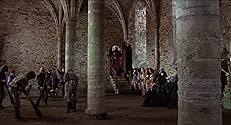
- Battle Abbey, East Sussex, England, UK(merchant's tale: hall interior)
- Production companies
- See more company credits at IMDbPro
Box office
- Gross worldwide
- $9,028
- Runtime
- 1h 51m(111 min)
- Sound mix
- Aspect ratio
- 1.85 : 1
Contribute to this page
Suggest an edit or add missing content