
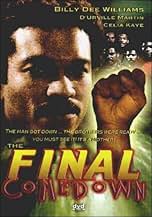
Black revolutionaries take action in the white suburbs.Black revolutionaries take action in the white suburbs.Black revolutionaries take action in the white suburbs.
- Director
- Writers
- Stars



Ed Cambridge
- Dr. Smalls
- (as Edmund Cambridge)
Morris D. Erby
- Mr. Johnson
- (as Morris Erby)


- Director
- Writers
- All cast & crew
- Production, box office & more at IMDbPro
5.8473
1
2
3
4
5
6
7
8
9
10
Featured reviews
Violence on the streets in this gritty blaxploitation effort
THE FINAL COMEDOWN is a cheap blaxploitation vehicle for actor Billy Dee Williams, later to achieve worldwide fame and recognition for his role in the STAR WARS films. His appearance here is something of a star-making turn for the actor, who burns up the screen as the black revolutionary determined to stand up to the racist white cops who are making his life a nightmare.
This is an undeniably cheap film that's plenty rough around the edges, although it's an interesting picture for sure. It avoids the usual stereotypes of sex and violence that often prop up this genre, even though both are present throughout the running time, most noticeably during a lengthy and gratuitous sex scene. Instead it provides a kind of social commentary exploring the issues of the times, and the racism inherent in 1970s society.
The grungy vibe of THE FINAL COMEDOWN gives it a realistic appearance even though it isn't particularly satisfying on a visceral or emotional level. The supporting cast is a well-judged one and I was amused to see a younger R.G. Armstrong, still looking old even at this stage of his career. This isn't the kind of film that's going to set anyone's world on fire - it's obscure for a reason - but fans of the stars or genre will find themselves intrigued by it.
This is an undeniably cheap film that's plenty rough around the edges, although it's an interesting picture for sure. It avoids the usual stereotypes of sex and violence that often prop up this genre, even though both are present throughout the running time, most noticeably during a lengthy and gratuitous sex scene. Instead it provides a kind of social commentary exploring the issues of the times, and the racism inherent in 1970s society.
The grungy vibe of THE FINAL COMEDOWN gives it a realistic appearance even though it isn't particularly satisfying on a visceral or emotional level. The supporting cast is a well-judged one and I was amused to see a younger R.G. Armstrong, still looking old even at this stage of his career. This isn't the kind of film that's going to set anyone's world on fire - it's obscure for a reason - but fans of the stars or genre will find themselves intrigued by it.
good black propaganda
I was really touched by this film. I thought the cinematography was excellent in it. It's a pretty depressing movie, and it shouldn't be looked down upon just because it's propaganda. It's well edited and well crafted. Reminded me of the battleship potemkin in this regard.
Kind of a Let-Down If You're Expecting Hard-Hitting Action
Though labeled as a blaxploitation film, this is essentially a preachy character study about a young man from the slums, who is pressured into becoming a militant gang member, but is fatally wounded during a police shootout. The rest of the movie is mostly told in flashbacks, leading up to the showdown between the cops and the gang members. The movie is just sluggish with its pace. Because New World Pictures lost money when they picked it up for distribution, the movie was re-shot in 1976 with new footage and released under its new title Blast!, with new footage directed by Allan Arkush.
Heavy-handed....no, scratch that....elephant-handed drama
"The Final Comedown" wants to "say something" about racism and inner-city violence; unfortunately, the message is invalidated by the nonsensical script, the amateurish production, and the heavy-handed polemics. How heavy-handed, you ask? To give you just one example, a black doctor comes out of his hiding place, unarmed, with his hands up in the air, ready to surrender to the police: one of the (all-white) cops says "Don't shoot him, he's a doctor", to which another cop replies: "So what? He's still a n****r", and proceeds to shoot him in cold blood. The cops are portrayed as ignorant, racist killers, even though at the end there are just as many dead people among them as there are among the black people who staged the riot. And this whole event was meant somehow to "sensitize" the white folks to the demeaning treatment of the black folks, when in fact something like this can only breed more hate and violence on both sides. Pamela Jones, as Williams' girlfriend, briefly lights up the screen with her smile and body, particularly in a tender sex scene, and elevates the rating of this movie from 1 to 2 out of 10.
100% Socially Relevant for 1972 Los Angeles
My earliest memories of Billy Dee Williams were him as Lando Calrissian in The Empire Strikes Back. At that time I knew him as a relaxed hair heart throb to many women of color. I never knew he had a film like this to his credit.
This movie is excellent and it was 100% socially relevant for 1972.
Billy Dee plays Johnny Johnson, a frustrated young Black man like so many others at that time. He was educated, angry, and being crushed under the weight of being young, educated and Black in America. He externalized all of that frustration and acted on that frustration and that's where the movie picks up: at the point of no return.
This movie is not for everyone, Black or White. This movie is an uncensored, no holds barred reflection of American society at that time. It's a perspective that was never seen on T.V. or heard on radio. It's a perspective that one would only get by entering the ghettos and projects of America. The dialog was heavy and the actions taken were costly, but such a thing was almost inevitable.
This movie had to be made just as it was because it is a chronicling of an era. Whether the names and the people were real is immaterial. What was real was the anger, the frustration, the repression, the oppression, and the natural bubbling over from all of that being mixed together. I'm glad this movie was made and that I had the opportunity to watch it.
This movie is excellent and it was 100% socially relevant for 1972.
Billy Dee plays Johnny Johnson, a frustrated young Black man like so many others at that time. He was educated, angry, and being crushed under the weight of being young, educated and Black in America. He externalized all of that frustration and acted on that frustration and that's where the movie picks up: at the point of no return.
This movie is not for everyone, Black or White. This movie is an uncensored, no holds barred reflection of American society at that time. It's a perspective that was never seen on T.V. or heard on radio. It's a perspective that one would only get by entering the ghettos and projects of America. The dialog was heavy and the actions taken were costly, but such a thing was almost inevitable.
This movie had to be made just as it was because it is a chronicling of an era. Whether the names and the people were real is immaterial. What was real was the anger, the frustration, the repression, the oppression, and the natural bubbling over from all of that being mixed together. I'm glad this movie was made and that I had the opportunity to watch it.


Did you know
- TriviaReleased between two of Billy Dee Williams' best films; television's "Brian's Song" 1971, and the theatrical "Lady Sings The Blues" 1972.
- Alternate versionsBlast! (1976) is an alternate version of this film, with new footage directed by Allan Arkush. The director credited is "Frank Arthur Wilson."
- ConnectionsFeatured in Planet X: Episode #2.1 (2006)
Details
Box office
- Gross US & Canada
- $163,591
- Runtime
- 1h 23m(83 min)
- Sound mix
- Aspect ratio
- 1.85 : 1
Contribute to this page
Suggest an edit or add missing content