IMDb RATING
5.7/10
1.3K
YOUR RATING

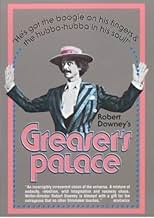
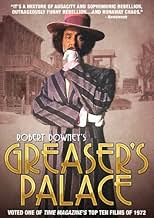
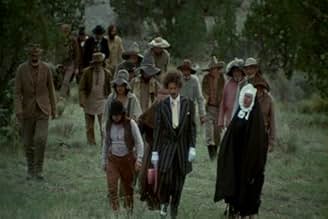
A strange man named Jesse who can revive life and walk on water comes into a surreal and cruel western town.A strange man named Jesse who can revive life and walk on water comes into a surreal and cruel western town.A strange man named Jesse who can revive life and walk on water comes into a surreal and cruel western town.



Lawrence Wolf
- French Padre
- (as Larry Wolf)


- Director
- Writer
- All cast & crew
- Production, box office & more at IMDbPro
5.71.2K
1
2
3
4
5
6
7
8
9
10
Featured reviews
fun and wacky.... from bob downey senior
Modern take on the old western... from robert downey senior. This one had all the makings of a cult film, but... it didn't seem to take. Old man greaser rules the town with an iron fist. Until a mysterious stranger (arbus) comes to town and turns everything upside down. Lots of religious references. Nuns, friars, repeatedly reviving lamy, walking on water. Angels in white sheets walking around. Swearing, frontal female nudity. Drag. It gets fairly dirty. It's wacky and entertaining. Filmed in various locations in beautiful new mexico. Herve villechaize is spitunia, five years before fantasy island. This is probably the highest rated of downey senior's films. And probably the most odd as well. At one point, one character just repeats the same nonsense line over and over. It's fun, and quirky, but probably not for everyone.
6sol-
A Stranger Arrives
Dressed in a 1920s zoot suit, an amateur magician parachutes in an Old West town where he causes unrest by performing tricks that the locals believe are miracles in this decidedly weird western from Robert Downey Sr. Written as a deliberately anachronistic character, the protagonist here is intriguing; as his tricks involve healing the sick and walking on water, he is clearly modeled on Christ, yet with the way he dresses and lands in town, it is as if he has been sent from the future back to the Wild West. Whatever the case, Allan Arbus (of 'M*A*S*H' fame) is excellent in the lead role, remaining calm and collected throughout (turn the other cheek) and always very enthusiastic about performing - even when a card guessing trick terribly backfires. For a Christ-like figure, he is highly subverted, encouraging kindness and good will by getting those he comes across to applaud his acts and marvel at his showmanship. For all its ambition though, 'Greaser's Palace' remains a highly episodic motion picture, often coming across as a series of loose sketches than a plot-driven story - something that dulls the religious parable at hand and makes the overall experience a tad uneven. There are some great running gags in the mix too though, such as Arbus constantly bringing local black sheep Michael Sullivan back to life, much to the outcast's constant bewilderment.
The weirdest American movie of the 1970s!
The unexpected box office success of 'Easy Rider' at the end of the 1960s opened all kinds of doors for all kinds of people. Suddenly there was a new "youth market" to be exploited. Thousands of hip kids were getting stoned and watching the likes of '2001' and 'Easy Rider'... mmm, what might they want to groove behind next? The old school film execs were baffled for the most part, and this allowed De Palma, Coppola, Altman, Scorsese, Ashby and Bogdanovich and others to get their big breaks. This period has been discussed a lot recently in books and documentaries, but what about the freaks who didn't become household names? What about say Robert Downey Sr and 'Greaser's Palace'?? Look I've seen some weird movies in my time, but 'Greaser's Palace' could well be the weirdest American movie of the 1970s! I have no idea whether Downey was familiar with 'El Topo' or not, and Hollywood had already dabbled in hippie Westerns with 'Zachariah' the previous year. Maybe these movies were some kind of influence on him, I don't know, maybe it was synchronicity. Even trying to describe this film makes it hard to believe it ever got made, watching it is even more bizarre. See, it's kind of a stoner's parable about Christ. Allan Arbus (who subsequently had a recurring role on 'MASH' the TV series and played the baddie in Jack Hill's blaxploitation classic 'Coffy') is Jessie, a zoot suit wearing fellow who parachutes into a wacked out town in the Old West. The town is run by Seaweedhead Greaser (Albert Henderson). His daughter Cholero (Luana Anders) is a burlesque performer, his son Lamy Homo (Michael Sullivan), well I don't know what he is exactly but he keeps getting killed and comes back from the dead describing his visions of the afterlife ("I was swimming in a rainbow with millions of babies... ...and they was naked......and then all of the sudden I turned into a perfect smile!"). Jessy just wants to sing and dance and get to Jerusalem where "the Agent Morris" awaits him, but he becomes a messiah figure for many of the townsfolk, which irks Cholero no end. Then you've got a topless Indian girl (Toni Basil), a gay midget (Herve Villeechaize), and a guy walking around wearing a sheet who I assume is the Holy Ghost (Ronald Nealy). Making sense? Maybe if you smoke as much weed as seemingly went into making it! Arbus is terrific throughout and it's always cool to see Luana Anders. She was one of the most interesting actresses of the period, appearing in cult favourites 'The Pit And The Pendulum', 'Night Tide', 'Dementia 13', 'The Trip', 'Easy Rider', 'Evil Roy Slade' and 'The Last Detail', and working with key figures Roger Corman, Francis Ford Coppola, Robert Altman, Hal Ashby, Dennis Hopper and Jack Nicholson. If you like weird movies then 'Greaser's Palace' is a must see!
Genius or Madness? You make the call!
Movie Review: Sometimes in film a scene which is weird, horrifying or disturbing is carried to such an extreme that it transcends being grotesque and becomes beautiful. Jodorowsky's "Santa Sangre," Fellini's "Satyricon," and all of Lynch's films have moments like these. Unfortunately, "Greaser's Palace," though it tries really hard, never quite goes from ugly duckling to swan. Weird, horrifying and disturbing (and sometimes hilarious) it is indeed, but the pieces in the puzzle never quite come together. I must say this, though, Robert Downey has made one hell of a riveting film. I couldn't turn away from my TV screen for an instant. The movie seems to be a rather loosely told version fo the passion of Christ, set in the wild west. There is a Christ figure (who arrives on earth rather anachronistically via a parachute wearing a pimp suit), some disciples (about 17 of them), a miracle or three (some walking on water, some raising of the dead, a little healing, a little stigmata, etc.), and the obligatory being nailed to a crucifix. However, I don't recall the rest of the plot being in the Bible. I'm not going to try and describe it, except to say that the Christ figure is a singer-dancer-actor going to Jerusalem, to get an audition with the great agent Morris. Indeed, in one scene he puts on a little song and dance routine for his disciples, but they aren't impressed with his performance until he starts screaming and bleeding from the holes that appear in his hands, at which point they applaud. The image of Christ as showman, rather than a shaman, is quite provocative, and the audience that is only satisfied when their savior is in pain seems to be a glimpse into human nature not often afforded the viewer of this film, which is filled with cartoony violence, stilted dialogue, and unnatural posturing. The fact that this hint of truth about what we really want out of entertainment (in an age when we pay $29.95 to watch the Ultimate Fighting Championship on Pay-Per-View, who wouldn't enjoy a little screaming and stigmata?) comes in the midst of all these people doing their best to act inhuman, or at least unhuman, may indicate that there is more to this film than meets the eye. But is the movie good? I'm not certain about how good or bad it is, but I know that I was mesmerized by it. There were so many disturbing, fantastic, and humorous things...A few that come to mind are: --Herve Villechaize as the diminutive gay man who has "Jesus" over for dinner and flirts with him. --Herve's "wife," a bearded man in drag who angrily squeezes the Messiah's testicles after he refuses to sleep with the couple. --The woman who keeps getting shot throughout the film by an unknown assailant. --Mr. Greaser's intense orgasm and/or bowel movement which causes his palace to explode (I didn't understand either...). --Lamey Homo's description of the afterlife, "I was swimming in a rainbow with naked babies, and I turned into a beautiful smile," which he repeats three times during the film (he keeps getting killed and brought back to life). --The Holy Ghost. --The Native American who gets his lower back problem fixed when the Messiah turns out to be not only the son of God, but also a fairly good chiropractor. --The savage beating of a transvestite nun by Lamey Homo and the monk. --Etc. Throughout the film I was continually trying to determine whether I was watching the work of a genius or a just a load of crap. I'm still not sure, but I know one thing; this movie is fascinating, and though it never really becomes more than the sum of its parts, they certainly are interesting parts. "Greaser's Palace," is weird, funny, disturbing, gross, ugly, and strange, and I wholeheartedly recommend it. I guarantee you won't forget this film.
Surreal, absurd, unique
Greaser's Palace is a comical, chaotic, absurdist and surreal religious parody. It's like El Topo meets The Life of Brian. Alan Arrbus plays a strange messiah-like zoot-suited actor/singer/dancer called Jessy, who one day parachutes into a field close to a Western town where a host of odd characters hang out, the main one being a constipated chap called Seaweedhead Greaser, who runs the titular saloon. Jessy has some miraculous traits - he can walk on water and heals some of the locals by telling them: "If you feel, you heal". One of the most memorable scenes (and my favourite) is when Jessy approaches a group of people praying and says to them: "I bring you a message. Exactly six miles north of Skagg Mountain in the Valley of Pain, there lives an evil devil-monster. His name is Bingo Gas Station Motel Cheeseburger With A Side Of Aircraft Noise And You'll Be Gary Indiana. And he loves to hurt people. The last time I saw Bingo Gas Station Motel Cheeseburger With A Side Of Aircraft Noise And You'll Be Gary Indiana, he told me what he wants to do. He wants to come down here and kill each and every one of you. But I said to him: 'Bingo, wait a minute!'. And the reason I said that is because I believe in you people. I believe you can do the job. I believe you can help each other. I believe you can make this world a better place to live in. That's it".
If you haven't seen this film then it must go on your must-see list of films, category surrealism. Chaotic cineastes will approve.
If you haven't seen this film then it must go on your must-see list of films, category surrealism. Chaotic cineastes will approve.


Did you know
- TriviaRobert Downey, Jr., the son of the writer-director of the film, has an uncredited role as a Quasimodo-like child. Elsie Downey who played "the Woman" was Robert Downey Sr.'s wife. Also in the cast were Allyson Downey and Stacy Sheehan, Downey Sr.'s daughter and niece.
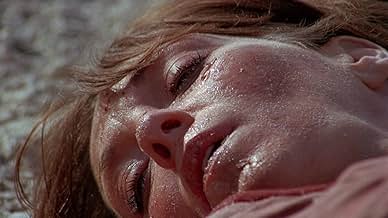
- GoofsIn the scene where the girl wakes to find her lover's throat cut she stands up wearing partially see-thru period underwear and you can see she is wearing tight-fitting modern panties underneath.
- Quotes
Lamy Homo Greaser: Dad, I was swimming in a rainbow with millions of babies... and they was naked... and then all of the sudden I turned into a perfect smile!
Old guy: Put a rope around the son of a bitch!
- ConnectionsFeatured in Remembering Greasers Palace (2010)
- How long is Greaser's Palace?Powered by Alexa
Details
- Runtime
- 1h 31m(91 min)
- Sound mix
- Aspect ratio
- 1.85 : 1
Contribute to this page
Suggest an edit or add missing content