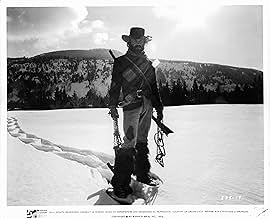
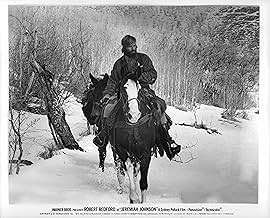
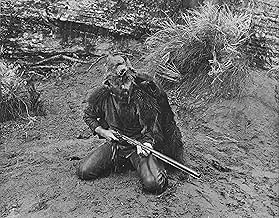
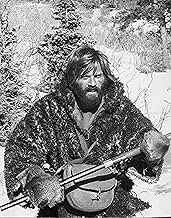
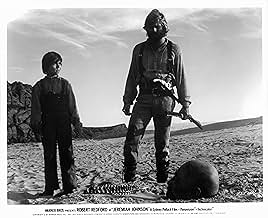
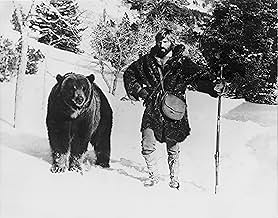
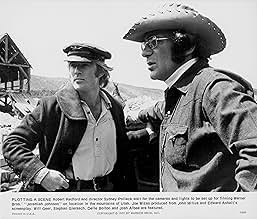
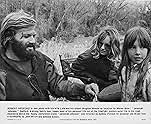
A mountain man who wishes to live the life of a hermit becomes the unwilling object of a long vendetta by the Crow tribe and proves to be a match for their warriors in single combat on the e... Read allA mountain man who wishes to live the life of a hermit becomes the unwilling object of a long vendetta by the Crow tribe and proves to be a match for their warriors in single combat on the early frontier.A mountain man who wishes to live the life of a hermit becomes the unwilling object of a long vendetta by the Crow tribe and proves to be a match for their warriors in single combat on the early frontier.
- Awards
- 1 win & 1 nomination total
- Paints His Shirt Red
- (as Joaquin Martinez)
- Robidoux
- (as Bill Durham)
- Indian
- (uncredited)
- Qualen's Daughter
- (uncredited)
Featured reviews
The Rocky Mountains are the marrow of the World.
Hardened after the war with Mexico, and fed up with everyday life, American Jeremiah Johnson (Redford) leaves civilisation behind to live life as a mountain man. He intends to be self-sufficient as a trapper, but he finds that mother nature can be tough, and out here in the mountain wilderness he is not alone. There are others here, and Jeremiah must face many challenges if he is to truly survive.
Filmed entirely on location in the vast wilderness beauty of Utah, Jeremiah Johnson is light on plot but all the better for it. Film basically constitutes Redford's mountain man learning to survive up in them thar mountains, and, earning the right to do so. A number of issues will arise to test his metal, giving him a number of hardships and adventures to define his transformation from average Joe to a fully fledged mythical man of the Earth. Redford is wonderfully at ease in the title role, and very quickly he gets the audience on side to share in his journey. But ultimately it's the landscapes that you take away from this movie. Not only gorgeous, but also the critical character that frames Johnson during his isolation and battle for survival. 8/10
Chronicle of life of an adventurer with great sense of humanness and good feeling
Solid western with interesting events , violent fights , emotions , thrills and spectacular outdoors . From the initiation until the final are proceeded continuous battles against nature and a survival fighting versus wintry wilderness , enemy trappers and savage Indians, among others . The story is a crossover of various films, the battle against nature of ¨Man of a wilderness land¨ and Indians as ¨ Man called horse ¨ and the obstinacy and stubbornness of relentless enemies who fight with no rest such as ¨The duelists¨. The magnificent cast is starred by an excellent Robert Redford , a simple man who has no taste for cities and becomes a tough and two fisted mountain man obsessed a bloody revenge . Supporting cast is featured by various actors in brief performances as Jack Colvin , Matt Clark , Charles Tyner and special mention to Will Geer as feisty old trapper . Splendid cinematography in Panavision and glimmer Technicolor by Duke Callagham as is reflected on spectacular outdoors filmed in sighting, rousing natural parks from Rocky Mountains. Lively and evocative musical score by usual secondary actor John Rubinstein and beautiful songs by also actor Tim McIntire . The motion picture is stunningly directed by the recently deceased Sidney Pollack (Yazuka, Three days of the condor, Way we were, Out of Africa). Rating : Better than average . This outstanding film will appeal to Robert Redford fans and landscape lovers .
Liver Eatin' Johnson
afternoon" movies. The scenery is wonderful, Redford does one of his
best performances, the characters are colorful, and it is a wonderful
story of the pioneer spirit. Then, a few years ago, a good friend told me he had the book about the
real "Liver Eatin' Johnson", about whom this movie was made. He lent
me the book to read - and I highly recommend it for anyone interested
in a first- and second-hand story of the old west. The real story of Johnson is greatly removed from the movie, though
there are many parts in common as well. Most notably absent is the
fact that Johnson would remove and partially eat the liver (raw) of the
Crow braves he would kill. This was done by Johnson to scare the Crow,
who believed their soul would wander the earth forever if the body was
not buried intact. Johnson was also known to have eaten meat from the
leg of a Blackfoot indian, whose tribe had captured him to sell to the
Crow. This incident, however, appears to have been more for survival,
as Johnson had to travel for several days through snow on foot after
escaping the Blackfoot. Johnson was a well traveled man, friend to more than the movie
suggests, and finally died of old age in Los Angeles in 1899. His
actual age is subject to dispute, but he was at least 75 yeard old.
During his long life, he met up with many recognizable characters from
the old west. I leave the names for you to discover in your reading -
it is well worth the time!
To connect with nature and find your place in the world.
Unfortunately, he is bamboozled into a most peculiar family situation involving a mute son of a crazy pioneer woman and the daughter of a French-speaking Native American chief. In the end, what director Sydney Pollack is all about is showcasing how nature can indeed salve some of our pain and make us feel more comfortable with our situations. Nevertheless, true relationships with people cannot be substituted. Beautiful photography, strong performances and a most intriguing storyline all help create a very interesting film that is worth multiple views and considerable think time.
" You've done well to Keep your hair, when so many's after it "
Did you know
- TriviaBased upon a real-life trapper named John Johnston, nicknamed "Crow Killer" and "Liver Eater Johnston" for his penchant for cutting out and eating the livers of Crow Indians he had killed (several Crows had murdered his wife and he swore vengeance against the entire tribe).
- GoofsThe time period is around the 1830s, yet when Johnson is guiding the soldiers to rescue the civilians stuck in the snow, he asks the lieutenant in charge how "the war with the president of Mexico is going." The lieutenant says, "It's over." Johnson asks, "Who won?" The war with Mexico was from 1845 to 1847. The trade in beaver pelts was over by 1840.
- Quotes
Del Gue: I ain't never seen 'em, but my common sense tells me the Andes is foothills, and the Alps is for children to climb! Keep good care of your hair! These here is God's finest scupturings! And there ain't no laws for the brave ones! And there ain't no asylums for the crazy ones! And there ain't no churches, except for this right here! And there ain't no priests excepting the birds. By God, I are a mountain man, and I'll live 'til an arrow or a bullet finds me. And then I'll leave my bones on this great map of the magnificent...
- Alternate versionsThe Warner Bros. Pictures logo is plastered with the Saul Bass variant in the 1982 VHS, 1992 variant in the DVD and 1998 VHS. The former print also has the closing Saul Bass variant plastering the line art WB shield.
- ConnectionsEdited into La classe américaine (1993)
Details
Box office
- Budget
- $3,100,000 (estimated)
- Runtime
- 1h 48m(108 min)
- Color
- Aspect ratio
- 2.35 : 1