IMDb RATING
6.5/10
4.1K
YOUR RATING

Godard examines the structure of movies, relationships and revolutions through the life of a couple in Paris.Godard examines the structure of movies, relationships and revolutions through the life of a couple in Paris.Godard examines the structure of movies, relationships and revolutions through the life of a couple in Paris.
- Directors
- Writers
- Stars
- Awards
- 1 win total


Louis Bugette
- Georges
- (as Bugette)
Yves Gabrielli
- Léon
- (as Yves Gabrieli)


- Directors
- Writers
- All cast & crew
- Production, box office & more at IMDbPro
6.54K
1
2
3
4
5
6
7
8
9
10
Featured reviews
Yet Another Strange One
Tout va bien (1972)
** (out of 4)
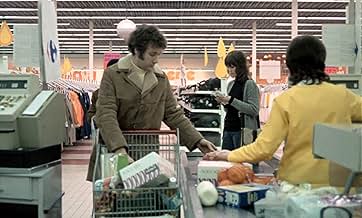
Jean-Luc Godard and Jea-Pierre Gorin directed this film about two directors (Godard, Gorin) who are trying to piece a film together, which is being played out by Jane Fonda and Yves Montand. Godard has been very hit and miss with me so this film here is somewhat in the middle. I really didn't hate this movie but at the same time I can't say that I was entertained by it either. I think there's some good ideas floating around here but I never felt like they were pulled together to make anything too interesting. I'm sure fans of the film will say there's a political message here and I'm sure there is somewhere but with all the madness going on I wasn't about to look for it. I think Montand is very good in his role but Fonda was a tad bit lacking and this is probably the biggest disappointment I've had with any of her films. I really enjoyed the sequence in the store and there's some very good moments scattered around but in the end this is just Godard being Godard and I wasn't going for it.
** (out of 4)
Jean-Luc Godard and Jea-Pierre Gorin directed this film about two directors (Godard, Gorin) who are trying to piece a film together, which is being played out by Jane Fonda and Yves Montand. Godard has been very hit and miss with me so this film here is somewhat in the middle. I really didn't hate this movie but at the same time I can't say that I was entertained by it either. I think there's some good ideas floating around here but I never felt like they were pulled together to make anything too interesting. I'm sure fans of the film will say there's a political message here and I'm sure there is somewhere but with all the madness going on I wasn't about to look for it. I think Montand is very good in his role but Fonda was a tad bit lacking and this is probably the biggest disappointment I've had with any of her films. I really enjoyed the sequence in the store and there's some very good moments scattered around but in the end this is just Godard being Godard and I wasn't going for it.
Good One
Jean-Luc Godard's follow-up to the ultra-Maoist Weekend, featuring Yves Montand as a former New Wave filmmaker and his wife Jane Fonda, as they become active in a factory takeover. The film is of course very sympathetic to Marxism and perhaps Leninism, but it's certainly toned down from the blood fest that is Weekend, perhaps regrettably. Godard insists on reinterpreting and imposing entirely new ideas about what a film can and ought to be, in this case an intellectualized espousal of the working class struggle. A few moments of daring misce-en-scene are worth mentioning; fist, Godard includes an awesome cutaway of the factory to reveal the power-dynamics of the uprising within, and an elaborate tracking sequence in a supermarket to reveal the gross stupidity of capitalist consumerism. Tout Va Bien is clearly a step-down from Godard's brilliant features of the 60's, but it's still provocative and worth any cinephile's time.
Deeply flawed but nonetheless important
After his four-year, self-imposed Maoist/nihilist "exile," Godard made a temporary -- albeit slight -- overture toward conventional commercial (or "bourgeois," as Godard called it) cinema by combining a leftist political essay with a dissection of human interaction. Alas, the film fails on both these levels; as a study of the male-female relationship, it is nowhere near "Contempt" and "Masculin-Feminin"; as a pure Maoist political tract, it is shallow and mind-numingly boring compared to "Le Gai Savior" and "Vladimir and Rosa." Nevertheless, "Tout va bien" is nonetheless important within Godard's extraordinary body of work, for it marked the beginning of the seven-year process in which his films would gradually shed their ultra-leftist leanings and move towards more universal, humanistic themes, a process that would ultimately cumulate in the excellent "Every Man For Himself." Even true Godard aficionados will be as bored as everyone else, but they should nonetheless go out of their way to secure a copy.
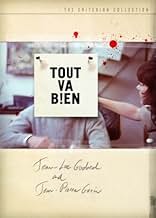
Newly released on (Region 1) DVD by Criterion
Although I'm quite familiar with most of Jean-Luc Godard's career, there is that 1970s period where he completely abandoned commercialism in all its forms and made experimental political films with Jean-Pierre Gorin and others. Tout Va Bien is not an impossible work, but it is challenging and, even if you win that challenge, the rewards are fairly limited. But it's interesting work, and Godard's fractured cinematic imagination is definitely brilliant at times. The grocery store sequence near the end of the film is as cinematic ally accomplished and impressive as the tracking shot of the apocalyptic highway in Week-End. And I love the meta-cinematic material at the beginning, where the filmmakers discuss how they can make a political film about May '68 and how the movement has evolved in the following four years. Step on: hire some stars. With stars come money. Thus Yves Montand and Jane Fonda are recruited for that purpose. The longest segment of the film has the two stars trapped with the manager of a slaughterhouse as his workers bar him from leaving his office. Godard and Gorin have a set designed after that large-windowed apartment building in Tati's Playtime. Perhaps it is even the same exact set, remodeled a bit for the way they want to use it here? The new Criterion DVD includes a follow-up film, A Letter to Jane, which discusses the famous photograph of Fonda meeting with the Viet-Cong. It is nearly unwatchable, though, and I gave up after 15 or 20 minutes (it's 52 minutes of Godard and Gorin speechifying which is also prevalent (and hard to take) in Tout Va Bien, as well).
a disarming cinematic hybrid of storytelling and agitprop
In the wake of May 1968 which effectually bookends the unrivaled movement of Nouvelle Vague, Godard founded Groupe Dziga Vertov (1968-1972), among which Maoist Jean-Pierre Gorin is a key figure, and TOUT VA BIEN is the most well-known works of the group's output, also heralds Godard's seminal transition from narrative tradition to a more essayistic, esoteric platform to which he has cleft ever since.
International star power swells in TOUT VA BIEN, Jane Fonda, freshly copping her first Oscar for KLUTE (1971), but subsequently...
keep reading my review on my blog: cinema omnivore, thanks!
International star power swells in TOUT VA BIEN, Jane Fonda, freshly copping her first Oscar for KLUTE (1971), but subsequently...
keep reading my review on my blog: cinema omnivore, thanks!


Did you know
- TriviaMost of the shots contain all the three colours of the French flag: blue, white and red.
- Quotes
Narrator: There'd be farmers who farm. Workers who work. And bourgeois who bourgeois.
- ConnectionsEdited into Bande-annonce de 'Tout va bien' (1972)
- SoundtracksIl y a du Soleil sur la France
Music by Eric Charden
Lyrics by Frank Thomas and Jean-Michel Rivat
Performed by Eric Charden and Stone
- How long is All's Well?Powered by Alexa
Details
- Release date
- Countries of origin
- Languages
- Also known as
- Everything's All Right
- Production companies
- See more company credits at IMDbPro
- Runtime
- 1h 35m(95 min)
- Sound mix
- Aspect ratio
- 1.66 : 1
Contribute to this page
Suggest an edit or add missing content