

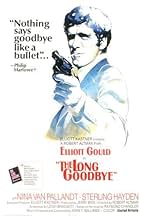
Private eye Philip Marlowe helps friend Terry Lennox out of a jam and is implicated in his wife Sylvia's murder. He also is hired by Eileen Wade to locate her dipsomaniac husband Roger, who ... Read allPrivate eye Philip Marlowe helps friend Terry Lennox out of a jam and is implicated in his wife Sylvia's murder. He also is hired by Eileen Wade to locate her dipsomaniac husband Roger, who frequently disappears when he wants to dry out.Private eye Philip Marlowe helps friend Terry Lennox out of a jam and is implicated in his wife Sylvia's murder. He also is hired by Eileen Wade to locate her dipsomaniac husband Roger, who frequently disappears when he wants to dry out.
- Director
- Writers
- Stars
- Awards
- 2 wins & 1 nomination total





- Detective Farmer
- (as Steve Coit)

- Vince
- (as Vince Palmieri)

- Doctor
- (as Pancho Cordoba)


- Director
- Writers
- All cast & crew
- Production, box office & more at IMDbPro
Featured reviews
A neo-noir haiku for a crumbling 70's Los Angeles.
Elliot Gould is Phillip Marlowe. Scruffy, sardonic and alienated private dick with a smart mouth and a cigarette eternally glued to his lips. Altman's twist? He's cool but not the suave kind that would impress dames in the 40's, the Bogart kind. He seems constantly out of place, a bit phased, doomed to observe and comment in his witty repartee on what's going on around him or just let the chips fall where they may. And they do.
Chandler's story is one of his very best. All the staples of noir are present, simultaneously fulfilling the promise of a Phillip Marlowe film and in the same time preparing the ground for Altman's take on it; murder, missing money, unhappy marriages, a private eye hired to investigate. The works. Sprawling and convoluted like the best of noirs usually are. The dialogue crackling with inventiveness, shedding tough guy lingo for a sense of playfulness, rolling in and out of the picture in a stream-of-consciousness way.
Some of the twists and characters seem to carry a sense of seething malice, a fleeting glimpse on the seamy underbelly of the Great American Beast, the scars and ugliness of Hollywood showing behind a faded facade of glamour, an escalating creepiness factor that recalls the later works of David Lynch, predating him by a good number of years as it does. The mousey Dr. Verringe and the whole clinic subplot reminded me of Lost Highway for example.
What really elevates The Long Goodbye in another level is Altman's direction and he has Vilmos Zsigmond with him. This is only my second Altman picture (after McCabe and Mrs. Miller) but 2 hours in his presence were enough to leave an indelible sense that I'm watching the work of a master on top of his craft. Altman's camera is always on the move, slowly panning and floating in and out of the frame, picking up details, guiding the eye but never getting in the middle of the story or screaming for attention. The whole thing has a natural, subdued feel to it, what with the unobtrusive lighting and bleached-out, hazy look; no glitz or glamour here. Only the faded, long-gone impression of it. This is a world we are enmeshed in that surrounds from all sides with hazy reflection.
The Long Goodbye is both a fantastic and somewhat hidden gem of 70's crime cinema and also one of the missing links in the evolution of noir, all the way from Sunset Blvd. to Mullholland Drive. You must visit at some point.
Marlowe, The Marlboro Man
The dialogue and the acting are stilted and self-conscious. In one party sequence that takes place on the beach, Dr. Verringer (Henry Gibson) insists that he get his money. The guests stand around, as if they are movie extras brought in for this one day of shooting. The viewer can easily imagine microphones just over the heads of the principal actors, and personnel just off-screen, waiting for Altman to yell: "Cut". Along with other scenes, it looks forced and staged.
The film's best attribute is its cinematography. I especially like the sequence showing human figures retreating into the surf at night. Combined with the sound of ocean waves, it makes for an interesting segment.
Some viewers love this film because of Altman's direction and Gould's performance. Others hate it because it so deviates from Chandler's original story. I personally did not like the film, mostly because of Marlowe, himself, and because of the tangled and convoluted plot, populated by loquacious characters who I found totally not interesting.
Not one for those looking for a gripping detective story, but still interesting
Hailed as a classic, this film is actually a bit of hard work crossed with cool style in a plot that gets somewhere but seems to take a long time and a million back roads to get there. It won't be to everyone's tastes as a result because, even though I quite liked it, I must confess that the narrative is hard to follow and hard to particularly care much about. The wit of it is watching Marlowe updated a device that will annoy as many as it pleases. In Gould's laidback and shabby detective we have the opposite of the tough and snappy detectives of the genre, but it sits well within the modern setting of the modern generation (as was) with its hedonism and fads. This is interesting but not the same as a good detective story, which sadly this isn't. If you're not won over by the overall approach then it is unlikely that you will find a lot more to fill the time.
Altman's direction is focused on the style and, although he is fairly respectful to the material in regards what happens, he doesn't go out of his way to make it engaging. Gould fits the role well and enjoys his character. I would have liked more of the complexity underneath to come through to contrast with this surface. He is the film but he is well supported by a hammy show from Sterling and solid turns from Rydell, Pallandt, Gibson and Bouton.
Overall then a difficult film to really like. It has enough of its own style to be interesting but not enough of a hook in the narrative to please a mass audience. Altman's hands are all over the film and I understand why some viewers don't like it for that reason. Not one for those looking for a gripping detective story, but still interesting.
Altman tells a story in a rhythm
Wade (Sterling Hayden) is a fantastic Hemingway-esque writer in the film. Hayden's size and booming voice, in conjunction with his alcoholism and potential brutality, lend an aroma of unpredictableness to his character. Wade's beautiful wife, who has a mysterious bruise on her face, is like a timid, loyal animal, subjected to the whims of her over bearing master. Henry Gibson, who plays Wade's doctor, is excellent as a sort of despotic mouse, who frightens an elephant into conforming to his will, this irony is one of the films intriguing, bizarre twists.
This film works well as a character study, and is one of the best films of the seventies. A must see for every student of film. 9/10
Fairly engrossing, with a pretty hard-edged cat
Times have really changed for Marlowe since 1946, when he was played by Humphrey Bogart. Then he was cool, implacable, wore a fedora a lot, and wound up with babe Lauren Bacall. That was the only strain of the plot viewers could follow. There were some dead bodies, smoking guns, and tough questions from cops along the way.
In this movie it's 1973, and Marlowe still think he's cool but that opinion is not so widespread this time - he's being played for a sucker by at least half the cast, including a longtime friend, and his own cat. He unravels the mystery mostly out of a lack of having anything better to do, which he clearly stood in need of.
Director Robert Altman follows his own ideas about how to communicate visually. Like when he changes scene to a hospital, he doesn't do any kind of establishing long shot, he shows a closeup of a light over a patient's bed. His montages create a kind of equivalent of our human experience, where we use our minds to focus on detail. He usually winds up with scenes that feel like we're watching something actually happen. But he does know how to use visuals for dramatic power when he wants, as the ending makes clear.
Some of the performances he gets from actors are amazing, like Mark Rydell as psychotically dangerous gangster Marty Augustine. The way he works himself into a rage with his rants changes gears from funny to frightening at high speed, and I can't believe it didn't influence Joe Pesci's performance in "Goodfellas."
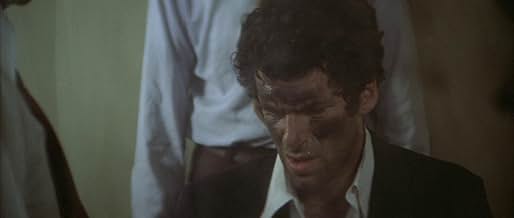
Not everything works here, like Gould smearing fingerprint ink on his face then breaking into Al Jolson at police headquarters, but on the whole a fairly engrossing take on detective mysteries.


Did you know
- TriviaThe location for Roger Wade - Sterling Hayden's home was actually Robert Altman's home at the time.
- GoofsWhen Marty Augustine and his henchmen are forcing Marlowe to get naked, Arnold Schwarzenegger looks straight into the camera for a full second when he is about to take his pants off.
- Quotes
Philip Marlowe: Nobody cares but me.
Terry Lennox: Well that's you, Marlowe. You'll never learn, you're a born loser.
Philip Marlowe: Yeah, I even lost my cat.
- ConnectionsEdited into El adios largos (2013)
- SoundtracksThe Long Goodbye
by John Williams and Johnny Mercer
Performed by The Dave Grusin Trio, Jack Sheldon, Clydie King, Jack Riley, Morgan Ames, Aluminum Band, The Tepoztlan Municipal Band
Details
- Release date
- Country of origin
- Languages
- Also known as
- Un largo adiós
- Filming locations
- 2178 High Tower Drive, Hollywood, Los Angeles, California, USA(Marlowe's residence)
- Production companies
- See more company credits at IMDbPro
Box office
- Budget
- $1,700,000 (estimated)
- Gross worldwide
- $27,504