
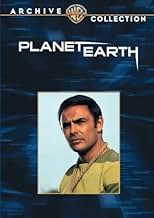
A 20th Century man wakes up in 2133, where men are slaves and women rule.A 20th Century man wakes up in 2133, where men are slaves and women rule.A 20th Century man wakes up in 2133, where men are slaves and women rule.



Jo de Winter
- Villar
- (as Johana De Winter)

Corinne Camacho
- Bronta
- (as Corrine Camacho)


Sue Dahlman
- Thetis
- (as Sara Chattin)


Robert Sutton
- Kreeg Captain
- (as Raymond Sutton)

- Director
- Writers
- All cast & crew
- Production, box office & more at IMDbPro
5.71K
1
2
3
4
5
6
7
8
9
10
Featured reviews
fun show
PLANET EARTH and GENESIS 2 were fun pilots. PLANET EARTH was set on a earth after a nuclear war yet, was ahead of it's time. It's a shame roddenberry couldn't get a syndication deal like Gerry Anderson of SPACE 1999. Syndication would have helped this show more than network airings.
Not great, but better than before
With Marc Daniels directing, William Theiss doing costumes, and Bob Justman producing, this is about the Star Trekkiest non-Trek this side of TNG: no less than seven people who directly worked on Star Trek TOS.
Essentially a sequel/revamp of Genesis II, reusing the premise, the bullet-train sets and even the p.o.v. Shot of the zooming tunnel. Ted Cassidy and Majel Barrett return -- Ted as the same character, Majel as slightly different one (though barely seen). Janet Margolin capably replaces Lynne Marta as the plucky Harper-Smythe.
As is usual for these fictional female-dominated societies, there's little logic applied and apparently no research into actual female-dominated societies, so we can forget the "science" part of "science fiction" and just call it fantasy. The good news is that the actresses largely pull it off: Sally Kemp particularly brings a feeling of naturalness to her character Treece, though that may partly owe to the fact that hers is the most realistic role. Diana Muldaur's role is tougher, as she has to embody the dumbest aspect of the plot, but she does it well.
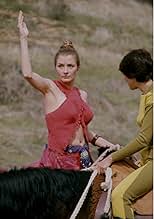
The overall result is adequate. I wouldn't tell anyone to make an effort to see it, but honestly John Saxon makes almost anything look good. Notable non-Roddenberry move: for Muldaur's final scene, they gave her a close-fitting red dress with a neckline that plunged to her navel .... and then only showed her from the side, from a great distance, or from the neck up. Women's lib indeed.
Essentially a sequel/revamp of Genesis II, reusing the premise, the bullet-train sets and even the p.o.v. Shot of the zooming tunnel. Ted Cassidy and Majel Barrett return -- Ted as the same character, Majel as slightly different one (though barely seen). Janet Margolin capably replaces Lynne Marta as the plucky Harper-Smythe.
As is usual for these fictional female-dominated societies, there's little logic applied and apparently no research into actual female-dominated societies, so we can forget the "science" part of "science fiction" and just call it fantasy. The good news is that the actresses largely pull it off: Sally Kemp particularly brings a feeling of naturalness to her character Treece, though that may partly owe to the fact that hers is the most realistic role. Diana Muldaur's role is tougher, as she has to embody the dumbest aspect of the plot, but she does it well.
The overall result is adequate. I wouldn't tell anyone to make an effort to see it, but honestly John Saxon makes almost anything look good. Notable non-Roddenberry move: for Muldaur's final scene, they gave her a close-fitting red dress with a neckline that plunged to her navel .... and then only showed her from the side, from a great distance, or from the neck up. Women's lib indeed.
Weakest of 70's horny Roddenberry phase
It plays kind of like a rejected Star Trek episode, but not one of the better ones but that does give it a bit of nostalgia value. The opening is loaded with voice over narration to explain the whole set up for those who didn't watch Genesis 2 the previous year. The basic idea is the same as one Rod Serling had for a series or show that he never had an ending for, that didn't stop Roddenberry. Of course since this is kind of weak stuff the network actually let Roddenberry have two pilots but it still didn't go to series.
This also shows where some of the "new" ideas for the first Star Trek film came from. The enemy characters have a sort of spine on their bald foreheads like the Klingons soon would have and the main uniforms are sort of the same "Jammies" that the first Star Trek feature featured.
It's poorly structured with characters disappearing for long periods of time and the whole thing stops totally dead during the horny Roddenbery staple which was part of all his things during this period of time. That would be the scene where the man has to prove he's the world's greatest lover to the less experienced woman to save the day. And it takes forever for this section to be over with. It just seems like dirty old man material, kind of leering and juvenile at the same time.
John Saxon does strike some good Kirk poses and it's nice to see Cassidy with a meaty role--he does a couple of impressive stunts during the big brawl ending.
This really feels like the Planet of the Apes series that came shortly after this.
It's perfectly fine this didn't go to series, too bad that far superior Spectre and Questor Tapes didn't even get 2 chances that this one didn't deserve.
This also shows where some of the "new" ideas for the first Star Trek film came from. The enemy characters have a sort of spine on their bald foreheads like the Klingons soon would have and the main uniforms are sort of the same "Jammies" that the first Star Trek feature featured.
It's poorly structured with characters disappearing for long periods of time and the whole thing stops totally dead during the horny Roddenbery staple which was part of all his things during this period of time. That would be the scene where the man has to prove he's the world's greatest lover to the less experienced woman to save the day. And it takes forever for this section to be over with. It just seems like dirty old man material, kind of leering and juvenile at the same time.
John Saxon does strike some good Kirk poses and it's nice to see Cassidy with a meaty role--he does a couple of impressive stunts during the big brawl ending.
This really feels like the Planet of the Apes series that came shortly after this.
It's perfectly fine this didn't go to series, too bad that far superior Spectre and Questor Tapes didn't even get 2 chances that this one didn't deserve.
I liked this TV pilot though most of America didn't
This was a second TV pilot for a proposed sci-fi series by Gene Roddenberry. The first, Earth II, starred Alex Cord. This time, things are almost the same, though John Saxon plays the lead. Saxon's characterization is less serious than Cord's and seems to be very much like Captain Kirk placed in an alternate version of Earth.
The plot involves a group from PAX (a group of goody-goodies who are a lot like a planet-bound Federation--they try to make sure the world runs in peace and try to interfere in other cultures only when it's necessary). They are looking for an important scientist who disappeared in an amazon-like culture. It's up to Saxon and the others to infiltrate and return him before it's too late.
FYI--Another team member is played by Ted Cassidy (Lurch the Butler from the Addams Family). I would have loved to see him return to a weekly series, though he died just a few years after this pilot was completed (died on the operating table while undergoing heart surgery).
The plot involves a group from PAX (a group of goody-goodies who are a lot like a planet-bound Federation--they try to make sure the world runs in peace and try to interfere in other cultures only when it's necessary). They are looking for an important scientist who disappeared in an amazon-like culture. It's up to Saxon and the others to infiltrate and return him before it's too late.
FYI--Another team member is played by Ted Cassidy (Lurch the Butler from the Addams Family). I would have loved to see him return to a weekly series, though he died just a few years after this pilot was completed (died on the operating table while undergoing heart surgery).
Roddenberry tried for the Future again, but it didn't happen
This might be enjoyed best as a review of 40-year old television effort. Gene Roddenberry is best remembered for Star Trek, but this Air Force veteran was writing well before the 1966 show hit the airwaves.
"Planet Earth" can be enjoyed on its own, but I got the opportunity to watch "Genesis II" first. Both these television pilots are based on the same story of a scientist suspended in time for 160 years. The world has mostly destroyed itself and we're invited for a collection of never-to-appear stories of the survivors bringing mankind back.
This story premise and those from Star Trek pivot on some type of Third World War wiping about most of our civilization. While Star Trek plots all seems to share the idea that mankind has evolved into a better kind of person, Planet Earth did not display that sensation to me; and maybe that's the problem. The illusion of an improved man seemed to led the following of Trekkers, plus the boundless story opportunities of visiting other planets. There was no way to expect that sense of wonderness with this story. Even though this future is probably a truer presentation of mankind following such a war, people like illusions and the lies to make us feel better.
Also interesting to see is the kind of loyalty Roddenberry has with actors. Like using DeForest Kelley, Leonard Nimoy, Nichelle Nichols and Majel Barrett (who he later married) on previous projects and then including them in Star Trek, Planet Earth cast includes Star Trek Alumni Diana Muldaur, Ted Cassidy and of course Majel.
I don't recall seeing either of the pilots (Genesis II or Planet Earth) in 1974 but I'm fairly sure I wouldn't been very intrigued by them. Roddenberry's humanists views are quite evident in all his material, which can make it difficult to fully engage in his stories. Star Trek, for the most part, worked well -- Planet Earth didn't. John Saxon acting and fight-scenes are better in other productions. Diana Muldaur is a very strong actress with great presence, but her character here was tiresome and I just wanted her to go away. I was looking forward to anything interesting for Ted Cassidy, but we barely see him.
So if you're interested in shows from the 70s or in Roddenberry, watch Planet Earth and possible Genesis II, but don't be disappointed that a new story franchise was not born.
"Planet Earth" can be enjoyed on its own, but I got the opportunity to watch "Genesis II" first. Both these television pilots are based on the same story of a scientist suspended in time for 160 years. The world has mostly destroyed itself and we're invited for a collection of never-to-appear stories of the survivors bringing mankind back.
This story premise and those from Star Trek pivot on some type of Third World War wiping about most of our civilization. While Star Trek plots all seems to share the idea that mankind has evolved into a better kind of person, Planet Earth did not display that sensation to me; and maybe that's the problem. The illusion of an improved man seemed to led the following of Trekkers, plus the boundless story opportunities of visiting other planets. There was no way to expect that sense of wonderness with this story. Even though this future is probably a truer presentation of mankind following such a war, people like illusions and the lies to make us feel better.
Also interesting to see is the kind of loyalty Roddenberry has with actors. Like using DeForest Kelley, Leonard Nimoy, Nichelle Nichols and Majel Barrett (who he later married) on previous projects and then including them in Star Trek, Planet Earth cast includes Star Trek Alumni Diana Muldaur, Ted Cassidy and of course Majel.
I don't recall seeing either of the pilots (Genesis II or Planet Earth) in 1974 but I'm fairly sure I wouldn't been very intrigued by them. Roddenberry's humanists views are quite evident in all his material, which can make it difficult to fully engage in his stories. Star Trek, for the most part, worked well -- Planet Earth didn't. John Saxon acting and fight-scenes are better in other productions. Diana Muldaur is a very strong actress with great presence, but her character here was tiresome and I just wanted her to go away. I was looking forward to anything interesting for Ted Cassidy, but we barely see him.
So if you're interested in shows from the 70s or in Roddenberry, watch Planet Earth and possible Genesis II, but don't be disappointed that a new story franchise was not born.


Did you know
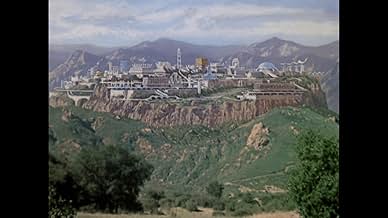
- TriviaThe outdoor scenes were filmed at The University of California, Riverside due to the many "futuristic" architectural features.
- ConnectionsFollows Genesis II (1973)
Details
Contribute to this page
Suggest an edit or add missing content