
In post-partition India, a Muslim businessman and his family struggle for their rights in a country which was once their own.In post-partition India, a Muslim businessman and his family struggle for their rights in a country which was once their own.In post-partition India, a Muslim businessman and his family struggle for their rights in a country which was once their own.
- Awards
- 4 wins & 4 nominations total



- Director
- Writers
- All cast & crew
- Production, box office & more at IMDbPro
8.0910
1
2
3
4
5
6
7
8
9
10
Featured reviews
Fabulous story, great performances (especially of Balraj Sahani) and the sensitivity of the content makes it a must watch ...
Based on an unpublished story by famous Urdu writer Ismat Chugtai, is one of the few movies dealing with state of Muslims who stayed back in India post partition. This film captures the struggle and anguish of the Muslim people who found themselves in strange situation where they in their own country were treated as outsiders. Salim Mirza, played brilliantly by Balraj Sahney, is one such Muslim who stays back in India. He with his family has to fight to find their identity and respect in this new country with changed realities. He can only watch as his world is slowly ripped by tragic aftermath of partition. Sikandar, played by Farooq Shaikh, is Salim Mirza's unemployed son who is often on his face told that he might have a better chance in Pakistan. The fabulous story, great performances (especially of Balraj Sahani) and the sensitivity of the content makes it a must watch. Garam Hawa was initially banned but eventually it won a national award for national integration and was even screened in Pakistan.
Garm Hawa
This film showcases great acting performances. Balraj Sahani, Geetha, and Shaukat Azmi play extremely complicated characters with great skill and poise. Of course a film like this would never be nominated for Oscars or any other major prize because it would be considered an off beat film. Nevertheless, the film portrays the political and cultural changes that affected innumerable common people right after the partition of India and Pakistan. I would definitely recommend this film to everyone. If you are looking for spontaneous acting that moves you and makes you want to revisit that historical era, this is the movie to go for!
Good movie about real issues.
The partition not only affected those who were displaced but also those who decided to stay back. And the minorities who decided to stay back amongst the majorities found themselves in a strange situation; suddenly they were outsiders in their own country and people viewed them with suspicion. 'Garam Hawa' deals with such issues with great sensitivity and perhaps is one of the best movies ever made on post partition.
Salim Mirza, brilliantly played by Balraj Sahney, is one such Muslim who stays back in India. India is a new democracy and has its problems of poverty and unemployment and Salim Mirza and his family has to fight to find its identity and respect in the country they chose not to leave. Sikandar, played by Farooq Shaikh, is Salim Mirza's unemployed son who is often told on his face that he might have a better chance in Pakistan but like his father he is determined. The family suffers a great deal for its decision but doesn't give up. I am sure everyone who was present during those days can identify with something in this story.
The grandmother wanting to die in her ancestral home and her whole life flashing before her eyes before she dies is an unforgettable scene.
Salim Mirza, brilliantly played by Balraj Sahney, is one such Muslim who stays back in India. India is a new democracy and has its problems of poverty and unemployment and Salim Mirza and his family has to fight to find its identity and respect in the country they chose not to leave. Sikandar, played by Farooq Shaikh, is Salim Mirza's unemployed son who is often told on his face that he might have a better chance in Pakistan but like his father he is determined. The family suffers a great deal for its decision but doesn't give up. I am sure everyone who was present during those days can identify with something in this story.
The grandmother wanting to die in her ancestral home and her whole life flashing before her eyes before she dies is an unforgettable scene.
A film created with the wrong intent and misguiding message
The film continues the thread throughout that post independence any Muslim who migrated to Pakistan had an easy, successful life. The subtle barbs are unmissable when they show that anyone moving out of the country with contempt are proven right, and even those who reluctantly moved, did well after settling in Pakistan ( got scholarship to Canada, and lots of orders from the army etc). And those staying back lose their homes, businesses, even their children are jobless and get cheated and commit suicide.
Whate is the intent of such a film than misguiding the Muslim youth our countrymen to feel a regret, and as if a missed opportunity. To feel alienated and having to fight for an equal treatment. The film ends in that note to complete its tale of woe.
A completely wrong message and to hail such films as landmark and must-watch is to only rub salt on the wounds of those who want our countrymen to feel wronged and disloyal.
The film itself has great performances, good editing and direction, hence I rate it a 6 on IMDB.
This is part of our (Indian) history
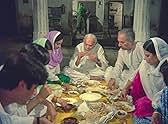
All those involved with this movie have done a service to Indian people, who are interested in history, partition, Hindu-Muslim relations etc. It does not matter whether this movie was declared hit, semi-hit or average, but it has left an incredible mark on one's psyche. It moves oneself to see those Muslim people who chose to stay behind in India, with their plight and dilemma. It definitely plays a big role to arouse sympathy and a soft corner for Muslim brethren who chose to stay in India, despite all the odds against them. All those associated with the story like Ismat Chugtai, Kaifi Azmi & Shama Zaidi have given an unbiased portrayal of that time. The story seemed to be too real. One loves to see the Muslim family in the movie sitting together and having their meals, where everybody participates in the discussion of the circumstances. Like the story, acting was natural all across the board, the only regret being, one expected some memorable songs, at least one or two, which were not there. Music is like dessert to an Asian mind, which adds to the lasting taste of the meal. With good music, this movie might have been declared a commercial hit too.


Did you know
- TriviaBalraj Sahni passed away just after finishing the dubbing of the film. His own daughter had died at a young age and there is a touching scene in the film where Salim Mirza's daughter commits suicide. His expressions are as real as they can be, in the scene when he finds her dead and in the next scene, is at her funeral. It was one of his best performances and his presence added a lot of class, grace and lifted the film to great heights. The effort and passion of the unit was rewarded by having him as the lead actor.
- ConnectionsFeatured in Mammo (1994)
- How long is Garm Hava?Powered by Alexa
Details
- Release date
- Country of origin
- Languages
- Also known as
- Горячие ветра
- Filming locations
- Agra, Uttar Pradesh, India(Mirza family's residential city)
- Production companies
- See more company credits at IMDbPro
Contribute to this page
Suggest an edit or add missing content