IMDb RATING
7.3/10
2.6K
YOUR RATING
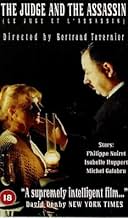
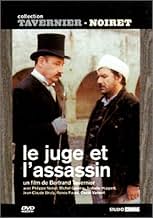
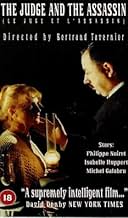
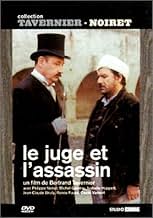
An unstable former French Sergeant commits many atrocities. A judge considers how this case could benefit or damage his career.An unstable former French Sergeant commits many atrocities. A judge considers how this case could benefit or damage his career.An unstable former French Sergeant commits many atrocities. A judge considers how this case could benefit or damage his career.
- Director
- Writers
- Stars
- Awards
- 3 wins & 4 nominations total
Jean-Claude de Goros
- Dr. Dutourd
- (as Jean-Claude de Gorros)
- Director
- Writers
- All cast & crew
- Production, box office & more at IMDbPro
7.32.5K
1
2
3
4
5
6
7
8
9
10
Featured reviews
A film I have always wanted to see
I can't make a real judgment on this film, although the other reviews are rave ones. I just want to add that the story is based on an actual case of the 1890s in France. Joseph Vacher was the real life murderer who is the basis for Michel Galabrue's Joseph Bouvier. Like Vacher he was a former soldier, and he went about the countryside slaughtering young boy shepherds and young girl servants. His destruction of these victims (in terms of mutilations) rivaled his contemporary Jack the Ripper (Vacher was known as Vacher the Ripper). Although he was quite insane the public demanded a death penalty - he was guillotined in 1898. His crimes briefly took public attention off the matter of Captain Alfred Dreyfus.
The Philippe Noiret character is partly based on the noted criminologist Professor Alexander Lacassagne, who (despite considerable evidence of insanity) determined that Vacher was sane, and deserved the death penalty.
Then came Tavernier!
And with him,the French cinema regained all that it had lost with the nouvelle vague:magnificent cinematography(I urge everybody to see this film in a movie theater),elaborate screenplays,Clouzot's Renoir's and Duvivier's bite ,all that made once the French cinema great."Le juge et l'assassin " is his sophomore effort ,after "l'horloger de Saint- Paul",but it was one which firmly and finally placed Tavernier among the greatest,most ambitious artists of the French cinema.
First of all,he did with Michel Galabru -who used to play in mediocre comedies - what Claude Chabrol did with Jean Yanne ("le boucher" "que la bete meure") :this actor is playing his lifetime part,revealing a talent which one would never expect from him.
France,end of the nineteenth century;anti-Semitism is rampant :twice ,a poster appears :"La croix (the cross): a paper against the Jews as no one can";Brialy's character:"we all need an outlet for our bad deeds:I have chosen the Jews,because it's safe";Renée Faure,the judge's good mother,serving the "mercy bouillon" to the Poor,provided that they sign a petition against captain Dreyfus .After the 1870 war,France was humiliated and the song a buck officer sings speaks volumes about the loss of Alsace and Lorraine.A world which Zola -whose books were burned- depicted ,where 2,500 children died in the coal mines... The killer killed 12 of them..
This is not a serial killer who comes out of the blue.Tavernier takes time to describe his mind :he was bitten by a rabid dog (or more like as one scene in a church tells us ,he was raped by a priest),he served in the army but was discharged,and mainly the girl he loved did not want him anymore.He tried to kill her and to take his own life but he failed twice,and in the asylum,they wrecked his brain.Although he is a killer,he is actually a political prisoner:he realized that as far his crimes were concerned ,the blame had to be put on a criminal society:in a remarkable scene ,the judge's mother reads the reports concerning the awful crimes as if she 's reading the tittle-tattle of the town.The serial killer identifies himself with Jesus and Joan of Arc ...
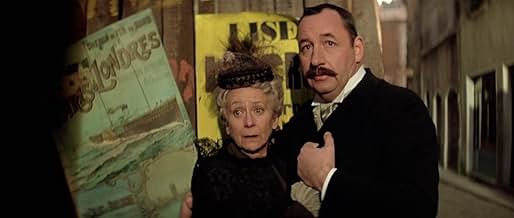
In direct contrast to hîm,we have the judge :admirably portrayed by Tavernier's favourite actor ,Philippe Noiret,he epitomizes the bourgeoisie,the man who wants to keep the world as it is;this is a very complex opaque character:nearing 50,he stills lives with his mother,and he's got nasty habits (see the scene when he buggers Isabelle Huppert).
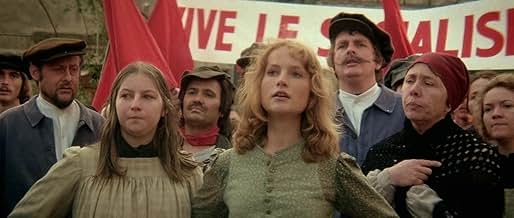
There are a lot of things to say about "le juge et l'assassin":the film successfully recreates the atmosphere of the period,not only by its hints at Dreyfus,at a country which is bent on revenge ,at a Church which feels its power slip away (the priest thundering against "school without God" ,about 10 years after Jules Ferry instituted secular education,and about 10 years before the separation of the Church and the State in France).But it even recreates it with its original songs ,which is quite a feat.We really feel we are in the time machine,and that's the main reason why Tavernier's movie is so precious:no one can find echoes of the seventies in France,which would have dated and marred the film.Even if the socialists appear at the end of the movie,there's no connection with their impending coming in the eighties.
A masterpiece ,Tavernier's best film along with "la vie et rien d'autre".
First of all,he did with Michel Galabru -who used to play in mediocre comedies - what Claude Chabrol did with Jean Yanne ("le boucher" "que la bete meure") :this actor is playing his lifetime part,revealing a talent which one would never expect from him.
France,end of the nineteenth century;anti-Semitism is rampant :twice ,a poster appears :"La croix (the cross): a paper against the Jews as no one can";Brialy's character:"we all need an outlet for our bad deeds:I have chosen the Jews,because it's safe";Renée Faure,the judge's good mother,serving the "mercy bouillon" to the Poor,provided that they sign a petition against captain Dreyfus .After the 1870 war,France was humiliated and the song a buck officer sings speaks volumes about the loss of Alsace and Lorraine.A world which Zola -whose books were burned- depicted ,where 2,500 children died in the coal mines... The killer killed 12 of them..
This is not a serial killer who comes out of the blue.Tavernier takes time to describe his mind :he was bitten by a rabid dog (or more like as one scene in a church tells us ,he was raped by a priest),he served in the army but was discharged,and mainly the girl he loved did not want him anymore.He tried to kill her and to take his own life but he failed twice,and in the asylum,they wrecked his brain.Although he is a killer,he is actually a political prisoner:he realized that as far his crimes were concerned ,the blame had to be put on a criminal society:in a remarkable scene ,the judge's mother reads the reports concerning the awful crimes as if she 's reading the tittle-tattle of the town.The serial killer identifies himself with Jesus and Joan of Arc ...
In direct contrast to hîm,we have the judge :admirably portrayed by Tavernier's favourite actor ,Philippe Noiret,he epitomizes the bourgeoisie,the man who wants to keep the world as it is;this is a very complex opaque character:nearing 50,he stills lives with his mother,and he's got nasty habits (see the scene when he buggers Isabelle Huppert).
There are a lot of things to say about "le juge et l'assassin":the film successfully recreates the atmosphere of the period,not only by its hints at Dreyfus,at a country which is bent on revenge ,at a Church which feels its power slip away (the priest thundering against "school without God" ,about 10 years after Jules Ferry instituted secular education,and about 10 years before the separation of the Church and the State in France).But it even recreates it with its original songs ,which is quite a feat.We really feel we are in the time machine,and that's the main reason why Tavernier's movie is so precious:no one can find echoes of the seventies in France,which would have dated and marred the film.Even if the socialists appear at the end of the movie,there's no connection with their impending coming in the eighties.
A masterpiece ,Tavernier's best film along with "la vie et rien d'autre".
interesting and brooding account of a heinous killer and his obstinate pursuer
Intriguing courtroom drama based on true events , dealing with a nasty murderer called Bouvier : Michel Galabru , based on an actual series killer , proceeding a criminal spree throughout France and a prejudiced judge : Philippe Noiret who has his values challenged when he has to decide if the supect person is insane or no . And eventually, considering if it benefits or harms his career .
A suspenseful, thrilling and surprising movie with historical background during Dreyfuss affaire , and the publication of Emilio Zola's J'accuse....!. A good as well as provoking flick, including drama , thrills , violence and competent performances .The peculiar relationship that develops between the murderer and the judge in the movie's focus . It results to be a nice movie shot in French with English subtitles . Duo of protagonists , Michel Galabru and Philippe Noiriet, are frankly magnificent. They are well accompanied by a fine support cast , such as : Isabelle Huppert as judge's sweetheart , Renee Faure as possessive mother , Yves Robert and Jean Claude Brialy as Procureur.
It displays evocative and shining cinematograhy by Perre William Glenn , showing splendidly the French outdoors . As well as sensitive and moving musical score by Philippe Sarde . The motion picture was compellingly directed by Bertrand Tavernier . Bernard is deemed to be one of the best French fimmakers , writing and directing thought-provoking and interesting pictures , outstanding the following ones : "Captain Conan", "Revenge of the Musketeers" , "L627" , "Daddy Nostalgia", "Life and nothing but" , "Beatrice" , "Round Midnight", "A Sunday in the Country" , "Coup de Torchon" , Spoiled Children", "Death Watch" , "The Clockmaker" , among others . Rating : 7/10 . Better than average.
A suspenseful, thrilling and surprising movie with historical background during Dreyfuss affaire , and the publication of Emilio Zola's J'accuse....!. A good as well as provoking flick, including drama , thrills , violence and competent performances .The peculiar relationship that develops between the murderer and the judge in the movie's focus . It results to be a nice movie shot in French with English subtitles . Duo of protagonists , Michel Galabru and Philippe Noiriet, are frankly magnificent. They are well accompanied by a fine support cast , such as : Isabelle Huppert as judge's sweetheart , Renee Faure as possessive mother , Yves Robert and Jean Claude Brialy as Procureur.
It displays evocative and shining cinematograhy by Perre William Glenn , showing splendidly the French outdoors . As well as sensitive and moving musical score by Philippe Sarde . The motion picture was compellingly directed by Bertrand Tavernier . Bernard is deemed to be one of the best French fimmakers , writing and directing thought-provoking and interesting pictures , outstanding the following ones : "Captain Conan", "Revenge of the Musketeers" , "L627" , "Daddy Nostalgia", "Life and nothing but" , "Beatrice" , "Round Midnight", "A Sunday in the Country" , "Coup de Torchon" , Spoiled Children", "Death Watch" , "The Clockmaker" , among others . Rating : 7/10 . Better than average.
Fabuleux Galabru!
Michel Galabru got the highest french award for his role in this movie, the "Cesar du meilleur acteur". Galabru became then one of the greatest actor in France.
Either in comedy or in tragedy (see "Le gendarme" and "L'été meurtrier".
Political wit.
A French provincial town in the late 1890's where a Judge attempts to advance his political power by trying to prove that a soldier was not insane at the time of committing murder, which means soilder gets the guillotine and not the mad house. A movie that is more about the social turmoil in France.
Did you know
- TriviaThis is a fairly straight-forward account of the crimes of Joseph Vacher. "Vacher" and "Bouvier" both mean "cowherd" in French. The names of many of the characters - like Lacassagne - have not been changed.
- GoofsYou can see the shadow of the microphone and the boom moving across the wall of the chapel where the priest is giving his sermon about five minutes after the beginning.
- ConnectionsFeatured in Keskiyön auringon kuvat (1987)
- SoundtracksLa Complainte de Bouvier l'Éventreur
Music by Philippe Sarde
Lyrics by Jean-Roger Caussimon
Performed by Jean-Roger Caussimon
- How long is The Judge and the Assassin?Powered by Alexa
Details
- Runtime
- 2h 8m(128 min)
- Sound mix
- Aspect ratio
- 2.35 : 1
Contribute to this page
Suggest an edit or add missing content