The Bye-Bye Sky High I.Q. Murder Case
- Episode aired May 22, 1977
- TV-PG
- 1h 10m
IMDb RATING
7.6/10
2.9K
YOUR RATING

A high IQ Sigma Society member murders his business partner and fellow society member when he threatens to expose him as an embezzler, while engineering a seemingly foolproof alibi. Lt. Colu... Read allA high IQ Sigma Society member murders his business partner and fellow society member when he threatens to expose him as an embezzler, while engineering a seemingly foolproof alibi. Lt. Columbo outsmarts the genius.A high IQ Sigma Society member murders his business partner and fellow society member when he threatens to expose him as an embezzler, while engineering a seemingly foolproof alibi. Lt. Columbo outsmarts the genius.





Carlene Watkins
- Amy
- (credit only)

Fay DeWitt
- Angela
- (as Fay Dewitt)


Mike Lally
- Club Member
- (uncredited)
Peter Lampert
- Alvin Metzler
- (uncredited)
- Director
- Writer
- All cast & crew
- Production, box office & more at IMDbPro
7.62.8K
1
2
3
4
5
6
7
8
9
10
Featured reviews
good comeuppance
The Sigma Society is a group of high I. Q. members. One member, Oliver Brandt, is an embezzler and murders his business partner who threatened to expose him. He has planted misdirection to confuse the other members who could hear the gun shots. Columbo (Peter Falk) puts his smarts to the test.
I like the premise. I like the villain and his comeuppance. It's the classic arrogant smart guy being outsmarted by his perceived inferior. I didn't really understand the gold question as described. I know that I can get it. I got it as soon as they started pulling out the coins. I know that I can do it. I'm smart... maybe.
OMG That's Jamie Lee Curtis, a year before Halloween. She does a small comedic scene with a couple of lines. Somebody is giving her a break.
I like the premise. I like the villain and his comeuppance. It's the classic arrogant smart guy being outsmarted by his perceived inferior. I didn't really understand the gold question as described. I know that I can get it. I got it as soon as they started pulling out the coins. I know that I can do it. I'm smart... maybe.
OMG That's Jamie Lee Curtis, a year before Halloween. She does a small comedic scene with a couple of lines. Somebody is giving her a break.
Fun and entertaining - great ending
This is my favorite Columbo episode.
Columbo is investigating a murder surrounded by geniuses with there own theories.
Pay close attention to the ending in which the climax is as well orchestrated as the musical score it is surrounded in.
To top it off Mr. Bikel utters one of the best anti-climactic lines in film. After his much younger wife calls him immediately after his confession feeling needy for her oft rejected husband she tells him to come home "I need you." To which he replies "Alas my dear. I won't be needing you." Great acting, great direction, great fun!
Columbo is investigating a murder surrounded by geniuses with there own theories.
Pay close attention to the ending in which the climax is as well orchestrated as the musical score it is surrounded in.
To top it off Mr. Bikel utters one of the best anti-climactic lines in film. After his much younger wife calls him immediately after his confession feeling needy for her oft rejected husband she tells him to come home "I need you." To which he replies "Alas my dear. I won't be needing you." Great acting, great direction, great fun!
The extravagantly titled, moderately entertaining, less than credible Murder Case
Columbo is pitted against a murderous accountant with an exceptionally high I.Q., but despite, possibly, the best premise in the whole series, the results are average rather than spectacular.
There are three problems here:
Firstly, the script-writer's insistence that the murderer's supreme intelligence must be mirrored in the way the murder is conceived and executed.
Secondly, the increasing lack of strength, smugness and assuredness shown by the murderer after he commits his crime.
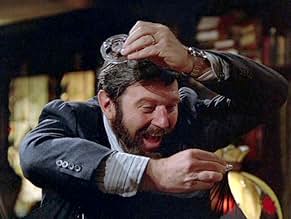
Thirdly, the ease with which Columbo solves the case, particularly, the way he details the objects and materials used to create the illusion that the victim was shot whilst the murderer was downstairs with several other people.
Essentially, more subtlety and simplicity was needed to make the whole thing believable, whilst the murderer's characterisation should have been more sinister and hard-edged.
A slight improvement on the other season's episodes "Fade Into Murder" and "Try and Catch Me", but generally, not Columbo at his best.
There are three problems here:
Firstly, the script-writer's insistence that the murderer's supreme intelligence must be mirrored in the way the murder is conceived and executed.
Secondly, the increasing lack of strength, smugness and assuredness shown by the murderer after he commits his crime.
Thirdly, the ease with which Columbo solves the case, particularly, the way he details the objects and materials used to create the illusion that the victim was shot whilst the murderer was downstairs with several other people.
Essentially, more subtlety and simplicity was needed to make the whole thing believable, whilst the murderer's characterisation should have been more sinister and hard-edged.
A slight improvement on the other season's episodes "Fade Into Murder" and "Try and Catch Me", but generally, not Columbo at his best.
Fascinating Character Study
Most of the critiques of this movie find this Columbo episode to be sorely lacking in comparison to other Columbo movies like "Murder By The Book" or "Suitable for Framing." But not every Columbo movie has to be a suspenseful battle of wits. To my observation, there are two types of Columbo plots: The Battle of Wits and The Character Study. The Battle of Wits, of course, is where Columbo takes on a wily, arrogant opponent who practically dares Columbo to catch him or her. The Character Study is an engaging examination of the person driven to commit murder.
The arrogant murderers are usually played by actors like Jack Cassidy, Leonard Nimoy or Robert Culp, and we usually don't like them. We cheer when Columbo finally nabs them. However, the murderers portrayed in the Character Study plots are usually far more sympathetic, and are sometimes the last people you would suspect of homicide i.e. a charming, elderly mystery novelist, a meek wine connoiseur, a folksy gospel singer, etc.
Oliver Brandt would seem to fall into the first category. Belonging to a club for intellectuals, Brandt seems aloof, arrogant, and secure in his place in the community as a genius. But it's all a sham. His need to belong is what dooms him. His marriage to a beautiful, vivacious woman is fraught with peril as her constant spending has led to him committing acts of embezzlement and a murder to cover it up. And despite his membership to an elite club of intellectuals, he has no particular empathy for them. For all his apparent success, Oliver Brandt is a lonely man who's in over his head.
Brandt also relies too heavily on brainteasers and puzzles. While his murder plot dupes even his fellow intelligentsia, his nerve begins to fail him when he realizes that the rumpled and seemingly preoccupied detective is just as smart as he is. Theodore Bikel plays this character to perfection, showing the genius who enjoys creating and solving puzzles, and then peeling back the layers to show the tortured man within.
Another highlight of this movie is learning more about Columbo's background. "All my life I kept running into smart people," he says to Brandt in the final act, "I don't mean smart like you or the rest of the people in this house. You know what I mean." He means, of course, his struggle to succeed despite the prejudices he encountered based on his background. Though Columbo is a genius in his own right, he is constantly dismissed as unworthy. We discover that it's his work ethic that sees him through. And he learns to use people's tendency to underestimate him to his advantage.
It is perhaps, because of Columbo's outsider status, that Brandt warms to him as a kindred spirit. He replies to Columbo towards the end, "I was an imitation adult, because that's what was expected of me. Most people don't like smart people. Most children despise smart children. So, early on, I had to hide my so-called gift...painful, lonely years."
When Columbo finally does nab him, it comes as a relief. For me, this is one of the best Columbo episodes. Not because of the murder plot, or the way Columbo catches him, but because of how much we learn about the characters, and how we connect with them.
The arrogant murderers are usually played by actors like Jack Cassidy, Leonard Nimoy or Robert Culp, and we usually don't like them. We cheer when Columbo finally nabs them. However, the murderers portrayed in the Character Study plots are usually far more sympathetic, and are sometimes the last people you would suspect of homicide i.e. a charming, elderly mystery novelist, a meek wine connoiseur, a folksy gospel singer, etc.
Oliver Brandt would seem to fall into the first category. Belonging to a club for intellectuals, Brandt seems aloof, arrogant, and secure in his place in the community as a genius. But it's all a sham. His need to belong is what dooms him. His marriage to a beautiful, vivacious woman is fraught with peril as her constant spending has led to him committing acts of embezzlement and a murder to cover it up. And despite his membership to an elite club of intellectuals, he has no particular empathy for them. For all his apparent success, Oliver Brandt is a lonely man who's in over his head.
Brandt also relies too heavily on brainteasers and puzzles. While his murder plot dupes even his fellow intelligentsia, his nerve begins to fail him when he realizes that the rumpled and seemingly preoccupied detective is just as smart as he is. Theodore Bikel plays this character to perfection, showing the genius who enjoys creating and solving puzzles, and then peeling back the layers to show the tortured man within.
Another highlight of this movie is learning more about Columbo's background. "All my life I kept running into smart people," he says to Brandt in the final act, "I don't mean smart like you or the rest of the people in this house. You know what I mean." He means, of course, his struggle to succeed despite the prejudices he encountered based on his background. Though Columbo is a genius in his own right, he is constantly dismissed as unworthy. We discover that it's his work ethic that sees him through. And he learns to use people's tendency to underestimate him to his advantage.
It is perhaps, because of Columbo's outsider status, that Brandt warms to him as a kindred spirit. He replies to Columbo towards the end, "I was an imitation adult, because that's what was expected of me. Most people don't like smart people. Most children despise smart children. So, early on, I had to hide my so-called gift...painful, lonely years."
When Columbo finally does nab him, it comes as a relief. For me, this is one of the best Columbo episodes. Not because of the murder plot, or the way Columbo catches him, but because of how much we learn about the characters, and how we connect with them.
Women's status in I977
I've always been a Theodore Bikel fan and enjoyed this outing. I especially liked his relationship with the little girl. But I got sidetracked by the business about the male secretaries. Some kind of Women's Lib, Columbia wonders. No, the receptionist tells him. The firm only hires young men as secretaries because they are junior accountants who are getting more training in preparation for promotion. Evidently women were not considered qualified to become accountants, so they were not eligible to be secretaries to the firm's owners.
It took me back to real life circa 1977, when a friend who worked at a savings and loan used to train young men for higher positions. She would have liked to be promoted a higher position herself and she was obviously qualified for it. One day her boss told her that the reason that she had never been promoted was that she was too valuable to him in her current position and he was "too selfish" to part with her. He probably thought she would be flattered. She sued him for discriminiation instead. And won. Now that is Women's Lib.
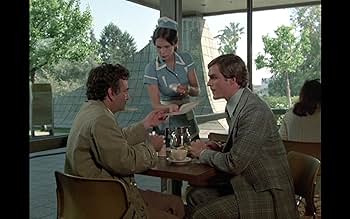
Fun to see Jamie Lee Curtis as a waitress with an attitude
It took me back to real life circa 1977, when a friend who worked at a savings and loan used to train young men for higher positions. She would have liked to be promoted a higher position herself and she was obviously qualified for it. One day her boss told her that the reason that she had never been promoted was that she was too valuable to him in her current position and he was "too selfish" to part with her. He probably thought she would be flattered. She sued him for discriminiation instead. And won. Now that is Women's Lib.
Fun to see Jamie Lee Curtis as a waitress with an attitude


Did you know
- TriviaThe portrait of Mrs. Melville, the fictional detective of the Franklin and Ferris mystery novels, prominently featured in Murder by the Book (1971), makes a cameo appearance on the back wall of the meeting room at the Sigma Society club.
- GoofsWhen the murderer demonstrates for Columbo how the dictionary is made to fall by a Magic Marker knocked onto it by the turntable arm, overbalancing the dictionary, the dictionary begins to fall before the marker lands on it.
- Quotes
Lt. Columbo: Here I've been talking with the most intelligent people in the world, and I never even noticed.
- SoundtracksBoo Hoo (You've Got Me Crying For You)
Written by Carmen Lombardo, Edward Heyman and John Jacob Loeb
Heard early on and again over the end credits
Details
- Release date
- Country of origin
- Language
- Also known as
- Prova d'intelligenza
- Filming locations
- Lafayette Park, Los Angeles, California, USA(Oliver Brandt disposes of the murder weapon)
- Production company
- See more company credits at IMDbPro
Contribute to this page
Suggest an edit or add missing content