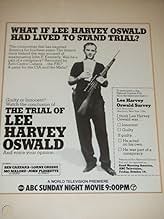
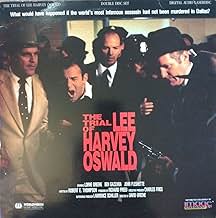
The bizarre story behind Lee Harvey Oswald, the man accused of assassinating U.S. President John F. Kennedy in Dallas, Texas on November 22, 1963, and what might have happened had he been br... Read allThe bizarre story behind Lee Harvey Oswald, the man accused of assassinating U.S. President John F. Kennedy in Dallas, Texas on November 22, 1963, and what might have happened had he been brought to trial, if he had not been murdered by Jack Ruby.The bizarre story behind Lee Harvey Oswald, the man accused of assassinating U.S. President John F. Kennedy in Dallas, Texas on November 22, 1963, and what might have happened had he been brought to trial, if he had not been murdered by Jack Ruby.
- Directors
- Writer
- Stars
Charles Robinson
- Melvin Johnson
- (as Charlie Robinson)
- Directors
- Writer
- All cast & crew
- Production, box office & more at IMDbPro
Featured reviews
As a serious researcher of the Kennedy assassination (and Lee Harvey Oswald in particular), I was intrigued by this film's title and grabbed it as soon as it became available on VHS.
The film is based on the supposition that Lee Harvey Oswald was not killed on November 24th, 1963, and lived to stand trial for the assassination of President John F. Kennedy. It was shot on location (that's worth the price in itself) and all of the key people are represented, although many of the names have been changed (possibly to avoid paying royalties to the real witnesses and players, but who knows). This could tend to be slightly irritating to researchers and serious students, but it doesn't detract from the drama as it unfolds.
I want to point out here that at no time during the film does it show Oswald doing anything illegal. We never see him with the rifle; we never see him in or around the "sniper's nest"; and we never see him shoot Officer Tippit. All conjecture. The film does tend to follow the findings of the Warren Commission Report, so new students to the assassination can get a good start here. Bottom line ... whether you believe in the lone nut theory or conspiracy, it is an entertaining and thought-provoking film.
The film is based on the supposition that Lee Harvey Oswald was not killed on November 24th, 1963, and lived to stand trial for the assassination of President John F. Kennedy. It was shot on location (that's worth the price in itself) and all of the key people are represented, although many of the names have been changed (possibly to avoid paying royalties to the real witnesses and players, but who knows). This could tend to be slightly irritating to researchers and serious students, but it doesn't detract from the drama as it unfolds.
I want to point out here that at no time during the film does it show Oswald doing anything illegal. We never see him with the rifle; we never see him in or around the "sniper's nest"; and we never see him shoot Officer Tippit. All conjecture. The film does tend to follow the findings of the Warren Commission Report, so new students to the assassination can get a good start here. Bottom line ... whether you believe in the lone nut theory or conspiracy, it is an entertaining and thought-provoking film.
2bux
This picture has only one thing going for it: Pleshette. The portrayal of Oswald here is the only item worthy of mention. Made for TV, on the threshold of the publishing of the House Select Committee on Assassination's Report, this is yet another apology for the Warren Commission. As with Gerald Posner's book "Case Closed" there was by necessity a myriad of omissions and errors committed to make this story believable. The subject is better covered in Walt Brown's novel "The Trial of Lee Harvey Oswald." As a piece of fiction, this movie moves at a good pace and the acting is fine, as fact, it is only for those that have a yearning to buy the Brooklyn Bridge, or occasionally peer out the window searching for flying pigs.
The film goes completely off the rails by choosing to focus on wild conspiracy theories instead of the actual criminal trial of Oswald. What really destroyed the value of the film for me was the fictionalized version of Harold Norman's eyewitness account (he was called "Melvin Johnson" in the film.) Norman was on the fifth floor of the Depository at the time of the shooting. He clearly heard shells falling above him (he referred to them as "hulls") as they were being ejected AND THE BOLT ACTION OF THE RIFLE. The sound of the bolt action was completely omitted from the fictional "testimony". Also omitted was the fact that Norman was quite familiar with rifles and the sound they make during such actions. His use of the word "hulls" ( a common description of ejected shells by those familiar with rifles) shows that he was hardly the ignorant "golly gee, they sounded like shells" buffoon he was made out to be in the film. Also, the film claims that supposed conspirators knew about the motorcade route weeks in advance. This is nonsensical, because the Secret Service decided on the route just days in advance, and it was announced just three days beforehand. Another example of the film's distortion of facts is the idea that the bag that the Carcano rifle was in should have had oil on it, because the rifle was "well oiled". What the FBI was referring to was the firing pin and spring. They did NOT say that the rifle was slathered in oil.
On November 22, 1963, Lee Harvey Oswald gunned down the President of the United States in the most spectacular assassination in history. He was arrested in double quick time, not for the Kennedy assassination, but for the cold-blooded execution of a police officer who perhaps acting on instinct had challenged him in a routine stop.
It took no time at all for the authorities to connect Oswald to the first crime, and in due course he would have been indicted for the assassination, tried, convicted, and sentenced to death. But forty-eight hours after the crime of the century, Oswald himself fell victim to an assassin's bullet.
Up to a point, this docu-drama does a reasonable job of tracing that predictable but abandoned future by airbrushing Jack Ruby out of the picture and putting Oswald on trial. There are no faults with the acting, especially that of John Pleshette who bears a more than superficial resemblance to Oswald and who mimics the mannerisms and moods of this narcissistic non-entity to a tee. Unfortunately, towards the end the film loses its way in a maze of manufactured conspiracy. While it is true that these imaginary conspiracies were extant rather than newly invented, a more straightforward approach would have had true historical legitimacy.
Nevertheless, some people will have liked it, and the ending is certainly novel, like everything else about the life and death of Lee Harvey Oswald.
It took no time at all for the authorities to connect Oswald to the first crime, and in due course he would have been indicted for the assassination, tried, convicted, and sentenced to death. But forty-eight hours after the crime of the century, Oswald himself fell victim to an assassin's bullet.
Up to a point, this docu-drama does a reasonable job of tracing that predictable but abandoned future by airbrushing Jack Ruby out of the picture and putting Oswald on trial. There are no faults with the acting, especially that of John Pleshette who bears a more than superficial resemblance to Oswald and who mimics the mannerisms and moods of this narcissistic non-entity to a tee. Unfortunately, towards the end the film loses its way in a maze of manufactured conspiracy. While it is true that these imaginary conspiracies were extant rather than newly invented, a more straightforward approach would have had true historical legitimacy.
Nevertheless, some people will have liked it, and the ending is certainly novel, like everything else about the life and death of Lee Harvey Oswald.
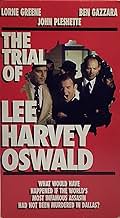
With all due respect to the previous viewer, what makes this speculative TV movie so effective is *because* it ends up coming down on the side of the Warren Commission conclusions for the most part, which have been vindicated by all subsequent investigations and serious historical analyses, particularly Gerald Posner in "Case Closed." A priceless moment is when the judge berates Oswald's defense attorney (Lorne Greene) for deliberately injecting a grassy knoll gunman during a shooting demonstration.
Skip "JFK", which is all about making things up out of thin air to fit a biased theory. Watch this instead if you can, along with the 1992 Quantum Leap episode "The Oswald Conspiracy".
Did you know
- TriviaThis TV film has a reenactment of the infamous 'Zapruder' film. Due to censorship issues, it does not depict the President's blood/brain matter being blown-out when he's shot in the head.
- ConnectionsVersion of The Trial of Lee Harvey Oswald (1964)
Details
- Release date
- Country of origin
- Language
- Also known as
- Wer erschoß John F. Kennedy?
- Filming locations
- McKinney Square, McKinney, Texas, USA(interiors)
- Production company
- See more company credits at IMDbPro
Contribute to this page
Suggest an edit or add missing content