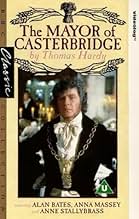
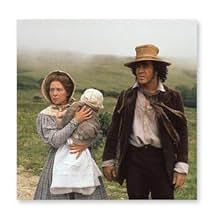
Drunken Henchard sells wife at fair. Sober, he reforms, becomes mayor but past catches up when wife returns years later.Drunken Henchard sells wife at fair. Sober, he reforms, becomes mayor but past catches up when wife returns years later.Drunken Henchard sells wife at fair. Sober, he reforms, becomes mayor but past catches up when wife returns years later.
Browse episodes
7.9413
1
2
3
4
5
6
7
8
9
10
Featured reviews
The dramatic tension of a peanut dissolving in oil
A classic ancient BBC production: promising actors with a sparsely populated script, indecipherable accents, atrocious sound quality, and Extremely Long Takes Wherein Nothing Really Happens.
Potentially deeply emotional scenes are read through instead of explored. It's as if the text of the script is so sacred the actors daren't internalize it for fear of desecrating it.
Confusing jumps in time compound the badness. In addition, by trimming some exposition, we're not quite sure what transpires between some characters, or if we do know What, we're never sure Why.
This is an excellent soporific. It also works well if you need to exercise your thumb on the fast-forward button. It's difficult to miss an important piece of dialogue or even a scene. If "torpid" is what you're looking for, this is the mini-series for you.
Potentially deeply emotional scenes are read through instead of explored. It's as if the text of the script is so sacred the actors daren't internalize it for fear of desecrating it.
Confusing jumps in time compound the badness. In addition, by trimming some exposition, we're not quite sure what transpires between some characters, or if we do know What, we're never sure Why.
This is an excellent soporific. It also works well if you need to exercise your thumb on the fast-forward button. It's difficult to miss an important piece of dialogue or even a scene. If "torpid" is what you're looking for, this is the mini-series for you.
A Story about karma
This brilliant adaption of a typically grim hardy novel was filmed in Corfe Castle, Dorset, but is set in Dorchester (aka Casterbridge). Given that it is 45 years old and it stands up well. Technically. Bates is of course the star. Sadly, Farfrae and Lucetta are poorly caste (the newer version being much better) but it is good to see the story told as written (mostly) and no one afraid to take a long time about it. It shows a man recovering from an early failure of character, who then does well. But then he lets himself down again and starts to fail. He makes a recovery of sorts, only to let himself (and others) down again. In short. This is a story about karma and how we control our own fortune. For those of us who are able to concentrate for an extended period of time it is well worth agonising over his life.
Surprisingly good adaptation by the ever-surprising Dennis Potter
Please pardon the substandard Americanism, but "who'd a thunk" that the insanely imaginative bete noire of British television writing, Dennis Potter, could have written such a disciplined, book-faithful, beautifully-paced script as this. He pays full and respectful homage to the great Thomas Hardy's masterpiece.
No repetition of the accolades of prior reviewers is needed here. They're spot on.
What I would like to see, if I had control of casting of both the 1978 and 2003 versions, is a redistribution of the cast. For this exercise, I need a time warp.
Understanding, for example, that Polly Walker, who plays Lucetta in 2003, was only 12 years old in 1978, I would have preferred her (as she was in 2003) to Anna Massey as Lucetta in 1978. Walker has some beauty and magnetism and is believable as a man- hungry "fallen woman." Massey was undeniably an excellent actress, but as a vamp she simply can't cut it. To think Farfrae or Henchard could be attracted to her sensually is laughable. The suspension of disbelief here is too much for me to make. (By the way, her miscasting as Laura in the Pallisers is equally disturbing, as there is NO spark between her and Donal McCann in that series.)
Then I'd grab Juliet Aubrey out of the 2003 version and cast her in place of Anne Stallybrass - Aubrey portrays Susan more sensitively, more skilfully.
Janet Maw is superb as Elizabeth-Jane, so I'd leave her there, and not import Jodhi May into 1978 - May is too stilted as E-J. Both Purefoy and Galloway are very good as Farfrae, but Goodman is so very good in the minor role of Jopp that I would pull him out of 2003 to replace Lacey,
And last, I leave it to you as to Hinds or Bates as Henchard. They both turn in the most remarkable performances of their careers in Mayor of C. And that's why it's such a pleasure to watch both versions. despite the dreadful editing of Hardy in 2003.
No repetition of the accolades of prior reviewers is needed here. They're spot on.
What I would like to see, if I had control of casting of both the 1978 and 2003 versions, is a redistribution of the cast. For this exercise, I need a time warp.
Understanding, for example, that Polly Walker, who plays Lucetta in 2003, was only 12 years old in 1978, I would have preferred her (as she was in 2003) to Anna Massey as Lucetta in 1978. Walker has some beauty and magnetism and is believable as a man- hungry "fallen woman." Massey was undeniably an excellent actress, but as a vamp she simply can't cut it. To think Farfrae or Henchard could be attracted to her sensually is laughable. The suspension of disbelief here is too much for me to make. (By the way, her miscasting as Laura in the Pallisers is equally disturbing, as there is NO spark between her and Donal McCann in that series.)
Then I'd grab Juliet Aubrey out of the 2003 version and cast her in place of Anne Stallybrass - Aubrey portrays Susan more sensitively, more skilfully.
Janet Maw is superb as Elizabeth-Jane, so I'd leave her there, and not import Jodhi May into 1978 - May is too stilted as E-J. Both Purefoy and Galloway are very good as Farfrae, but Goodman is so very good in the minor role of Jopp that I would pull him out of 2003 to replace Lacey,
And last, I leave it to you as to Hinds or Bates as Henchard. They both turn in the most remarkable performances of their careers in Mayor of C. And that's why it's such a pleasure to watch both versions. despite the dreadful editing of Hardy in 2003.
A superb series
The Mayor of Casterbridge is a wonderful story, maybe not the most accessible of his work but bleak but compelling and poignant. This 1978 series is superb. The photography is skillful, while the costumes and sets are both beautiful and bleakily atmospheric. The music conveys an appropriately evocative mood, while the story while unfolding at a deliberate slow pace is still moving and the script sophisticated, thoughtful and faithful in spirit to Hardy's work. The performances are just as impressive, whether in the facial expressions or the nuanced accents, with Alan Bates embodying Henchard's character to perfection. In support Anne Stallybrass and Anna Massey fare best in portrayals just as moving and well-realised. Janet Maw is also great. Jack Galloway is not quite as good, he is suitably dour but his character here is not as complex.
All in all, superb series and highly recommended. 10/10 Bethany Cox
a tragic hero in the dreaming spires
A thoughtful TV production, running over six hours, and a fine adaptation of Thomas Hardy's novel, arguably his best Wessex tale. Casterbridge stands for the real-life Oxford, a town where dreams can happen and a man such as Michael Henchard can rise as high as man can climb, and fall as far as man can sink. He is a tragic hero, a towering tour-de-force of good and evil, fearlessness and folly, and is beautifully played by Alan Bates in this version.
In support, Anne Stallybrass and Anna Massey shine the most, with Jack Galloway going some way to give life to the dour and ambitious Scot Farfrae, but stopping short of illuminating his complexities as set out in the book.
The music and the settings of this adaptation are excellent, and the atmosphere of a farm town, not yet touched by anything beyond industrialisation, is richly drawn. Slow-paced, but satisfying, this drama's reputation has grown steadily, and it is well deserved.
Interestingly, the adaptor of Hardy's book is none other than TV's infant terrible, Dennis Potter, and it is interesting to compare 'The Mayor of Casterbridge' with the likes of 'Pennies from Heaven' or 'The Singing Detective'.
In support, Anne Stallybrass and Anna Massey shine the most, with Jack Galloway going some way to give life to the dour and ambitious Scot Farfrae, but stopping short of illuminating his complexities as set out in the book.
The music and the settings of this adaptation are excellent, and the atmosphere of a farm town, not yet touched by anything beyond industrialisation, is richly drawn. Slow-paced, but satisfying, this drama's reputation has grown steadily, and it is well deserved.
Interestingly, the adaptor of Hardy's book is none other than TV's infant terrible, Dennis Potter, and it is interesting to compare 'The Mayor of Casterbridge' with the likes of 'Pennies from Heaven' or 'The Singing Detective'.
Did you know
- TriviaThis was one of the first major British television dramas to be shot entirely on videotape, using the new generation of portable video cameras and equipment for location footage. However, it was by no means the first BBC drama to do this, as series such as Doctor Who (1963) and Survivors (1975) had already used video for location footage as early as 1974-75.
- ConnectionsEdited into Masterpiece: The Mayor of Casterbridge: Part 1 (1978)
- How many seasons does The Mayor of Casterbridge have?Powered by Alexa
Details
Contribute to this page
Suggest an edit or add missing content