IMDb RATING
7.1/10
2.7K
YOUR RATING

In an interwar France struggling with profound social and political change, 18-year-old Violette Nozière rebels against the constraints of her claustrophobic, working-class (and possibly inc... Read allIn an interwar France struggling with profound social and political change, 18-year-old Violette Nozière rebels against the constraints of her claustrophobic, working-class (and possibly incestuous) family, with troubling consequences.In an interwar France struggling with profound social and political change, 18-year-old Violette Nozière rebels against the constraints of her claustrophobic, working-class (and possibly incestuous) family, with troubling consequences.
- Awards
- 2 wins & 5 nominations total

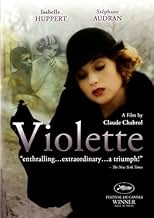


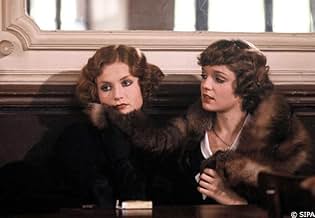


Stéphane Audran
- Germaine Nozière
- (as Stephane Audran)


Greg Germain
- Le musicien noir
- (as Grégory Germain)


7.12.7K
1
2
3
4
5
6
7
8
9
10
Featured reviews
The True Story of a French Psychopath
In the early 30's, in France, the eighteen-year-old Violette Nozière (Isabelle Huppert) lives with her mother, the housewife Germaine Nozière (Stephane Audran), and her father, the mechanic of train Baptiste Nozière (Jean Carmet) , in a small apartment in Paris. The ambitious Violette has a double-life, working as prostitute during the afternoons, saying that she meets a fictitious friend, who would be the sister of her doctor. When she learns that she contracted syphilis from a client, she lures her parents, says that she is a virgin, syphilis would be a genetic disease, and they would take medicine. Soon she meets the pimp Jean Dabin (Jean-François Garreaud) that explores her, and Violette gives money and gifts to him every day. She says that she is wealthy, but she gets the money through prostitution and stealing from her parents. When she learns that her father has a dowry to her wedding, she poisons them, but Germaine survives, and the murderer goes to court.
"Violette Nozière" (1978) is the true story of a French psychopath in the 30's by Claude Chabrol. The plot is ambiguous in many moments, mostly regarding the accusation of incest. But the film induces the viewer that Violette is a cold-blood murderer, ambitious and in love with a pimp. Isabelle Huppert ii excellent, as usual, in her first work with Chabrol. My vote is seven.
Title (Brazil): "Violette"
"Violette Nozière" (1978) is the true story of a French psychopath in the 30's by Claude Chabrol. The plot is ambiguous in many moments, mostly regarding the accusation of incest. But the film induces the viewer that Violette is a cold-blood murderer, ambitious and in love with a pimp. Isabelle Huppert ii excellent, as usual, in her first work with Chabrol. My vote is seven.
Title (Brazil): "Violette"
profile of a murderess
In 1978, when Claude Chabrol made 'Violette Noziere', many people in France remembered very well the criminal case of the woman who gives the film its name. It had been one of the scandalous, passionate, and morbid stories of the interwar period, a story that competed on the front pages of Parisian newspapers in 1933 with the news about Adolf Hitler's rise to power in Germany, and which had divided the French public opinion into two camps, as no another sensational affair had since the Dreyfus case. The heroine of the gloomy story was a 16-year-old girl from a working / mid-class neighborhood, who had poisoned her parents. The father had died but the mother survived. The investigation revealed the double life of a girl suffocated by the environment in which she lived, considered a sinister criminal by some and a victim of social conditions and a perverse family environment by others. However, Chabrol only mentions in passing the media scandal around this case, being rather fascinated by the young woman's personality and also fascinating his spectators in the way he tells the story of the crime and the circumstances that led to its committing.
The whole film revolves around the heroine played by Isabelle Huppert. The script is quite faithful to the story, presents the facts as reported by the press of the time and does not try to serve surprises or insert speculative interpretations about the reasons for the actions and the psychological sources of the acts committed by the young woman. The director's attention is focused on reconstructing the confined and devoid of personal separation in which the Noziere family lives, the bohemian environment in which the young high school girl spends her time in the company of students, crooks, and old bourgeois who take advantage of the youth of girls in need for money or sensations. Rejecting both moral judgments and psychoanalytic interpretations, Chabrol lets Isabelle Huppert build the role of the girl who, instead of teenage dreams, plunges into promiscuity, and who travels from adolescent rebellion to murder with an impassive coldness. We don't find too many reasons in the film that would put us as spectators in the camp of Violette's supporters, except for the personality of the actress who fills the role with gloomy feelings and self-destructive tension.
Isabelle Huppert achieves with the part of Violette in this film one of the first great roles of a fabulous career. She is supported by Stéphane Audran (the director's second wife, whom he would break up after 14 years of marriage and many remarkable films in the same year 1978) and Jean Carmet, one of those talented French actors whom Chabrol was giving the opportunity of consistent parts even if they were not first rank stars. A special award should be given to those who recognize Fabrice Luchini in one of the first roles of his film career. The style of the story is interesting and elaborate, temporally separated frames continue visually one another, flashbacks and imaginary scenes (especially from Violetta's fantasies or nightmares) are interleaved nervously and non-linearly, but perfectly following the logic of the action. 'Violette Noziere' manages to describe the interwar social environment, with social contradictions, moral prejudices, inequalities and stigmas related to the status of women and the pressure of the press of sensation. The film also intents to be a psychological study into the motives of the crime. Here, I think intentionally, the answer is not clear. We are shown the conditions that can generate crime, but not the gates that open between reality and horror. Judgments belong to us, the spectators.
The whole film revolves around the heroine played by Isabelle Huppert. The script is quite faithful to the story, presents the facts as reported by the press of the time and does not try to serve surprises or insert speculative interpretations about the reasons for the actions and the psychological sources of the acts committed by the young woman. The director's attention is focused on reconstructing the confined and devoid of personal separation in which the Noziere family lives, the bohemian environment in which the young high school girl spends her time in the company of students, crooks, and old bourgeois who take advantage of the youth of girls in need for money or sensations. Rejecting both moral judgments and psychoanalytic interpretations, Chabrol lets Isabelle Huppert build the role of the girl who, instead of teenage dreams, plunges into promiscuity, and who travels from adolescent rebellion to murder with an impassive coldness. We don't find too many reasons in the film that would put us as spectators in the camp of Violette's supporters, except for the personality of the actress who fills the role with gloomy feelings and self-destructive tension.
Isabelle Huppert achieves with the part of Violette in this film one of the first great roles of a fabulous career. She is supported by Stéphane Audran (the director's second wife, whom he would break up after 14 years of marriage and many remarkable films in the same year 1978) and Jean Carmet, one of those talented French actors whom Chabrol was giving the opportunity of consistent parts even if they were not first rank stars. A special award should be given to those who recognize Fabrice Luchini in one of the first roles of his film career. The style of the story is interesting and elaborate, temporally separated frames continue visually one another, flashbacks and imaginary scenes (especially from Violetta's fantasies or nightmares) are interleaved nervously and non-linearly, but perfectly following the logic of the action. 'Violette Noziere' manages to describe the interwar social environment, with social contradictions, moral prejudices, inequalities and stigmas related to the status of women and the pressure of the press of sensation. The film also intents to be a psychological study into the motives of the crime. Here, I think intentionally, the answer is not clear. We are shown the conditions that can generate crime, but not the gates that open between reality and horror. Judgments belong to us, the spectators.
A true story
Generally considered Chabrol's return to form after a period of barren inspiration ,including his worst ever ("Folies Bourgeoises").It was probably her best since "les Noces Rouges" (1973) .Like it,it was based on a true story, but an old one ,for the story takes place in 1933.Violette Nozières (the first of a long series of lead parts for Isabelle Huppert in Chabrol's canon) ,predating the director's "Madame Bovary" ,tries to shun her petty milieu ,falls for a gigolo (Jean Dabin! the heroine mistakes it first for the actor Gabin),and tries to poison her parents (she has mitigating circumstances ,for her father desires her ).Stephane Audran and Jean Carmet provide good support as the folks.
In the streets ,the buskers sang the horrible story of the infamous Violette Nozière.
In the streets ,the buskers sang the horrible story of the infamous Violette Nozière.
Claude Chabrol fine endeavor over the infamous-mediatic Violette Nozière's case!!
The infamous mediatic Violette Nozière case that shocked France in thirties between the wars took Claude Chabrol to enterprise this bold project in late seventies, the wiser director hits the target off the bat to cast Isabelle Huppert to play the young criminal that fits perfect as teenager Violette, the screenplay was based upon Jean-Marie Fiterè's novel in accurate manner as expected by own writer, extensively documented due at its time Violette already had died and wouldn't possible any further information thru her.
Chabrol got replicate the tiny Nozière's apartment where the main sequences unfold, also several spots of period piece to shooting in external scenes, further exposing with accurately Violette's double life on Parisian flamboyant lifestyle at Quartier Latin and her involvement with the crook Sorbonne's student Jean Daban, moreover a possible incest Chabrol just implles it slight on suggestive scenes, due he never believe that his father had committed such outrageous crime whatsoever, an stunning portrait from bleak past of Nozière's family!!
Thanks for reading.
Resume:
First watch: 2025 / How many: 1 / Source: DVD / Rating: 8.5.
Chabrol got replicate the tiny Nozière's apartment where the main sequences unfold, also several spots of period piece to shooting in external scenes, further exposing with accurately Violette's double life on Parisian flamboyant lifestyle at Quartier Latin and her involvement with the crook Sorbonne's student Jean Daban, moreover a possible incest Chabrol just implles it slight on suggestive scenes, due he never believe that his father had committed such outrageous crime whatsoever, an stunning portrait from bleak past of Nozière's family!!
Thanks for reading.
Resume:
First watch: 2025 / How many: 1 / Source: DVD / Rating: 8.5.
Violette and Dr. Hannibal Lecter can be an adorable couple!
It is an atrociously unlawful act depicted in Chabrol's sensational melodrama, the based-on-a- true-story type (a murder case in 1933) which would usually generate a slew of horrific feedback in the social news commentary, about an adolescent girl poisons her parents in order to back up her gold-digger boyfriend to elope together.
What makes the film so gravely provocative is the entire scheme of Violette (Huppert) seems so juvenile and wanton, the viciousness is inexorable and beyond any logical solace. Violette is a lackadaisical, apolitical and promiscuous teenager, although at the age of 24, Huppert is unbecoming to pass for the role, but Chabrol adroitly restyles Violette with a more precocious patina, the dexterous transition between the good girl veneer when she is with her parents and the motel-hogging and man-hunting hussy potently incites Huppert's chameleonic escapade, each and every single frame zooms in on her unprovoked aloofness and obtrusive sex appeal. She is perpetually indulging in her own pathetic realm, sneers at her parents' clumsy intercourse and disgruntled at their ordinary petit bourgeois trivia, she is in an impetuous situation to find an egress, but the man in her dreams is a major disappointment as viewers all being well- informed in advance, it is money he is on the lookout for. The affair is doomed to futility, in some sense Violette knows it fairly well, but it is the defects (the egocentric selfishness, deep- rooted misanthrope and diabolic cruelty) in her character blind her sight, poison her mind and abet her into carrying on the abhorrent action.
After the murder plan goes as expected and the lousy gas-accident cover-up, Germaine, the mother (Audran) survives the poison, it is not a detective story after all, instead, it is an awkward moment of facing the truth, but Violette's vituperative accusation to her late father (Carmet) in order to justify her motive shatters all the expectation if there is any mercifulness left in her, she is an archetype of the malevolent side of human nature, an anomaly which defies all the logical interpretation, she and Dr. Hannibal Lecter can be an adorable couple!
Stéphane Audran, whom I just appraised for her delicate performance in BABETTE'S FEAST (1987, 8/10), is astounding here as the overbearing but doting mother of Violette, she is the one we can mostly project our compassion on, yet, we might also prompt to question her tutelage, perhaps she is at least partially responsible for the decadence of her sole daughter, how Violette's double act (constantly stays in motels and hangs out someone the parents have never met) can blatantly evade a mother's instinctive nature is a shade bemusing, not to mention the intaking of unknown medicine for the sake of hereditary syphilis, at least verify with the doctor first (and in this case, both parents are too unmindful)!
New to the canon of Claude Chabrol, the pick of VIOLETTE may not be the optimum starter, the disrupted narrative never fully register any excitement barring a bitter aftertaste and shocking values of the subject matter, its foremost merit is to grant Huppert a stage to unleash her glacial pulchritude, which one can appreciate from every unyielding close-up on her, and comfortingly augurs an eminent career for her as crème de la crème of the French cinema, her screen magnetism is inherent.
What makes the film so gravely provocative is the entire scheme of Violette (Huppert) seems so juvenile and wanton, the viciousness is inexorable and beyond any logical solace. Violette is a lackadaisical, apolitical and promiscuous teenager, although at the age of 24, Huppert is unbecoming to pass for the role, but Chabrol adroitly restyles Violette with a more precocious patina, the dexterous transition between the good girl veneer when she is with her parents and the motel-hogging and man-hunting hussy potently incites Huppert's chameleonic escapade, each and every single frame zooms in on her unprovoked aloofness and obtrusive sex appeal. She is perpetually indulging in her own pathetic realm, sneers at her parents' clumsy intercourse and disgruntled at their ordinary petit bourgeois trivia, she is in an impetuous situation to find an egress, but the man in her dreams is a major disappointment as viewers all being well- informed in advance, it is money he is on the lookout for. The affair is doomed to futility, in some sense Violette knows it fairly well, but it is the defects (the egocentric selfishness, deep- rooted misanthrope and diabolic cruelty) in her character blind her sight, poison her mind and abet her into carrying on the abhorrent action.
After the murder plan goes as expected and the lousy gas-accident cover-up, Germaine, the mother (Audran) survives the poison, it is not a detective story after all, instead, it is an awkward moment of facing the truth, but Violette's vituperative accusation to her late father (Carmet) in order to justify her motive shatters all the expectation if there is any mercifulness left in her, she is an archetype of the malevolent side of human nature, an anomaly which defies all the logical interpretation, she and Dr. Hannibal Lecter can be an adorable couple!
Stéphane Audran, whom I just appraised for her delicate performance in BABETTE'S FEAST (1987, 8/10), is astounding here as the overbearing but doting mother of Violette, she is the one we can mostly project our compassion on, yet, we might also prompt to question her tutelage, perhaps she is at least partially responsible for the decadence of her sole daughter, how Violette's double act (constantly stays in motels and hangs out someone the parents have never met) can blatantly evade a mother's instinctive nature is a shade bemusing, not to mention the intaking of unknown medicine for the sake of hereditary syphilis, at least verify with the doctor first (and in this case, both parents are too unmindful)!
New to the canon of Claude Chabrol, the pick of VIOLETTE may not be the optimum starter, the disrupted narrative never fully register any excitement barring a bitter aftertaste and shocking values of the subject matter, its foremost merit is to grant Huppert a stage to unleash her glacial pulchritude, which one can appreciate from every unyielding close-up on her, and comfortingly augurs an eminent career for her as crème de la crème of the French cinema, her screen magnetism is inherent.


Did you know
- TriviaThe first time that director Claude Chabrol worked with actress Isabelle Huppert. They would later work together on: Story of Women (1988), Madame Bovary (1991), The Ceremony (1995), The Swindle (1997), Nightcap (2000), and Comedy of Power (2006).
- How long is Violette?Powered by Alexa
Details
- Release date
- Countries of origin
- Language
- Also known as
- Violeta Nozier
- Filming locations
- Rue Santos-Dumont, Paris 15, Paris, France(Violette and Jean in the street, making plans)
- Production companies
- See more company credits at IMDbPro
Box office
- Budget
- CA$1,360,000 (estimated)
Contribute to this page
Suggest an edit or add missing content