IMDb RATING
7.4/10
2K
YOUR RATING

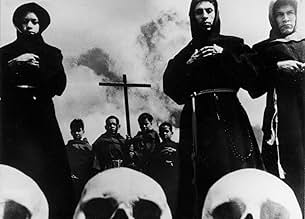
Eisenstein shows us Mexico in this movie, its history and its culture. He believes, that Mexico can become a modern state.Eisenstein shows us Mexico in this movie, its history and its culture. He believes, that Mexico can become a modern state.Eisenstein shows us Mexico in this movie, its history and its culture. He believes, that Mexico can become a modern state.
- Director
- Writers
- Stars
- Awards
- 1 win total





- Director
- Writers
- All cast & crew
- Production, box office & more at IMDbPro
7.42K
1
2
3
4
5
6
7
8
9
10
Featured reviews
10Aleksand
First video version of a flawed masterpiece (nevertheless ****)
Although its coscenarist and director, Sergei M. Eisenstein did not live to complete "Que Viva Mexico?," the Russian who reconstructed this 1979 version for Mosfilm, Grigori Alexandrov, co-authored the film and worked closely with Eisenstein in 1931 and 1932 in the filming of the footage ultimately fashioned into several pictures, including butchered versions released by Sol Lesser and even some Bell and Howell documentaries! At some point, the man who initially commissioned the movie, Upton Sinclair, donated all or almost all of Eisenstein's footage to the Museum of Modern Art, which made it available as it was shot (take by take by take) in a "study" film. This is the first time, to my knowledge, that an edited version has appeared in video, and for that, Eisenstein fans and lovers of cinema should be jubilant! Even if Alexandrov had cut the footage completely out of order and in a form that would make Sergei Mikhailovich roll over in his grave, we can appreciate the dynamic power of the images, so ingeniously composed and photographed by Eisenstein with his longtime cameraman, Eduard Tisse. Of course, Eisenstein's remarkable scenario could never be realized EXACTLY as he wrote it, but Alexandrov did an admirable job all the same. In whatever form we see it, Eisenstein's footage reminds us that this aborted masterpiece, had he been able to complete the movie, would have been just that -- one of the greatest motion pictures of all time. It is a tragedy for film lovers that Eisenstein could not obtain the negative from the Sinclair cabal (which included the American author's Pasadena, California Standard Oil cronies!) at the time. But this 1979 version is better than nothing, and a lot better than many so-called movies churned out by Hollywood today. The film should be studied by every student of cinema, and especially photographers and editors. In truth, Eisenstein probably was planning as many as six different films, but Sinclair sent his alcoholic brother-in-law to ride herd on the Russians, to the result that the "plug was pulled" on the production short of its completion by Eisenstein. Frankly, had the latter managed to complete the movie and edit it himself, I am convinced film buffs would put it right up there with "Citizen Kane" and "Casablanca" (i.e. among the greatest masterpieces of cinema). I recommend the film highly, if only as a reminder of what might have been!
Interesting shell of a film
I was going to skip this because Eisenstein never finished it. He filmed for months without completing what he wanted. He had to return to the Soviet Union, the film got impounded, and he had no access to the footage for the rest of his life. After his death, his codirector on October: Ten Days that Shook the World and The General Line, Grigori Aleksandrov got access to the footage and put together a short feature that approximated what Eisenstein was supposed to have wanted. This is that result. It reminds me of some of Orson Welles's abandoned projects, mostly Mr. Arkadin, in that it should be Eisenstein's, but no matter how hard you squint: it's not going to be.
It's supposed to be the history of Mexico, and considering that Eisenstein shot somewhere between 30 and 50 hours of footage, I doubt it was supposed to be only 90 minutes long. I mean...I don't expect a 20 hour film out of that, but since he wasn't even done filming and considering the large scope intended, I suspect he was going for a multi-part film, like how he originally started in the Soviet Union and had planned a series of films detailing the history of Russia from the revolution of 1905 to the October Revolution in 1917. That was never supposed to be a 90 minute film. It was supposed to be a series of films, and I suspect that what became Que Viva Mexico as supposed to be like that.
However, what Aleksandrov quickly threw together in a few months was a 90-minute long film, something that reminded more of Henri-Georges Clouzot's Inferno with far less behind the scenes interviews (Aleksandrov does introduce and exit the film in small segments in an editing bay).
So, the story of Mexico is handled through vignettes. The opening, essentially pre-Spanish, shows local Mexican natives sitting on Mayan temples and mourning a dead person. The second is still pre-Spanish about the matriarchal organization of society, portraying a perfect native society where no one ever dies, no one ever fights, and no one ever has conflict (a Rousseau influence on communist thought which I've always found interesting since the Soviet experiment early was all about industry and wealth of the modern world). The third is all about a bull fight, a cultural introduction by the Spanish, and it's probably the most exciting part of the film. It's all done through editing of what looks to be predominantly a real bullfight, and Eisenstein just follows the action expertly. This feels like classic Eisenstein, Aleksandrov mimicking well the deceased Soviet filmmaker's editing techniques.
The next is the longest about a young peasant in Spanish controlled Mexico before the Mexican revolution who has to take his bride to the local landowner (there are obvious visual echoes of the main kulak in The General Line). The landowner steals the bride, kidnapping her to do with as he wills, and the peasant leads a small, unsuccessful rebellion against the landowner, leading to the peasant being buried alive up to his neck until he dies as horses stomp on him.
An interesting aspect of this is that Eisenstein shot silent. He shot in 1931, two years into the sound era, using funding from American sources, and he either couldn't or chose to not use sound. Since so much was filmed outside, it might have been a cost/benefit ratio aspect where getting sound outside with the primitive equipment, even top of the line stuff, was so hard and expensive to do well. So, in order to capture the "reality" of the situation, and to make the most of a relatively small budget, he chose to shoot silently. I only bring it up because the early sound era is my favorite period in film history.
So, the portraits of Mexican life are interesting in their idyllic manifestations. The bull fight is exciting. The story of the plight of the peasant looking for his girl is good ole fashioned underdog against the odds storytelling (with a downer ending because propaganda against the ancien regime). It's more of a fractured curio, a remnant of an incomplete film, partially reconstructed by the director's friend and compatriot in the Soviet film industry (another Soviet director, Sergei Bondarchuck, the director of War and Peace, provides some narration as well), than a completed film. However, on that scale, I actually found it quite interesting as a portrait of a production that will never see completion. Part entertaining, part informative, Que Viva Mexico is quite worth discovery for Eisenstein completists.
It's supposed to be the history of Mexico, and considering that Eisenstein shot somewhere between 30 and 50 hours of footage, I doubt it was supposed to be only 90 minutes long. I mean...I don't expect a 20 hour film out of that, but since he wasn't even done filming and considering the large scope intended, I suspect he was going for a multi-part film, like how he originally started in the Soviet Union and had planned a series of films detailing the history of Russia from the revolution of 1905 to the October Revolution in 1917. That was never supposed to be a 90 minute film. It was supposed to be a series of films, and I suspect that what became Que Viva Mexico as supposed to be like that.
However, what Aleksandrov quickly threw together in a few months was a 90-minute long film, something that reminded more of Henri-Georges Clouzot's Inferno with far less behind the scenes interviews (Aleksandrov does introduce and exit the film in small segments in an editing bay).
So, the story of Mexico is handled through vignettes. The opening, essentially pre-Spanish, shows local Mexican natives sitting on Mayan temples and mourning a dead person. The second is still pre-Spanish about the matriarchal organization of society, portraying a perfect native society where no one ever dies, no one ever fights, and no one ever has conflict (a Rousseau influence on communist thought which I've always found interesting since the Soviet experiment early was all about industry and wealth of the modern world). The third is all about a bull fight, a cultural introduction by the Spanish, and it's probably the most exciting part of the film. It's all done through editing of what looks to be predominantly a real bullfight, and Eisenstein just follows the action expertly. This feels like classic Eisenstein, Aleksandrov mimicking well the deceased Soviet filmmaker's editing techniques.
The next is the longest about a young peasant in Spanish controlled Mexico before the Mexican revolution who has to take his bride to the local landowner (there are obvious visual echoes of the main kulak in The General Line). The landowner steals the bride, kidnapping her to do with as he wills, and the peasant leads a small, unsuccessful rebellion against the landowner, leading to the peasant being buried alive up to his neck until he dies as horses stomp on him.
An interesting aspect of this is that Eisenstein shot silent. He shot in 1931, two years into the sound era, using funding from American sources, and he either couldn't or chose to not use sound. Since so much was filmed outside, it might have been a cost/benefit ratio aspect where getting sound outside with the primitive equipment, even top of the line stuff, was so hard and expensive to do well. So, in order to capture the "reality" of the situation, and to make the most of a relatively small budget, he chose to shoot silently. I only bring it up because the early sound era is my favorite period in film history.
So, the portraits of Mexican life are interesting in their idyllic manifestations. The bull fight is exciting. The story of the plight of the peasant looking for his girl is good ole fashioned underdog against the odds storytelling (with a downer ending because propaganda against the ancien regime). It's more of a fractured curio, a remnant of an incomplete film, partially reconstructed by the director's friend and compatriot in the Soviet film industry (another Soviet director, Sergei Bondarchuck, the director of War and Peace, provides some narration as well), than a completed film. However, on that scale, I actually found it quite interesting as a portrait of a production that will never see completion. Part entertaining, part informative, Que Viva Mexico is quite worth discovery for Eisenstein completists.
Eisenstein Lite
Film buffs know the history of this lost all too well- Eisenstein came to Hollywood to work for Paramount, Paramount and Sergei never really saw eye to eye. Before giving up on making an American Production, Upton Sinclair invited Eisenstein to make a feature film about Mexico. Eisenstein shot miles of footage, and the money and interest from backers ran out. Eisenstein was forced to return to his native Russia without his Mexican footage. The footage was cut together by others at about this time to make THUNDER OVER MEXICO, and they did not follow Eisenstein's editing notes (They simply made an edit every four seconds. Watch the film and count, you'll see what I mean...) This version, completed by his associates 30 years after his 1948 death comes close to Eisenstein's intent, but without Eisensetin at the editing board, something is missing.
This resulting video is entralling. His incredible shot compositions (which influence me to no end as a film-maker) are all there. There's one scene, which involves a shoot-out reminds us what a John Wayne western directed by Eisenstein would of lookied like.
This resulting video is entralling. His incredible shot compositions (which influence me to no end as a film-maker) are all there. There's one scene, which involves a shoot-out reminds us what a John Wayne western directed by Eisenstein would of lookied like.
South of the border............
Sergei Eisenstein's relationship with Hollywood was naturally doomed from the outset but a light appeared at the end of the tunnel when he was given the opportunity by Upton and Mary Sinclair of making a film in Mexico about that country's history and culture and contracted to deliver the finished product in six months. When he arrived in Tetlapayec he declared: "This is the place I have been looking for all my life!" Predictably his artistic vision kicked in and his ideas for the film became more grandiose. Like most great creative artistes Eisenstein felt constrained by neither time nor money but eventually both ran out. The plug was pulled, he was summoned back to Russia and lost control of editing thousands of feet of film. It was not until long after his death that his script advisor at the time, Grigori Alexandrov, was able to piece together what we now know as 'Que Viva Mexico!"
Although fragmented, enough remains to make this an engrossing and emotional experience. Contrasted with the lyricism of a courtship and marriage we have the brutal images of a bull's carcass being dragged from the ring and the trampling to death of the peons. It is to be regretted that nothing at all was filmed of what promised to be the most exciting episode, that of the Mexican Revolution. What little remains of the Epilogue is a filmic gem. How blessed was Eisenstein in having the services of cinematographer Edward Tissé.
We should be grateful I suppose to have this much considering the fate that befell his 'Bezhin Meadow'.
Eisenstein was a director of monumental stature but destined to be sorely tried. This Mexican misadventure must surely have been a bitter disappointment to him but his biographer Marie Seton has observed that as a result of this failed project "an entirely new filmic theory of composition came to him." Looking ahead to 'Alexander Nevsky' and 'Ivan the Terrible', she may very well be right.
Although fragmented, enough remains to make this an engrossing and emotional experience. Contrasted with the lyricism of a courtship and marriage we have the brutal images of a bull's carcass being dragged from the ring and the trampling to death of the peons. It is to be regretted that nothing at all was filmed of what promised to be the most exciting episode, that of the Mexican Revolution. What little remains of the Epilogue is a filmic gem. How blessed was Eisenstein in having the services of cinematographer Edward Tissé.
We should be grateful I suppose to have this much considering the fate that befell his 'Bezhin Meadow'.
Eisenstein was a director of monumental stature but destined to be sorely tried. This Mexican misadventure must surely have been a bitter disappointment to him but his biographer Marie Seton has observed that as a result of this failed project "an entirely new filmic theory of composition came to him." Looking ahead to 'Alexander Nevsky' and 'Ivan the Terrible', she may very well be right.
A beautiful portrait of Mexico by a Russian genius
It's unbelievable how everything can be art when you look through the eyes of a genius. Sergei Eisenstein: the master of editing, the great father of Russian cinema, a role model for other famous directors like Charlie Chaplin or Andrei Tarkovski; author of cinematic masterpieces like Battleship Potemkin, Ivan the Terrible and Alexander Nevsky. Now we have his version of his Mexican adventure: "Que Viva Mexico!" an epic semi-documentary lost in time. Why was it lost in time for decades? Because no one in Russia or in the USA trusted this film enough to show it. Eisenstein was a nobody when he arrived in the USA to plan another project, the soviet authorities didn't want him in the USSR due to his polemic point of views of the October Revolution and the czarism. Sergei adored Mexico because of its beauty and its hospitality. Famous Mexican painters like Diego Rivera, Frida Kahlo and David Alfaro Siqueiros, along with his Russian partner Trotsky, helped him to inspire. Eisenstein filmed his version of the Mexican traditions and he was very close. As a Mexican, I didn't realized how magical these traditions were until I watched this film. A really good film maker knows how to show the real life in a fantastic way. Now, do I have to say the name of this really good film maker? I don't think so, I think you already know. "Que Viva Mexico!" highly recommendable, Mexican fellows: watch it, this is your real country.


Did you know
- TriviaItalian censorship visa # 75561 delivered on 25 September 1980.
- GoofsThe rifles Sebastian and his friends take from the gallery are of lever-action design, in the following gun-fight in the cactus fields they unmistakably use single-shot bolt-action rifles.
- ConnectionsEdited from ¡Que viva Mexico! (1932)
- How long is Que Viva Mexico?Powered by Alexa
Details
- Release date
- Country of origin
- Language
- Also known as
- ¡Que viva Mexico!
- Filming locations
- Production company
- See more company credits at IMDbPro
- Runtime
- 1h 30m(90 min)
- Color
- Sound mix
- Aspect ratio
- 1.37 : 1
Contribute to this page
Suggest an edit or add missing content