
The assassination of the would be ruler of Rome at the hands of Brutus and company has tragic consequences for Brutus and the republic.The assassination of the would be ruler of Rome at the hands of Brutus and company has tragic consequences for Brutus and the republic.The assassination of the would be ruler of Rome at the hands of Brutus and company has tragic consequences for Brutus and the republic.


- Director
- Writer
- All cast & crew
- Production, box office & more at IMDbPro
7.4271
1
2
3
4
5
6
7
8
9
10
Featured reviews
Men at some time are masters of their fates
When it comes to compiling a list of Shakespeare's best plays, from personal opinion, 'Julius Caesar' would not make the list, though it would certainly not be on the lesser play list. That is not saying that it's a bad play, quite the contrary. It is compelling with fully rounded characters, interesting themes and some of Shakespeare's most famous lines and speeches, Shakespeare once again showing how unrivalled he is in mastery of language, text and poetry whether in a few lines or big monologues. It does though run out of steam dramatically towards the end and in performance very rarely is the final scene nailed.
The late 70s-early 80s BBC Shakespeare adaptations are very interesting. Quality-wise they are variable with not all of them being great, but it is great to see productions that are generally faithful and respectful and have distinguished casts (most with performances that are good or more, not all mind). Even if some have problems with over-faithfulness, lack of imagination and under-budget. Their 'Julius Caesar' from 1979 is towards the better end on the whole and the second best of the four productions transmitted at this point of the series, King Richard II' being the best and the others being 'Romeo and Juliet' (left me mixed) and 'As You Like It' (uneven but decent). Though there is better in the series definitely.
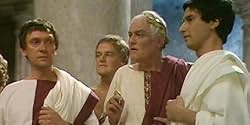
'Julius Caesar' is not completely perfect, a couple of aspects being hindered by budget. Although there are worse in the series, the costumes are unimaginative and somewhat drab (though the attempt at authenticity is admirable), those togas do look quite cheap.
As expected, but hoping the production would do it well, the final scene is once again not nailed and actually underwhelms. The momentum had gone and the staging felt static.
However, this production is interesting in quite a few respects. The camera work is more expansive than that for most productions in the series and doing the solliloquies in voice overs had a very effective psychological qualities. The characters are already fully rounded and flesh blooded, but are given more complexity and detail in the interpretations here (especially Brutus and Cassius). The stage direction is on the most part involving on a dramatic level, everything makes sense and nothing distracts or comes over as tasteless, credit is also due in having more detail and precision in the interactions and emotions than most in the series, complex in some places and subtle in others.
Costumes aside, 'Julius Caesar' doesn't look too bad with the sets being more authentic than those for the productions of the other Roman-set Shakespeare dramas/plays. Shakespeare's text shines brilliantly, all the major lines having their impact and the speeches/solliloquies having the right amount of nuance and intensity. There are great performances all round, a more subtle than usual Charles Gray portraying the title role with dignity and authority, nothing weak about him. Keith Michell is a virile Marc Antony and Richard Pasco brings a conflicted edge to Brutus. Same with David Collings as Cassius. In the female roles, Virginia McKenna and Elizabeth Spriggs more than hold their own, the former very touching and the latter a warm and interesting departure from the roles she tended to usually play (very well just to say and more).
On the whole, a 'Julius Caesar' worth praising and not one to bury. 8/10 Bethany Cox
The late 70s-early 80s BBC Shakespeare adaptations are very interesting. Quality-wise they are variable with not all of them being great, but it is great to see productions that are generally faithful and respectful and have distinguished casts (most with performances that are good or more, not all mind). Even if some have problems with over-faithfulness, lack of imagination and under-budget. Their 'Julius Caesar' from 1979 is towards the better end on the whole and the second best of the four productions transmitted at this point of the series, King Richard II' being the best and the others being 'Romeo and Juliet' (left me mixed) and 'As You Like It' (uneven but decent). Though there is better in the series definitely.
'Julius Caesar' is not completely perfect, a couple of aspects being hindered by budget. Although there are worse in the series, the costumes are unimaginative and somewhat drab (though the attempt at authenticity is admirable), those togas do look quite cheap.
As expected, but hoping the production would do it well, the final scene is once again not nailed and actually underwhelms. The momentum had gone and the staging felt static.
However, this production is interesting in quite a few respects. The camera work is more expansive than that for most productions in the series and doing the solliloquies in voice overs had a very effective psychological qualities. The characters are already fully rounded and flesh blooded, but are given more complexity and detail in the interpretations here (especially Brutus and Cassius). The stage direction is on the most part involving on a dramatic level, everything makes sense and nothing distracts or comes over as tasteless, credit is also due in having more detail and precision in the interactions and emotions than most in the series, complex in some places and subtle in others.
Costumes aside, 'Julius Caesar' doesn't look too bad with the sets being more authentic than those for the productions of the other Roman-set Shakespeare dramas/plays. Shakespeare's text shines brilliantly, all the major lines having their impact and the speeches/solliloquies having the right amount of nuance and intensity. There are great performances all round, a more subtle than usual Charles Gray portraying the title role with dignity and authority, nothing weak about him. Keith Michell is a virile Marc Antony and Richard Pasco brings a conflicted edge to Brutus. Same with David Collings as Cassius. In the female roles, Virginia McKenna and Elizabeth Spriggs more than hold their own, the former very touching and the latter a warm and interesting departure from the roles she tended to usually play (very well just to say and more).
On the whole, a 'Julius Caesar' worth praising and not one to bury. 8/10 Bethany Cox
More Television Technique Than Usual Here
This production of Julius Caesar was directed by Herbert Wise. It was his first and only contribution to the BBC Shakespeare series, and he was undoubtedly offered the job because of his superlative work directing the series "I Claudius." (Be sure also to track down his "The Woman in Black," a case study of how to scare the stuffing out of the audience with zero 'yuk' factor.)
Shakespeare makes different demands than Robert Graves or Nigel Kneale, however, and the director gives us a production more tailored to the strengths and weaknesses of the television medium than most in the series. Only here do we get gigantic closeups of the actors' faces, which are sometimes not sufficiently photogenic for such intense scrutiny. On one of today's large-screen televisions, the effect can be overwhelming. Also, the soliloquies are almost all voice over on the soundtrack accompanying the face of a closed-mouth actor, with actual speech only on certain key passages. Either you find it more psychologically valid, or totally disruptive.
Thanks to Herbert Wise, the general interplay of emotion is considerably more precise than in many others of the BBC Shakespeare series. People talk, listen, act, react, think in the most detailed way, and the pace is always just. Though the political aspect of the drama is given its due, the emphasis here is on the interpersonal relationships.
The director is on record as saying that Shakespeare and television make a bad fit, and that no one up to this time has "cracked it." We can argue among ourselves whether he was right or not, but this show is different from all the others, and well worth watching.
Richard Pasco, Charles Gray, Keith Michell and Virginia McKenna all turn in well-rounded performances. Elizabeth Spriggs surprises as a warm and mobile Calpurnia. given her chatty Mistress Quickly in "Merry Wives," and memorable turns in TV adaptations of "Middlemarch," "Martin Chuzzlewit" and "Sense and Sensibility." David Collings' Cassius starts out lean and hungry, but goes mushy and hysterical a little early.
The play itself usually runs out of steam after Antony's oration, and here it is less of a problem than usual. The physical production by Tony Abbott is good, providing a more spacious Rome than that of the Coriolanus broadcast, and a somewhat flowery battlefield.
However, for those in search of an alternative, find on the Internet the audiocassette of the Caedmon Shakespeare Recording Society version of a generation earlier. Anthony Quayle is the Brutus, John Mills the Cassius, Alan Bates the Mark Antony and Sir Ralph Richardson as Julius Caesar. Even without visuals, everyone is one size larger, and I for one appreciate it.
Shakespeare makes different demands than Robert Graves or Nigel Kneale, however, and the director gives us a production more tailored to the strengths and weaknesses of the television medium than most in the series. Only here do we get gigantic closeups of the actors' faces, which are sometimes not sufficiently photogenic for such intense scrutiny. On one of today's large-screen televisions, the effect can be overwhelming. Also, the soliloquies are almost all voice over on the soundtrack accompanying the face of a closed-mouth actor, with actual speech only on certain key passages. Either you find it more psychologically valid, or totally disruptive.
Thanks to Herbert Wise, the general interplay of emotion is considerably more precise than in many others of the BBC Shakespeare series. People talk, listen, act, react, think in the most detailed way, and the pace is always just. Though the political aspect of the drama is given its due, the emphasis here is on the interpersonal relationships.
The director is on record as saying that Shakespeare and television make a bad fit, and that no one up to this time has "cracked it." We can argue among ourselves whether he was right or not, but this show is different from all the others, and well worth watching.
Richard Pasco, Charles Gray, Keith Michell and Virginia McKenna all turn in well-rounded performances. Elizabeth Spriggs surprises as a warm and mobile Calpurnia. given her chatty Mistress Quickly in "Merry Wives," and memorable turns in TV adaptations of "Middlemarch," "Martin Chuzzlewit" and "Sense and Sensibility." David Collings' Cassius starts out lean and hungry, but goes mushy and hysterical a little early.
The play itself usually runs out of steam after Antony's oration, and here it is less of a problem than usual. The physical production by Tony Abbott is good, providing a more spacious Rome than that of the Coriolanus broadcast, and a somewhat flowery battlefield.
However, for those in search of an alternative, find on the Internet the audiocassette of the Caedmon Shakespeare Recording Society version of a generation earlier. Anthony Quayle is the Brutus, John Mills the Cassius, Alan Bates the Mark Antony and Sir Ralph Richardson as Julius Caesar. Even without visuals, everyone is one size larger, and I for one appreciate it.
A very faithful and enjoyable version, though pacing is commensurate with its age
This is a very slow but enjoyable and faithful version of Julius Caesar. It feels a bit 'sword and sandals' thanks to the now old and low budget TV production. But its focus is on faithfulness to the text and that it is. Richard Pasco is a brilliant Brutus, you totally feel along with him the battle in his conscience and what is right and wrong in the brutal world that he lives in. For a more modern and engaging version watch the National Theatre's 2018 version if you can get hold of it.
A Fine Version of The Tragic Drama
William Shakespeare's classic tragedy, Julius Caesar, has always been one of his lesser liked plays. It's predominantly an all male drama with only two supporting female characters like Calpurnia and Portia. It was still a male dominated world in Caesar's time where women are wives, nurses, maids, and mistresses. The BBC did a service in producing Shakespeare's plays faithfully to the word. I watch the English subtitles to get a better account of the story. The BBC has faithfully recreated the background scenes without much cost. There is no audience for a reaction or applause. The cast includes Charles in the title role. He is a fine Caesar. Richard Pasco and Keith Michell are also fine too. Unlike Shakespeare's other tragedies, this story is about politics, power, corruption, and greed.
A full play gives fuller characters and themes
Unlike the movies, this is a full version of the play, clocking in at a little under three hours. In performing the whole play, we see that Julius Caesar is one of Shakespeare's best plays- not simply for the masterful rhetoric but for the characterisation. There are shades of Iago in the manipulative Cassius, eaten away by jealousy, and Brutus is a mixture of Macbeth and proto-Hamlet.
The BBC Complete Shakespeare series has been criticised for over-reverence to the text, emphasising educational value over dramatic value, and for its low budget productions. However, by presenting the full play, or at least, as full a version of the play than you are ever likely to get, they show subtleties and ambiguities that aren't present in streamlined versions.
This production's strength is that it does not offer us the big tragic hero. Initially, it looked as if Richard Pasco was going to play Brutus as the typical bland noble hero. However, once Brutus does the deed, Pasco presents him as a lonely man with a lot of power but the inability to do anything with it. This adds a wonderful irony to Brutus' earlier soliloquy musing on the extent of Caesar's ambition.
David Collings initially presents us with a villainous ambitious Cassius, but then Cassius slowly becomes a tragic figure, who does what he does out of love and admiration for Brutus. Admittedly it does come across as a bit stereotypically homosexual at times, but it is interesting to see Cassius as ultimately a good guy.
Charles Grey is a very toad-like Julius Caesar. Initially I disliked his performance; Caesar has generally been presented as a feeble man with a God-delusion. Grey's Caesar is very much a man of the people. He represents popular politics that are based around personalities (much like today's politics), which helped to contrast with Brutus' archaic concepts of honour. Keith Michell as Marc Antony also showed that he belonged to the school of politics that appeals to emotions rather than honour. Antony is probably the closest thing the play has to a hero, and even he looks villainous at one point, as he orders the death of his nephew.
I would urge people who think they know the play to watch this production, look past the skimpy togas, and discover a play rich in themes and characters. Julius Caesar is an eternally relevant play, more so than any other Shakespeare play.
The BBC Complete Shakespeare series has been criticised for over-reverence to the text, emphasising educational value over dramatic value, and for its low budget productions. However, by presenting the full play, or at least, as full a version of the play than you are ever likely to get, they show subtleties and ambiguities that aren't present in streamlined versions.
This production's strength is that it does not offer us the big tragic hero. Initially, it looked as if Richard Pasco was going to play Brutus as the typical bland noble hero. However, once Brutus does the deed, Pasco presents him as a lonely man with a lot of power but the inability to do anything with it. This adds a wonderful irony to Brutus' earlier soliloquy musing on the extent of Caesar's ambition.
David Collings initially presents us with a villainous ambitious Cassius, but then Cassius slowly becomes a tragic figure, who does what he does out of love and admiration for Brutus. Admittedly it does come across as a bit stereotypically homosexual at times, but it is interesting to see Cassius as ultimately a good guy.
Charles Grey is a very toad-like Julius Caesar. Initially I disliked his performance; Caesar has generally been presented as a feeble man with a God-delusion. Grey's Caesar is very much a man of the people. He represents popular politics that are based around personalities (much like today's politics), which helped to contrast with Brutus' archaic concepts of honour. Keith Michell as Marc Antony also showed that he belonged to the school of politics that appeals to emotions rather than honour. Antony is probably the closest thing the play has to a hero, and even he looks villainous at one point, as he orders the death of his nephew.
I would urge people who think they know the play to watch this production, look past the skimpy togas, and discover a play rich in themes and characters. Julius Caesar is an eternally relevant play, more so than any other Shakespeare play.

Did you know
- TriviaDirector Herbert Wise felt that Julius Caesar should be set in the Elizabethan era, but as per the emphasis on realism, he instead set it in a Roman milieu. Wise argued that the play "is not really a Roman play. It's an Elizabethan play and it's a view of Rome from an Elizabethan standpoint." However, of setting the play in Shakespeare's day, Wise stated "I don't think that's right for the audience we will be getting. It's not a jaded theatre audience seeing the play for the umpteenth time: for them that would be an interesting approach and might throw new light on the play. But for an audience many of whom won't have seen the play before, I believe it would only be confusing." Nevertheless, Wise estimated that only ten lines had been cut.
- GoofsThe sound of retracting blades can be heard as Caesar is stabbed.
- ConnectionsFeatured in The Story of English: A Muse of Fire (1986)
Details
- Release date
- Countries of origin
- Language
- Also known as
- The Complete Dramatic Works of William Shakespeare: Julius Caesar
- Production companies
- See more company credits at IMDbPro
Contribute to this page
Suggest an edit or add missing content