IMDb RATING
6.1/10
1.8K
YOUR RATING

When a leak of information in the African section of British Intelligence is discovered, security man Daintry is brought in to investigate.When a leak of information in the African section of British Intelligence is discovered, security man Daintry is brought in to investigate.When a leak of information in the African section of British Intelligence is discovered, security man Daintry is brought in to investigate.
- Director
- Writers
- Stars




- Director
- Writers
- All cast & crew
- Production, box office & more at IMDbPro
6.11.7K
1
2
3
4
5
6
7
8
9
10
Featured reviews
An embarrassing success?
Tom Stoppard's adaptation, and Preminger's direction, seem to have produced a stylish and grown-up filmed interpretation of Greene's sardonic yet moving condemnation of the cruelty of the Cold-War, during which both the Left and the Right have forgotten 'The Human Factor.'
Both the West and the Soviets are portrayed as they execute a risibly elephantine yet humanly appalling dance of death over the crushed lives of ordinary, decent people.
This remarkably accomplished and understated politico/moral thriller is a far more effective translation of an immeasurably greater book than is the more recent film of John Le Carre's original novel of 'The Tailor of Panama.' The latter film in particular entirely fudges the politics of Noriega's Panama, and the United States' role therein. Preminger's film, by contrast, is amazingly honest and balanced, for its period, about the protagonists of the fraught global struggle of its time. In this it is faithful to Greene's intentions.
No doubt the earlier film was critically sunk by its evident contempt for the received political 'wisdom' of its age. And by its willingness to entertain the possibility that the 'democratic' West could quite easily countenance Nazi-style medical research, both for the removal of inconvenient individuals like the wretched Davis, and for sale to strategic allies like apartheid-era South Africa in the form of a poison gas 'cordon sanitaire' between them and black Africa. Certainly, even the best American reviews (which always heavily preponderate on this Website), while they 'condemn with faint praise,' studiedly avoid any mention of the political and moral core of the film. This is to circumvent, and to radically subvert, the integrity of a serious work.
However, anyone who has actually grown up since then should enjoy and appreciate this rather brilliant - if neglected - film version of a Grahame Greene classic: Script, performances, design and filming are uniformly excellent. It is far, far more than a spy-thriller. Greene's original is faithfully followed into areas that Le Carre merely touches upon.
Special praise and thanks, therefore, to BBC4's original and brave choice to programme it on their new British channel, recently! Naturally, it is not commercially available in Britain. American capitalism, however - to its partial credit! - is capable of allowing this film to exist at least as a product, relying on dialectical hostility to effectively police the public's exposure to such an evidently heretical viewpoint! Sufficient numbers of people will always helpfully parrot the 'official line' that is peddled by our cultural 'commissars' in order to prevent such views spreading in the wildfire manner which a truly free exchange of ideas would permit. Their critical contempt for the viewing public is obviously justified, I regret to say.
Both the West and the Soviets are portrayed as they execute a risibly elephantine yet humanly appalling dance of death over the crushed lives of ordinary, decent people.
This remarkably accomplished and understated politico/moral thriller is a far more effective translation of an immeasurably greater book than is the more recent film of John Le Carre's original novel of 'The Tailor of Panama.' The latter film in particular entirely fudges the politics of Noriega's Panama, and the United States' role therein. Preminger's film, by contrast, is amazingly honest and balanced, for its period, about the protagonists of the fraught global struggle of its time. In this it is faithful to Greene's intentions.
No doubt the earlier film was critically sunk by its evident contempt for the received political 'wisdom' of its age. And by its willingness to entertain the possibility that the 'democratic' West could quite easily countenance Nazi-style medical research, both for the removal of inconvenient individuals like the wretched Davis, and for sale to strategic allies like apartheid-era South Africa in the form of a poison gas 'cordon sanitaire' between them and black Africa. Certainly, even the best American reviews (which always heavily preponderate on this Website), while they 'condemn with faint praise,' studiedly avoid any mention of the political and moral core of the film. This is to circumvent, and to radically subvert, the integrity of a serious work.
However, anyone who has actually grown up since then should enjoy and appreciate this rather brilliant - if neglected - film version of a Grahame Greene classic: Script, performances, design and filming are uniformly excellent. It is far, far more than a spy-thriller. Greene's original is faithfully followed into areas that Le Carre merely touches upon.
Special praise and thanks, therefore, to BBC4's original and brave choice to programme it on their new British channel, recently! Naturally, it is not commercially available in Britain. American capitalism, however - to its partial credit! - is capable of allowing this film to exist at least as a product, relying on dialectical hostility to effectively police the public's exposure to such an evidently heretical viewpoint! Sufficient numbers of people will always helpfully parrot the 'official line' that is peddled by our cultural 'commissars' in order to prevent such views spreading in the wildfire manner which a truly free exchange of ideas would permit. Their critical contempt for the viewing public is obviously justified, I regret to say.
Very low-key.
Nicol Williamson remains restrained throughout the film, yet his face is so expressive that it does mirror the emotions and thoughts of his character. His admirable performance elevates this otherwise flat, talky thriller, which definitely tries to be a non-taditional spy drama, in the spirit of "The Ipcress File", but doesn't even have the elementary excitement we expect from the genre. (**)
Intrigue , suspense and magnificent acting by an excellent cast in this filmization of Graham Greene's spy novel .
The picture concerns the world of secrets agents and spies . Unexciting spy caper has a leak of information in the African section of British Intelligence , as a British Service agent betraying his country in order to aid a woman and a friend . The high-command fears he may be the leak to Moscow, and schemes to stop the damage permanently . Then Security man Daintry is brought in to investigate. As a result of his actions an innocent man is condemned to a fatal fate . Things go wrong when the responsible person is discovered and is forced to defect . Every man in love is a potential traitor !.
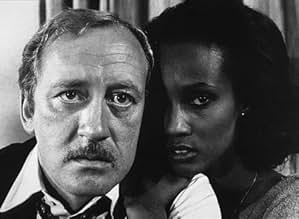
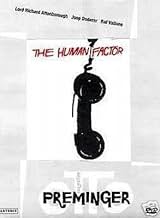
This interesting but low-key movie is a cold thriller plenty of suspense , mystery , plot twists , tension and top cast . The prospect of Tom Stoppard rendition a Graham Greene novel promises more than movie really offers , though darkly ironic tale of Foreign Office treason still throws up delights and twisted surprises . The casting is first-rate with a top-notch star-studded , including script by prestigious Tom Stoppard , though results are average. As the bulk of the formidable cast is pleasantly familiar in this engaging if slow-moving drama , including the following ones : Richard Attenborough , John Gielgud , Derek Jacobi , Robert Morley, Ann Todd , Richard Vernon , Tony Vogel , Fiona Fullerton, Adrienne Corri , Martin Benson . And no fault of the always splendid Nicol Williamson as a British double agent who is forced to defect to Russia , though he's billed eight in order alphabetic , but quite clearly has the central part , and surprisingly the gorgeous model Iman , David Bowie's wife, resulting to be an acting discovery by providing an nice performance.
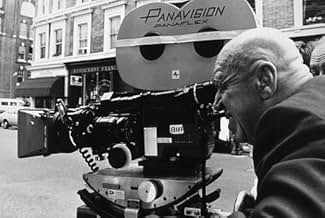
Based on the novel by Graham Greene , almost all of his novels and five plays -including "Brighton Rock", "The Ministry of Fear" and "The End of the Affair"- , have been brought to the screen. A superb storyteller, he also wrote the screenplays for such classics as The fallen idol (1948) and The Third Man (1949). The flick belongs to spies sub-genre developed during ¨Cold war¨ and its maxim representations are John LeCarre's novels rendered to cinema in movies as ¨The spy who came in from cold¨ (by Martin Ritt with Richard Burton) , ¨The Kremlin Letter¨(John Huston with Nigel Green) and ¨Russia House¨(Fred Schepisi with Sean Connery) , these films get similar atmosphere and twisted intrigues about spies among East and west World but with no relation to spies from James Bond novels by Ian Fleming . The motion picture was professionally directed by Otto Preminger. His direction tends to to lack passion , robbing what what should be a thrilling story of some of the human factor of the title . The great filmmaker Otto Preminger made several successful and classic movies , such as : ¨Fallen Angel , Daisy Kenyon, Forever amber , Whirlpool, Angel face, The moon is blue, Carmen Jones , Court martial of Billy Mitchell, The man with the golden arm , Saint Joan, Bonjour Tristesse , Exodus , The cardinal, Advise and consent, Hurry sundown , Bunny Lake is missing , In harm's way¨, and this ¨The human factor¨ : Preminger's final film . Rating 6/10 . Watchable spy drama , but neither extraordinary , nor notable , but acceptable and passable . The story will appeal to suspense movies fans and people with adquired tastes .
This interesting but low-key movie is a cold thriller plenty of suspense , mystery , plot twists , tension and top cast . The prospect of Tom Stoppard rendition a Graham Greene novel promises more than movie really offers , though darkly ironic tale of Foreign Office treason still throws up delights and twisted surprises . The casting is first-rate with a top-notch star-studded , including script by prestigious Tom Stoppard , though results are average. As the bulk of the formidable cast is pleasantly familiar in this engaging if slow-moving drama , including the following ones : Richard Attenborough , John Gielgud , Derek Jacobi , Robert Morley, Ann Todd , Richard Vernon , Tony Vogel , Fiona Fullerton, Adrienne Corri , Martin Benson . And no fault of the always splendid Nicol Williamson as a British double agent who is forced to defect to Russia , though he's billed eight in order alphabetic , but quite clearly has the central part , and surprisingly the gorgeous model Iman , David Bowie's wife, resulting to be an acting discovery by providing an nice performance.
Based on the novel by Graham Greene , almost all of his novels and five plays -including "Brighton Rock", "The Ministry of Fear" and "The End of the Affair"- , have been brought to the screen. A superb storyteller, he also wrote the screenplays for such classics as The fallen idol (1948) and The Third Man (1949). The flick belongs to spies sub-genre developed during ¨Cold war¨ and its maxim representations are John LeCarre's novels rendered to cinema in movies as ¨The spy who came in from cold¨ (by Martin Ritt with Richard Burton) , ¨The Kremlin Letter¨(John Huston with Nigel Green) and ¨Russia House¨(Fred Schepisi with Sean Connery) , these films get similar atmosphere and twisted intrigues about spies among East and west World but with no relation to spies from James Bond novels by Ian Fleming . The motion picture was professionally directed by Otto Preminger. His direction tends to to lack passion , robbing what what should be a thrilling story of some of the human factor of the title . The great filmmaker Otto Preminger made several successful and classic movies , such as : ¨Fallen Angel , Daisy Kenyon, Forever amber , Whirlpool, Angel face, The moon is blue, Carmen Jones , Court martial of Billy Mitchell, The man with the golden arm , Saint Joan, Bonjour Tristesse , Exodus , The cardinal, Advise and consent, Hurry sundown , Bunny Lake is missing , In harm's way¨, and this ¨The human factor¨ : Preminger's final film . Rating 6/10 . Watchable spy drama , but neither extraordinary , nor notable , but acceptable and passable . The story will appeal to suspense movies fans and people with adquired tastes .
Unjustly forgotten
After I had read this late Graham Greene novel years ago, I was immediately fascinated by its le Carré-like plot with very much Greene-like characters. I immediately thought that this should have been made into a movie.
Shortly afterwards, I learnt that Preminger had already made it into a film back in 1979, so I was of course very eager to see this movie. Yet - this film has fallen into oblivion, it is not commercially available and it is hardly ever on TV.
Very strange if you consider that it features a cast bristling with splendid British character actors (Nicol Williamson, Derek Jacobi, Robert Morley, Richard Attenborough, to name but a few) and has a screenplay by Tom Stoppard (which IMHO was a straightforward, enjoyable transfer of Greene's novel to the screen).
So, only yesterday did I have the opportunity to watch it on TV. Certainly, it is no cinematographic highlight: it is very low-key, very unfussily directed by Otto Preminger in a more than plain style, and has basically no "action" (but then - what would you expect of a Greene novel?). It might as well have been made for TV, but this impression may also be due to the serious budget problems while filming.
However, it has some splendid performances by actors whom I could watch all day long. The mere cast turns this film into a success and makes it worthwhile watching.
Shortly afterwards, I learnt that Preminger had already made it into a film back in 1979, so I was of course very eager to see this movie. Yet - this film has fallen into oblivion, it is not commercially available and it is hardly ever on TV.
Very strange if you consider that it features a cast bristling with splendid British character actors (Nicol Williamson, Derek Jacobi, Robert Morley, Richard Attenborough, to name but a few) and has a screenplay by Tom Stoppard (which IMHO was a straightforward, enjoyable transfer of Greene's novel to the screen).
So, only yesterday did I have the opportunity to watch it on TV. Certainly, it is no cinematographic highlight: it is very low-key, very unfussily directed by Otto Preminger in a more than plain style, and has basically no "action" (but then - what would you expect of a Greene novel?). It might as well have been made for TV, but this impression may also be due to the serious budget problems while filming.
However, it has some splendid performances by actors whom I could watch all day long. The mere cast turns this film into a success and makes it worthwhile watching.
a little disappointing
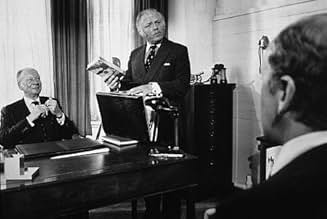
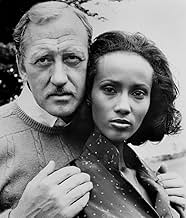
Maurice Castle (Nicol Williamson) is a bland mid-level bureaucrat in British intelligence. The only notable fact about him is his African wife Sarah (Iman). His superiors suspect a leak in the firm and decide to quietly eliminate the mole to avoid any publicity. Castle's office mate Arthur Davis (Derek Jacobi) becomes the main target of investigation.
Otto Preminger directs this realistic espionage thriller from a Graham Greene novel with many veteran British actors. With such great pedigree, I expected a great classic but this is definitely second tier level. It does get better in the second half. The first half is a slow slough. Maurice's blandness works against the film during that first half. In fact, he's a side character in his own movie. The production value is limited. This looks more like a TV movie. Preminger is really struggling even considering the budget. The filming is not imaginative and very static. It's almost a throwback to the early black and white movies. The only salvation is the Graham Greene writing which has a sense of realism which is very intriguing. This is a little disappointing.
Otto Preminger directs this realistic espionage thriller from a Graham Greene novel with many veteran British actors. With such great pedigree, I expected a great classic but this is definitely second tier level. It does get better in the second half. The first half is a slow slough. Maurice's blandness works against the film during that first half. In fact, he's a side character in his own movie. The production value is limited. This looks more like a TV movie. Preminger is really struggling even considering the budget. The filming is not imaginative and very static. It's almost a throwback to the early black and white movies. The only salvation is the Graham Greene writing which has a sense of realism which is very intriguing. This is a little disappointing.


Did you know
- TriviaAuthor Graham Greene said of his novel "The Human Factor" in his 1980 autobiography "Ways of Escape" that it was "to write a novel of espionage free from the conventional violence, which has not, in spite of James Bond, been a feature of the British Secret Service. I wanted to present the Service unromantically as a way of life, men going daily to their offices to earn their pensions."
- GoofsIn the South African scenes (filmed in Kenya), the cars have Kenyan registration plates.
- Quotes
Maurice Castle: [referring to Davis] He calls all children "little bastards".
- How long is The Human Factor?Powered by Alexa
Details
- Release date
- Country of origin
- Official site
- Language
- Also known as
- Der menschliche Faktor
- Filming locations
- Production companies
- See more company credits at IMDbPro
Box office
- Budget
- $5,500,000 (estimated)
- Gross US & Canada
- $376,050
- Gross worldwide
- $376,050
Contribute to this page
Suggest an edit or add missing content