IMDb RATING
6.6/10
1.1K
YOUR RATING
An ex-aristocrat from France and an alcoholic English lawyer find themselves crossing paths and in love with the same woman during the French Revolution.An ex-aristocrat from France and an alcoholic English lawyer find themselves crossing paths and in love with the same woman during the French Revolution.An ex-aristocrat from France and an alcoholic English lawyer find themselves crossing paths and in love with the same woman during the French Revolution.
- Nominated for 1 Primetime Emmy
- 2 nominations total
Valérie de Tilbourg
- Seamstress
- (as Valerie de Tilburg)
- Director
- Writers
- All cast & crew
- Production, box office & more at IMDbPro
6.61.1K
1
2
3
4
5
6
7
8
9
10
Featured reviews
A solid TV adaptation
I wouldn't call it the definitive version nor would I, for every conceivable criticism you could give this film, vote it low for not showing them cutting everyone's hair before beheading them as a previous reviewer did. As far as Dickens adaptations go, this is alright if you need a visualization of the novel. The actors all do good jobs, especially Peter Cushing as Doctor Mannette, Billie Whitelaw as Madame Defarge, and especially Alice Krige as Lucie Mannette, who makes the character feel a little more real than she was in the original novel. In the dual role of Charles Darnay and Sydney Carton, Chris Sarandon does alright. Obviously he has more to work with playing Carton, but I would not call either performance brilliant.
The sets and costumes are good; obviously the production values are not sky high, seeing as this is a TV movie. The lighting is flat and dull, as was per usual in many TV productions during the 1970s and 1980s. The music is passable, but not memorable.
Still, even at over two and a half hours, this film feels rushed. We never as close to the characters as we should be and Sydney's "last dream of my soul" line and most of his final speech being cut are criminal. I think the whole production could have benefited from an extra thirty minutes.
Nothing special, but a nice way to illustrate the novel for an English class or for your own enjoyment. Just don't expect the definitive A Tale of Two Cities adaptation.
The sets and costumes are good; obviously the production values are not sky high, seeing as this is a TV movie. The lighting is flat and dull, as was per usual in many TV productions during the 1970s and 1980s. The music is passable, but not memorable.
Still, even at over two and a half hours, this film feels rushed. We never as close to the characters as we should be and Sydney's "last dream of my soul" line and most of his final speech being cut are criminal. I think the whole production could have benefited from an extra thirty minutes.
Nothing special, but a nice way to illustrate the novel for an English class or for your own enjoyment. Just don't expect the definitive A Tale of Two Cities adaptation.
Really liked it
Profound human love and the most repugnant savagery, horror and redemption, a heroine and a grotesque revenger, two families with dark secrets, two cities, all in the backdrop of the bloodbath that was the French Revelation. In watching it, be prepared for the "Best of Times and the Worst of Times." James Welch Henderson Arkansas 5/17/21.
Convincing and very enjoyable historical fiction
First things first: I have to say I have never read Charles Dicken's book, but after seeing this movie, I'll be stopping by the state library to pick it up. This is a GREAT movie - enjoyable, moving, and historically convincing. (My history teacher made us watch it to see what the French Revolution (especially the Reign of Terror) was like.)
After reuniting with her father, Dr. Manette (they had been separated from each other for many years), Lucie Manette goes back to England, where she meets a handsome stranger, Charles Darnay. Darnay is really Charles Evremonde, a French aristocrat who disdains his vain and arrogant uncle and who runs away from France. They fall in love and marry. But there is an English lawyer, Sydney Carton, who also loves Lucie. When Darnay returns to France to save his servant, he is thrown into prison and besieged by all the foolishness and speculation of the French Revolution. I won't divulge any more of the story to you.but I have to say the ending is really, really great. It's so moving that I can't watch it without crying at least a little. (Yeah, I cried when we were watching it at school, and hopefully no one saw me.)
For others who know the story, I can't tell you if the movie lives up to the book, but I do think the movie is a very convincing depiction of what happened during the French Revolution. Madame DeFarge, one of the `revolutionaries' (ha!), embodies the spirit of the common people during the Revolution. She felt it was absolutely necessary to kill a lot of nobles, even if they were innocent and had done nothing wrong. In the court scenes, we see how unfair the French tribunals are; defendants are barely given the chance to speak and they are convicted on little evidence and a lot of speculation. (The film compares the French court to the English court, which is infinitely more just.) We see the so-called anti-Revolutionaries being marched to the guillotine.it's a very moving moment. The film works very well because it doesn't lose any part of the story or the historical background. They work very nicely together.
To single out someone for acting, I have to commend the talented Chris Sarandon, who played Sydney Carton and Charles Darnay. That must have been really hard to do, especially since Darnay gets everything he wants and Carton doesn't. It's great acting. However, Sarandon manages to stay on course and the results are wonderful. He manages to combine jealousy, love, and strength all in the same gaze.
A WONDERFUL film.it gets your anger going, pulls on your heartstrings, and keeps you perfectly enraptured through the entire running time. I loved this movie. 10/10
After reuniting with her father, Dr. Manette (they had been separated from each other for many years), Lucie Manette goes back to England, where she meets a handsome stranger, Charles Darnay. Darnay is really Charles Evremonde, a French aristocrat who disdains his vain and arrogant uncle and who runs away from France. They fall in love and marry. But there is an English lawyer, Sydney Carton, who also loves Lucie. When Darnay returns to France to save his servant, he is thrown into prison and besieged by all the foolishness and speculation of the French Revolution. I won't divulge any more of the story to you.but I have to say the ending is really, really great. It's so moving that I can't watch it without crying at least a little. (Yeah, I cried when we were watching it at school, and hopefully no one saw me.)
For others who know the story, I can't tell you if the movie lives up to the book, but I do think the movie is a very convincing depiction of what happened during the French Revolution. Madame DeFarge, one of the `revolutionaries' (ha!), embodies the spirit of the common people during the Revolution. She felt it was absolutely necessary to kill a lot of nobles, even if they were innocent and had done nothing wrong. In the court scenes, we see how unfair the French tribunals are; defendants are barely given the chance to speak and they are convicted on little evidence and a lot of speculation. (The film compares the French court to the English court, which is infinitely more just.) We see the so-called anti-Revolutionaries being marched to the guillotine.it's a very moving moment. The film works very well because it doesn't lose any part of the story or the historical background. They work very nicely together.
To single out someone for acting, I have to commend the talented Chris Sarandon, who played Sydney Carton and Charles Darnay. That must have been really hard to do, especially since Darnay gets everything he wants and Carton doesn't. It's great acting. However, Sarandon manages to stay on course and the results are wonderful. He manages to combine jealousy, love, and strength all in the same gaze.
A WONDERFUL film.it gets your anger going, pulls on your heartstrings, and keeps you perfectly enraptured through the entire running time. I loved this movie. 10/10
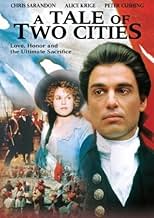
CBS TV rework of a Dickens classic
This CBS TV movie reworking of the Dickens novel certainly has an epic feeling to it and a running time to match. The author's tale of the French Revolution is one of his most dramatic and tragic and certainly this hits the right marks at times, with a real intensity in some of the scenes set in Paris. The cast is obviously wide-ranging and offers a good mix of seasoned old-timers (like Peter Cushing) and fresh new faces, including Chris Sarandon and Alice Krige. It gets a bit plodding during the middle section but there are always performances like Billie Whitelaw's to enjoy, and the ending certainly ties it off nicely.
Excellent Adaptation of Dicken's Classic
I was very impressed with this movie, as it was well told, and didn't go in for melodrama. You can really feel like you're glimpsing actual moments from the past and get swept up in the French Revolution, with sympathy for both sides.
This is not the first time I've appreciated seeing Peter Cushing in a role other than Van Helsing, and in a film other than the horror genre. He did an excellent job here as Dr. Manette , as did Chris Sarandon in the dual role of Charles Darnay and Sidney Carlton.
I was also pleased, as an Agatha Christie fan, to discover that David Suchet (a.k.a. Hercule Poirot) was a part of this movie, too.
This one's a winner, not to be missed.
This is not the first time I've appreciated seeing Peter Cushing in a role other than Van Helsing, and in a film other than the horror genre. He did an excellent job here as Dr. Manette , as did Chris Sarandon in the dual role of Charles Darnay and Sidney Carlton.
I was also pleased, as an Agatha Christie fan, to discover that David Suchet (a.k.a. Hercule Poirot) was a part of this movie, too.
This one's a winner, not to be missed.
Did you know
- TriviaFinal performance of Kenneth More (Dr. Jarvis Lorry).
- Quotes
Sydney Carton: It is a far, far better thing that I do, than I have ever done; it is a far, far better rest that I go to than I have ever known.
- ConnectionsEdited into Hallmark Hall of Fame (1951)
Details
- Release date
- Country of origin
- Official site
- Language
- Also known as
- Hallmark Hall of Fame: A Tale of Two Cities (#30.1)
- Filming locations
- Production companies
- See more company credits at IMDbPro
Contribute to this page
Suggest an edit or add missing content