IMDb RATING
7.5/10
7.2K
YOUR RATING

A young man's personality is shaped, involving some weird happenings around.A young man's personality is shaped, involving some weird happenings around.A young man's personality is shaped, involving some weird happenings around.
- Director
- Writers
- Stars
- Awards
- 9 wins & 1 nomination total


Pavle Vuisic
- Tetak
- (as Pavle Vujisic)
Zivko 'Zika' Ristic
- Cica
- (as Zika Ristic)
- Director
- Writers
- All cast & crew
- Production, box office & more at IMDbPro
7.57.2K
1
2
3
4
5
6
7
8
9
10
Featured reviews
Socialism and rock music
In a style that reminds us of Italian neo-realism of last century forties and fifties, Kusturica gives us in syncopated sequences the story of a not so wealthy family whose head is a die-hard Marxist who still believes that communism will come in 2000 (this movie dates back to 1981). The youngsters of the family, however and like youngsters all over the world, are more inclined to rock music than to communism. The story develops itself in episodes of great realism in terms of images, against the background of socialist Yugoslavia which appears here and there in the speeches of a local official who thinks that juvenile delinquency can be fought by creating a juvenile rock ensemble in a club, in the Marxist talk of the old father and in the efforts he makes to get a house provided by the State to replace the squalid dwelling where the family lives. Ironically this will come only after his death. Behind the apparent simplicity of the story we feel that its characters have deepness of feelings and reactions, being very human. Love is present in its various forms though shown almost bashfully. The love between father and son and the love between the son and the young prostitute for instance. The action takes place in Bosnia but nothing in the movie makes us to surmise the bloodbath that occurred there 20 years after. In conclusion we can say this is a good and well made movie.
Kusturica at his earliest ... and best
Quite simply, this is - together with "When Father Was Away on Business" - Kusturica's best film. Stylistically, the film is quite different from Kusturica's later efforts, starting with "Time of the Gypsies", but this film needs no flashy style to impress you; it is the way Kusturica tells the story and the nature of characters that draws you in instantaneously. A lot of it has to do with the screenwriter Abdulah Sidran who also worked with Kusturica on the follow-up "When Father..." (which, incidentally, deals with the same family), and who more than successfully translated his, Kusturica's and, in a way, Sarajevo's collective past onto a page (Sidran has a book by the same title) and the basis for the film. In many respect, this is the film that introduced Sarajevo and its cultural idiosyncrasies to the rest of then-Yugoslavia and put it on the country's cultural map. As strange as it may sound, before "Dolly Bell" Sarajevo was, culturally and - to some extent - otherwise, the big unknown to the rest of Yugoslavia - 'tamni vilajet', as it was referred to. The film, however, changed all of that. Whatever you may think of Kusturica and his later films, you cannot deny the superbness and extraordinary importance of his early works. See them and enjoy.
10doa2001
Well , it all started back in the '60s when ...
Excellent. One word to describe the hour and a half of a master-piece.I'm not so sure that non-ex-yugoslav audience would use word master-piece but I think we would all agree that we are talking about excellent , marvelous , memorable (and etc) movie.Well , to be honest , I never expected less from Emir Kusturica as a director teamed with Abdulah Sidran (who is a poet) as a screenplay writer , who gave the movie intelligent and funny dialogues (really a lot of quotes to remember) combined with deep and memorable talking about communism brought to the audience trough the words of main character Dino's father (whose occupation is head waiter in the restaurant). But , before everything `Do you remember , Dolly Bell' is a movie who drags you to the past , to the 60s in the Sarajevo , Yugoslavia , making you wish that you were there then , just to feel the life of the previous generations in the communist system in the time of yugoslav `brotherhood and unity'. Except that it is also the movie about life in the tough neighbourhood full of scoundrels of any kind. After all, Dolly Bell is a victim of the one of them , and Dino tryes to rescue her in the name of love what gives the movie romantic note.One more good thing in the movie is guaranteed the music.It's simply marvelously selected so it really gives the right image of the 60s in Sarajevo (of course you ought to know that in the 70s Sarajevo became capital of ex-yugoslav rock n' roll , so in some way movie represents roots of rock n' roll in Yugoslavia). So , what more to say than watch the movie and you'll remember Dolly Bell for the rest of your life.
Coming of age in Sarajevo
Emir Kusturica's first film Do You Remember Dolly Bell? is a bittersweet comedy set in the former Yugoslavia during the 1960s. The film, which won the Golden Lion Prize at the 1981 Venice Film Festival, is both a coming of age story and a tribute to the city of Sarajevo, long before it was devastated by civil war. To the chagrin of his strict Communist father (Slobodan Aligrudic), sixteen-year old Dino (Slavo Stimac) is more into hypnosis and self-help mantras than Marxist ideology. He recites the phrase "Every day in every way I'm getting better and better" and sings in a new band mandated by the local Eastern European bureaucracy as they relax the Communist grip and allow some influence of Western culture.
Dino's family of six live in a cramped one-room house while they wait for state housing. The father drinks excessively and the family is poor. This is underscored when, during a visit to relatives, the youngest boy makes a point of saying how much he wishes he had a bicycle like the one he sees in the relative's home. Through Dino's relationship with Sonny, an unsavory pimp, he meets a cabaret singer and prostitute Dolly Bell (Ljiljana Blagojevic), named after a stripper in an Italian film they had seen recently at the Culture Club. Dolly is forced by Sonny to wait in the attic of Dino's home until he returns and Dino is a passive onlooker as a band of delinquent boys take their turn with her.
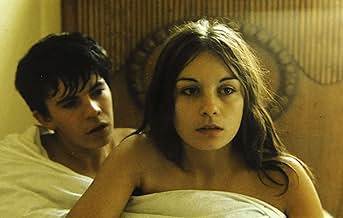
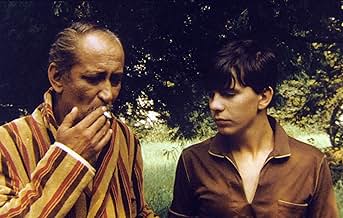
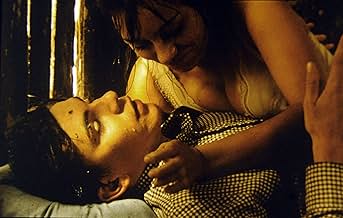
Dino's sweet innocence captivates the young girl, however, and the two form a bond that results in Dino's sexual initiation and first love affair. Dino has to cope with his father's illness, a lung cancer that has become life-threatening and their days together reveal a much mellower man who tells Dino he knew about the girl in the loft and no longer disapproves his using hypnosis and auto-suggestion. While Dolly Bell lacks the polish and cinematic flair of Kusturica's later work, it is an honest and intelligent film, one that avoids sentimentality and provides compelling insight into what it meant to grow up in Eastern Europe during the sixties.
Dino's family of six live in a cramped one-room house while they wait for state housing. The father drinks excessively and the family is poor. This is underscored when, during a visit to relatives, the youngest boy makes a point of saying how much he wishes he had a bicycle like the one he sees in the relative's home. Through Dino's relationship with Sonny, an unsavory pimp, he meets a cabaret singer and prostitute Dolly Bell (Ljiljana Blagojevic), named after a stripper in an Italian film they had seen recently at the Culture Club. Dolly is forced by Sonny to wait in the attic of Dino's home until he returns and Dino is a passive onlooker as a band of delinquent boys take their turn with her.
Dino's sweet innocence captivates the young girl, however, and the two form a bond that results in Dino's sexual initiation and first love affair. Dino has to cope with his father's illness, a lung cancer that has become life-threatening and their days together reveal a much mellower man who tells Dino he knew about the girl in the loft and no longer disapproves his using hypnosis and auto-suggestion. While Dolly Bell lacks the polish and cinematic flair of Kusturica's later work, it is an honest and intelligent film, one that avoids sentimentality and provides compelling insight into what it meant to grow up in Eastern Europe during the sixties.
art outlasts politics
Seeing "Dolly Bell" during the recent war in Kosovo forced me to think of the political significance of the film. Almost twenty years after the film was made, Yugoslavia is an extraordinarily different place, albeit one in which traditions die hard. But whether considered in relation to the Yugoslavia of the early 80s or to today's Serbia, what impresses about "Dolly Bell" is its filmmakers' devotion to art and the human condition rather than to a political agenda. It has not become an artifact because it was made to provoke human sympathy, not political reaction. "Dolly Bell" is not a tragicomic masterpiece like "Underground" nor a celebration of optimism and levity in the face of absurdity and injustice as are "When Father Was Away on Business" and "Time of the Gypsies": it is not Kusturica's most clever film, but it is perhaps his most enduring.


Did you know
- TriviaWinner Best Actor (Slavko Stimac) at 25th Panama International Film Festival.
- ConnectionsFeatured in Maradona by Kusturica (2008)
- Soundtracks24 mila baci
Written by Adriano Celentano, Lucio Fulci, Piero Vivarelli
Performed by Adriano Celentano
[Sung along to by Slavko Stimac]
- How long is Do You Remember Dolly Bell??Powered by Alexa
Details
Contribute to this page
Suggest an edit or add missing content