IMDb RATING
7.5/10
7.2K
YOUR RATING

A young man's personality is shaped, involving some weird happenings around.A young man's personality is shaped, involving some weird happenings around.A young man's personality is shaped, involving some weird happenings around.
- Director
- Writers
- Stars
- Awards
- 9 wins & 1 nomination total
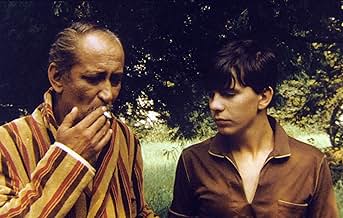


Pavle Vuisic
- Tetak
- (as Pavle Vujisic)
Zivko 'Zika' Ristic
- Cica
- (as Zika Ristic)
- Director
- Writers
- All cast & crew
- Production, box office & more at IMDbPro
7.57.2K
1
2
3
4
5
6
7
8
9
10
Featured reviews
Movie that announced Kusturica's arrival on the European film scene
Post written by a person nicknamed No Gods, perhaps just proves that this movie may not be for consumption by audiences outside of the Balkans. He/she completely missed the point. There's so much more to this movie, watching it was of great joy and delight for me.
It gives an honest, simple and raw account of Sarajevo realities back in the 1960s, when it was an expanding city in Tito's Yugoslavia. 'Dolly Bell' offers many memorable snapshots that it uses as setting: teenagers mimicking Adriano Celentano, audiences watching 'Rome by night', couples with children dreaming of moving into new housing complexes built by the communist government, lunches with extended family members, community center struggling to buy instruments for their band.....etc, etc. And all this while the main character Dino (played by Kusturica's favourite Slavko Stimac) is finding his way through adolescence.
Basically, the movie is Kusturica's and Sidran's love letter to their respective childhoods, which happened to take place during an interesting time in Yugoslav history not too long after World War II when the country was being rebuilt under new social order and a tangible sense of excitement of participating in something good and worthy was felt amongst certain sections of its population.
Kusturica would of course go on to make much more serious and challenging films later in his career, but this one shows his ability to successfully deal with simple stories that are not driven by big, complex ideas and don't have an instantly dramatic setting.
It gives an honest, simple and raw account of Sarajevo realities back in the 1960s, when it was an expanding city in Tito's Yugoslavia. 'Dolly Bell' offers many memorable snapshots that it uses as setting: teenagers mimicking Adriano Celentano, audiences watching 'Rome by night', couples with children dreaming of moving into new housing complexes built by the communist government, lunches with extended family members, community center struggling to buy instruments for their band.....etc, etc. And all this while the main character Dino (played by Kusturica's favourite Slavko Stimac) is finding his way through adolescence.
Basically, the movie is Kusturica's and Sidran's love letter to their respective childhoods, which happened to take place during an interesting time in Yugoslav history not too long after World War II when the country was being rebuilt under new social order and a tangible sense of excitement of participating in something good and worthy was felt amongst certain sections of its population.
Kusturica would of course go on to make much more serious and challenging films later in his career, but this one shows his ability to successfully deal with simple stories that are not driven by big, complex ideas and don't have an instantly dramatic setting.
Unique&excellent...
I've seen this piece very shortly after I've seen Underground(which is my personal no.1). I was prepared for another energy daredevil movie trip into metaphor and symbolism - I was surprised and pleased ... Kusturica has shown ability to produce two absolutely different movies - both superb!
Do you remember Dolly Bell? is funny, sad, romantic, mystic ... and it is real, it is not a movie to go for if you are not in a mood to think and think a lot ... it is a movie about communism and its philosophy as understood by each generation - I've lived those times and I accept: this is not the typical life we lived, but it defines the essence of how we felt and what we did...
Do you remember Dolly Bell? is funny, sad, romantic, mystic ... and it is real, it is not a movie to go for if you are not in a mood to think and think a lot ... it is a movie about communism and its philosophy as understood by each generation - I've lived those times and I accept: this is not the typical life we lived, but it defines the essence of how we felt and what we did...
Where's your Dolly Bell now?
Kusturica's first feature-length film when he was 27, a teenage story in Sarajevo. The growth of a young boy who faces the first experience of sex with Dolly Bell, his odd family members and his band.
The film is typical of Kusturica, full of noisy but cozy music, funny and distinctive characters. And sometimes the bittersweet feeling haunts me quite a long time during the film. I haven't seen a lot of Emir's works, besides this one I have only seen "Black Cat, White Cat", love the satirical comedy style, great way to magnify the neglectable truth of the society.
Hypnosis and Communism, quite different stuff but all some kind of Utopian, I live in a socialistic country and watch a film from Yugoslavia which used to be a socialistic one, but failed. So many similarities can find between peoples, lively and spiritual-satisfied with the situations. We cannot realize Communism by hypnosis, in a real world, that's cruel but true.
Loneliness is always the most severe sickness among people, even this film has so many characters, but still you can smell the loneliness throughout it, it's nothing to do with Communism or Capitolism, the hopelessness is always buried inside deeply in our hearts.
Do you remember Dolly Bell? after watching this movie, I cannot remember her look, just a vague silhouette, because everyone has his or her own image of Dolly Bell, we can say goodbye to our youth thoroughly, thank every Dolly Bell and smile.
The film is typical of Kusturica, full of noisy but cozy music, funny and distinctive characters. And sometimes the bittersweet feeling haunts me quite a long time during the film. I haven't seen a lot of Emir's works, besides this one I have only seen "Black Cat, White Cat", love the satirical comedy style, great way to magnify the neglectable truth of the society.
Hypnosis and Communism, quite different stuff but all some kind of Utopian, I live in a socialistic country and watch a film from Yugoslavia which used to be a socialistic one, but failed. So many similarities can find between peoples, lively and spiritual-satisfied with the situations. We cannot realize Communism by hypnosis, in a real world, that's cruel but true.
Loneliness is always the most severe sickness among people, even this film has so many characters, but still you can smell the loneliness throughout it, it's nothing to do with Communism or Capitolism, the hopelessness is always buried inside deeply in our hearts.
Do you remember Dolly Bell? after watching this movie, I cannot remember her look, just a vague silhouette, because everyone has his or her own image of Dolly Bell, we can say goodbye to our youth thoroughly, thank every Dolly Bell and smile.
The Lost First Time
Kusturica is something of a challenge for me to parse. The experience is a bit troubling because it seems so genuine that we should be ashamed for intruding. He does not seem to accomplish this by ordinary means. Yes, the acting is good, but what works here is something quite a bit deeper than usual.
Instead of the world of the film coming to us, as is usually the case, he inserts the camera in such a way that we – or rather our intent to see – brings it into being. This is an early film, and already he seems to have mastered the art of composition. This has a couple of his trademarked panning sequences that are the most elaborately choreographed I know. But more than that, each scene progresses through what seems to be an ordered diorama of gypsy projection. It is intensely human. I can imagine the filmmaker crying as he blocks the shot and places the actors, lights, camera.
I can imagine him obsessing over how objects and shadows form families that work the way the central family does here. I can see his passion in how he guides the camera in arcs that are unnatural. It is a wonder he continued to make films, such is the obvious cost.
A lost nation. A lost larger family. A lost love. Do we remember? Can you?
Because I encounter young filmmakers, and see their first works, I know it is possible to spring whole into the art, allowing open completion of soul to make up for insufficient craft. As time went on, Emir learned to layer humor and circumstance, to tell a story. But nothing he will do can match this, his first love.
Ted's Evaluation -- 3 of 3: Worth watching.
Instead of the world of the film coming to us, as is usually the case, he inserts the camera in such a way that we – or rather our intent to see – brings it into being. This is an early film, and already he seems to have mastered the art of composition. This has a couple of his trademarked panning sequences that are the most elaborately choreographed I know. But more than that, each scene progresses through what seems to be an ordered diorama of gypsy projection. It is intensely human. I can imagine the filmmaker crying as he blocks the shot and places the actors, lights, camera.
I can imagine him obsessing over how objects and shadows form families that work the way the central family does here. I can see his passion in how he guides the camera in arcs that are unnatural. It is a wonder he continued to make films, such is the obvious cost.
A lost nation. A lost larger family. A lost love. Do we remember? Can you?
Because I encounter young filmmakers, and see their first works, I know it is possible to spring whole into the art, allowing open completion of soul to make up for insufficient craft. As time went on, Emir learned to layer humor and circumstance, to tell a story. But nothing he will do can match this, his first love.
Ted's Evaluation -- 3 of 3: Worth watching.
Kusturica at his earliest ... and best
Quite simply, this is - together with "When Father Was Away on Business" - Kusturica's best film. Stylistically, the film is quite different from Kusturica's later efforts, starting with "Time of the Gypsies", but this film needs no flashy style to impress you; it is the way Kusturica tells the story and the nature of characters that draws you in instantaneously. A lot of it has to do with the screenwriter Abdulah Sidran who also worked with Kusturica on the follow-up "When Father..." (which, incidentally, deals with the same family), and who more than successfully translated his, Kusturica's and, in a way, Sarajevo's collective past onto a page (Sidran has a book by the same title) and the basis for the film. In many respect, this is the film that introduced Sarajevo and its cultural idiosyncrasies to the rest of then-Yugoslavia and put it on the country's cultural map. As strange as it may sound, before "Dolly Bell" Sarajevo was, culturally and - to some extent - otherwise, the big unknown to the rest of Yugoslavia - 'tamni vilajet', as it was referred to. The film, however, changed all of that. Whatever you may think of Kusturica and his later films, you cannot deny the superbness and extraordinary importance of his early works. See them and enjoy.


Did you know
- TriviaWinner Best Actor (Slavko Stimac) at 25th Panama International Film Festival.
- ConnectionsFeatured in Maradona by Kusturica (2008)
- Soundtracks24 mila baci
Written by Adriano Celentano, Lucio Fulci, Piero Vivarelli
Performed by Adriano Celentano
[Sung along to by Slavko Stimac]
- How long is Do You Remember Dolly Bell??Powered by Alexa
Details
Contribute to this page
Suggest an edit or add missing content