
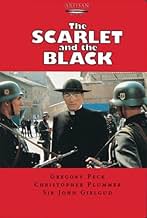
Vatican efforts, led by Monsignor Hugh O'Flaherty, to save Allied P.O.W.s and downed Allied airmen as the Nazis invade Rome.Vatican efforts, led by Monsignor Hugh O'Flaherty, to save Allied P.O.W.s and downed Allied airmen as the Nazis invade Rome.Vatican efforts, led by Monsignor Hugh O'Flaherty, to save Allied P.O.W.s and downed Allied airmen as the Nazis invade Rome.
- Director
- Writers
- Stars
- Won 1 Primetime Emmy
- 1 win & 2 nominations total


- Pope Pius XII
- (as Sir John Gielgud)


- Capt. Hirsch
- (as Ken Colley)


- Director
- Writers
- All cast & crew
- Production, box office & more at IMDbPro
Featured reviews
Inspiring true-life adventure
This is the true story of a man whose conscience will not let him stand by while the world goes to hell around him. Gregory Peck plays an O'Flaherty whose quaint 'Oirish' charm hides a cunning and resourceful leader who has to balance the demands of his conscience with his role as an official in the Vatican government.
Pope Pius makes it clear he understands O'Flaherty's motivation while warning him that if he is arrested, the Pope will not compromise Vatican neutrality to save him. The film does its best to restore Pius XII's reputation - he has been called "Hitler's Pope" - but it is unclear how much he knew of, or even condoned, O'Flaherty's activities. O'Flaherty cannot compromise, and continues with his work despite the Gestapo having orders to shoot him on sight if he is found outside the Vatican, and suffering a failed assassination attempt in St Peter's itself.
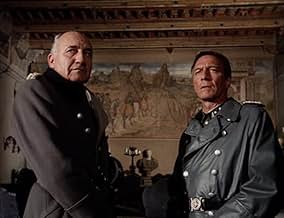
Christopher Plummer is always worth watching and his performance here is no exception. Shown first as an arrogant man who feels the Nazis now "own Rome... it's ours", we later see that Kappler is at the mercy of this ruthless regime even as he plays his part in it. Finally the only person he can turn to is his arch-enemy from the Vatican. This is a fairly conventional irony, but during the course of the film Plummer also suggests how Kappler is losing his soul to his inhuman work, becoming isolated from his family as he begins to loathe what he is doing. You feel Kappler hates O'Flaherty not simply because of what he does, but because O'Flaherty represents the better part of himself.
I would give the film more stars but it is about 15 minutes too long and becomes rather episodic towards the end. However, it's a great story, well-acted by a strong cast, and can be viewed and enjoyed many times.
So potent a film on the day John Paul 11 is buried!
There is talk today of making John Paul 11 a Saint. Surely somebody at the Vatican will remember this humble Monsignor who did (at the time) more to help mankind than anyone is such horrific circumstances. When I can afford it, I will visit this man's grave and say a silent prayer. I don't want a TV film crew there, but I want to say "Thank You" to a man who gave his all to save the free world! A certain telephone company ran a series of advertisements many years ago, asking who in History would you most like to talk to. For me... it would be Mons. Hugh O'Flaherty. At the moment in time, only this film, an area of trees and a gravestone honour this man. Surely he deserves more? An outstanding film, well cast, excellently photographed. Tension, intrigue, drama, even humour (dressing up as a Nun?) I say everyone should view this film. An inspiring, true life film.
The Scarlett Pimpernel of the Vatican
The book is entitled "The Scarlet Pimpernel of the Vatican," by J. P. Gallagher. It is the story of Irish Monsignor Hugh O'Flaherty who was a minor Vatican official during World War II. Right under the noses of Vatican officials who looked the other way, and the German army, he helped smuggle allied soldiers out of Rome to safety in the months before the liberation of Rome. Rome and the Vatican were supposed to be neutral; if the Germans found out that the monsignor was helping the allies, who knows what would have happened.
I was able to find a copy of the book several years ago but have lost it. I do recall though that it had even more incredible stories about how O'Flaherty helped allied soldiers. One of the best (that is not in the movie) was about one American soldier whose appendix burst and he needed it removed. O'Flaherty dressed him as a German soldier, called the German army, they came and took him to their hospital - and O'Flaherty managed to get the soldier out before he even woke up because of the general confusion in the military hospital.
The Scarlett Pimpernel reference, is of course, to the British spy who helped save people from being beheaded during the French Revolution. That's another good book and the movie, with Anthony Andrews and Jane Seymour, are both excellent (though the movie changed the ending...).
Intriguing true story; inspirational and well acted.
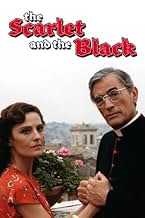
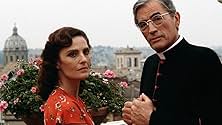
young couple in the Scarlet and the Black


Did you know
- TriviaWhile serving his sentence in prison, Herbert Kappler divorced his first wife and married his nurse, Anneliese, in 1972. In 1975, he was diagnosed with cancer. As the authorities refused to release him, in 1977, Anneliese carried Kappler out of prison in a large suitcase (he weighed less than one hundred five pounds at the time). They escaped to West Germany, where Kappler died six months later.
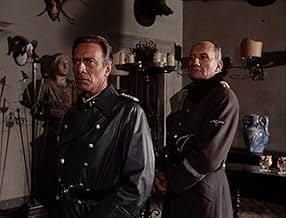
- GoofsIn at least four scenes, Herbert Kappler wears a black SS parade tunic instead of his usual office gray uniform. By 1943, when the film is set, the SS had completely phased the black SS tunic out of service and this uniform would not have been worn at even the most formal of functions.
- Quotes
Col. Herbert Kappler: You're alone?
Monsignor Hugh O'Flaherty: I am.
Col. Herbert Kappler: Not afraid I'll shoot you?
Monsignor Hugh O'Flaherty: No. If you were going to kill me, your man would have already done it in my room.
Col. Herbert Kappler: That is so.
[pause]
Col. Herbert Kappler: But believe me, at this moment, nothing would give me greater pleasure.
Monsignor Hugh O'Flaherty: Well, when it comes down to it, a bullet's your answer to just about everything, isn't it? The only argument you've got.
- Alternate versionsAn edited version of approximately 110 minutes (120 minutes when broadcast with adverts) is sometimes shown on TV in the UK.
- ConnectionsReferences Massacre in Rome (1973)
- SoundtracksLa Boheme
Composed by Giacomo Puccini