

Based on the true story of a transatlantic business correspondence about used books, which later developed into a close, long-distance friendship that evolved over the course of two decades.Based on the true story of a transatlantic business correspondence about used books, which later developed into a close, long-distance friendship that evolved over the course of two decades.Based on the true story of a transatlantic business correspondence about used books, which later developed into a close, long-distance friendship that evolved over the course of two decades.
- Director
- Writers
- Stars
- Won 1 BAFTA Award
- 3 wins & 3 nominations total





- Director
- Writers
- All cast & crew
- Production, box office & more at IMDbPro
Featured reviews
My favourite film
I love the film, and advise those who love it as well that they SHOULD read the book too... and also read The Duchess of Bloomsbury Street, and find out what happened when Helene went to England after all those years.
And don't stop there... look up the Oxford Book of English Prose and the Oxford Book of English Verse (http://www.bartleby.com/101/), edited by the venerable Q (Sir Arthur Quiller-Couch), and see what inspired Helene to begin the correspondence in the first place (basically she decided to read everything Q mentioned, "unless it's fiction.")
A poignant and well-crafted story of long-distance friendship.
A Quiet Gem
Letter-writing, unfortunately, is a lost art. As convenient as Email is, it's not quite the same as a good, old-fashioned letter. This movie reminded me of that and of the 17-year correspondence I shared with my best friend (he has since died). I'm told I have a talent for letter-writing and I have 2 friends with whom I share this talent. I used to think those friends should get a computer but now I see I was wrong. Email is expedient but letter-writing is so much more long-lasting.
One of the reasons I stayed with the picture was one scene: Helene goes to the movies (remember, this was 1950) and what are they playing? My all-time favorite movie, "Brief Encounter." I couldn't turn away after that and I'm glad I stayed with it. This is one movie I definitely will add to my DVD and/or VHS collection. It's a keeper for sure.
A love story, but not the way you're thinking
Hopkins has an amazing moment when Helene has to cancel her trip to London due to some much-needed dental work. His face shows so many things, all at once, that it really is beautiful and breaks my heart, no matter how often I see it.
For Oscar fans - this movie has four winners - Bancroft, Hopkins, Mercedes Ruehl and Judi Dench.
I am grateful that this movie got made with such care and humanity.
The Most Charming Film for Bibliophiles, Readers and Book Collectors
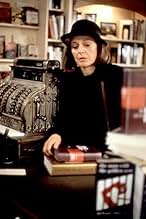
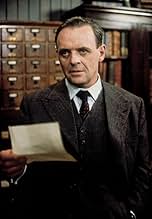
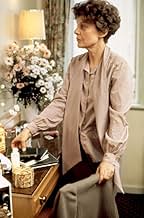
Anne Bancroft (who played Mrs Robinson in "the Graduate") is a writer habituating the exciting world of the New York scene. To quench her ever-present thirst for reading, she decides she wants to acquire books of an "antiquarian" nature, fine editions which have a bit more elegance than cheap mass-market editions. She also wants to read books of classic English literature rather than simply the latest NY Times Bestseller. She visits her local second-hand bookshops in New York, and none of the proprietors carry the books she seeks because, she is told, they do not have enough demand among NY book buyers. She then hears about a rare and second-hand book firm in London on Charing Cross Road and writes them, hoping they might have the kinds of books she seeks. One of the main purveyors, although not one of the owners of the firm, is Frank Doel, played with an understated civility by the incredible Anthony Hopkins.
Thus begins a correspondence between a humble book firm in London and an informal "client" in New York. As the correspondence progresses, she begins to learn more about and understand better the people whose livelihoods center around books. The scenes are mainly split between the contemplative world of the London bookshop and the loud and raucous city that is New York. Even the interactions between characters on each side are quite different. Helene the American is often smoking and boozing with friends while those at the shop quietly but seriously go about their business.
Helene the American and Frank the Brit correspond in English, but almost immediately we sense the wide difference in their respective letter-writing styles, their palette of colors quite diverse. The American is direct, blunt, and easily conveys her frustration if a book arrives which does not please her. On the other hand, the Englishman Doel writes in an overtly congenial tone, very low-key and almost formal, and courteous to the point of near-humility. He is never upset or put-off at the occasional brashness of his counterpart's letters but always attempts to make things right if his client is not entirely pleased with her purchase.
Then, in an interesting turn, Helene learns of the food rationing that is occurring in Britain largely as a result of the war. She resolves to help the struggling employees of the book through a black market coming out of Denmark. The employees become elated when a special package arrives for them. As a result, Helene and Frank become close in ways almost like a reader and a book, their images and understandings of each other only through words on paper, never through voices or body language. However, although they learn much about each other's lives throughout the correspondence, they never meet, but only can imagine each other's worlds.
"84 Charing Cross Road" is almost like a play with the correspondence, often spoken in voice-over, as the driving catalyst of the story. The piece is more a character study of the participants rather than having a real plot. But it is one of the few films I know of which celebrates the world of antiquarian booksellers and their prospective book buyers. Unfortunately, since the rise of the internet and the struggling economies in both America and Europe, the presence of second-hand and antiquarian bookshops have been markedly reduced in many urban areas. Charing Cross Road which used to boast many booksellers now has only a handful, which is strangely predicted by the film at the end.


Did you know
- TriviaMel Brooks bought Anne Bancroft the rights to the book "84 Charing Cross Road" for her birthday one year. They were husband and wife from 1964 to her death in 2005.
- GoofsHelene says that she wishes Geoffrey Chaucer had kept a diary of his time in the court of Richard III. Chaucer served Edward III and Richard II, more than 150 years before the reign of Richard III.
- Quotes
Helene Hanff: [reading from John Donne's "Meditations"] "All mankind is... one volume; when one man dies, one Chapter is not torn out of the book, but translated into a better language; and every Chapter must be so translated; God employs several translators; some pieces are translated by age, some by sickness, some by war, some by justice; but God's hand... shall bind up all our scattered leaves again, for that Library where every book shall lie open to one another."
- Crazy creditsThe production teams in New York and London were almost completely separate, and the closing credits reflect this: in front of a split screen showing Helene in New York and Frank in London, the crews for the two cities scroll side by side. In most cases the same jobs are shown in both columns, and the job titles are then shown in the center.
- SoundtracksFor unto us a child is born, Messiah HWV.56, act 3, No.12
Composed by George Frideric Handel
- How long is 84 Charing Cross Road?Powered by Alexa
Details
- Release date
- Countries of origin
- Language
- Also known as
- Zwischen den Zeilen
- Filming locations
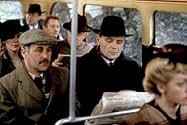
- Glynde Place, Glynde, East Sussex, England, UK(Frank takes a bus out into the country looking for books)
- Production companies
- See more company credits at IMDbPro
Box office
- Gross US & Canada
- $1,083,486
- Opening weekend US & Canada
- $24,350
- Feb 16, 1987
- Gross worldwide
- $1,083,486