IMDb RATING
6.8/10
2.6K
YOUR RATING

Playboy Hamlet sees the ghost of his father, a paper baron in today's Finland.Playboy Hamlet sees the ghost of his father, a paper baron in today's Finland.Playboy Hamlet sees the ghost of his father, a paper baron in today's Finland.
- Director
- Writers
- Stars
- Awards
- 1 win total

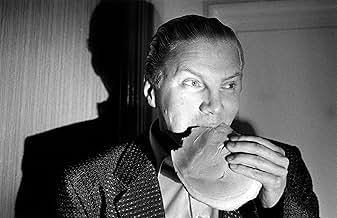
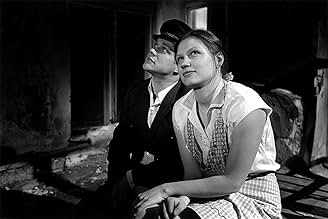


Puntti Valtonen
- Simo
- (as Hannu Valtonen)


- Director
- Writers
- All cast & crew
- Production, box office & more at IMDbPro
6.82.6K
1
2
3
4
5
6
7
8
9
10
Featured reviews
No famous soliloquy here
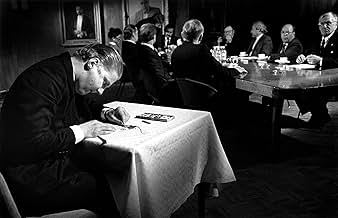
What are you left with if you take most of the psychological motivations away from characters, and turn a story into a social tract? Shakespeare lovers and those who persist on "character development" better beware, as Kaurismaki (in my fourth incursion into his cinema) transforms the Danish prince into a horny, ruthless and spoiled rich heir, who writes bad poetry, is worried about his weight and has a terrible secret. I admit I don't like William Shakespeare much --I believe he's overrated-- so I rather enjoyed Kaurismaki's "irreverence". It is a hint that he does not even give credit to Shakespeare: this story has been told since late 12th century and apparently Thomas Kyd wrote a "Hamlet", before Shakespeare. Kaurismaki is more interested in speculating what may happen to a family like Hamlet's in contemporary settings that seem peculiarly outdated. The first 70 minutes tell the story we know, with a few licenses that in most cases are funny, or simply reveal how the rich and powerful take ruthless decisions without considering their effects on the people they rule. Kaurismaki builds scenes and sequences using resolute ellipsis, a fixed camera, and alienating and ironic music commentaries. Scenes are often resolved in a single take, and to the point (for example, the only time he sees the ghost of his father, Hamlet asks him to talk fast because he does not want to miss dinner, and Kaurismaki cuts to another scene; also there is no famous soliloquy), which made my somewhat uneasy viewing a fast experience. In an aftermath we have never heard of before, Kaurismaki grabbed my full attention, up to his sarcastic end credits against a montage of a factory while a trite tune of hope fills the soundtrack. I found it far more interesting than Brannagh's and Zeffirelli's films.
Shakespeare's classic play adapted as an utterly deadpan comedy in the business world of 20th-century Finland
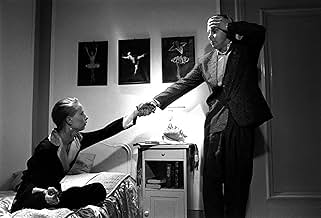
Released in 1987 and therefore a fairly early effort by Aki Kaurismäki, HAMLET LIIKEMAAILMASSA ("Hamlet Goes Business") is the Finnish auteur's idiosyncratic adaptation of Shakespeare's classic play. Kaurismäki sets the drama in the corporate world of 20th-century Finland: a business magnate (Pentti Auer) is murdered by his wife Gertrud (Elina Salo) and brother Klaus (Esko Salminen) so that they can marry and take over the group of companies. The deceased's son Hamlet (Pirkka-Pekka Petelius), depicted here as something of a dim-witted manchild, discovers the dark secret of his murder and moves towards revenge. At the same time, he maintains a curious love affair with Ofelia (Kati Outinen), daughter of a high-ranking employee, and also scrapes with other characters drawn ultimately from Shakespeare's play.
All of the main scenes from Shakespeare's play are present here, though sometimes (like the murder of Polonius) they don't make much sense in the context of the adaptation and are shown briefly to simply telegraph them. The dialogue is mainly original, though at times it switches into the traditional Finnish translation of Shakespeare's Elizabethan English to deliberately bizarre effect. There is however a laugh-out-loud twist ending going beyond the Shakespearean source material, which turns the film into a commentary on Finnish politics and labor relations.
All of Kaurismäki's films are dark comedies, though with humor so deadpan it is sometimes easy for an audience to miss it entirely. Riffing on the image of the Finnish people as taciturn and emotionless, Kaurismäki's actors are directed to state their lines in a very dry, robotic fashion. The death of Ophelia, a tragedy for the ages, is depicted here in a humorous way entirely due to Kati Outinen's deft facial expression and an unusual prop I won't spoil here. Kaurismäki's love of early rock 'n' roll and blues is present in all of his movies, and you can also expect to see a jukebox kicked into life here and a band performing on stage at some point.
While I am a fan of Kaurismäki and have seen nearly all of his many films, I don't think this is one of his major efforts. The black and white photography is a weak point. Kaurismäki loves utterly drab scenery and it is a big part of his aesthetic, but paradoxically color is necessary to bring this drabness across. It also feels like this is just one more adaptation of Hamlet, even if it's an unusual one, and none of the characters are as readily likable as in Kaurismäki's own original work. Most audiences will find his preceding effort VARJOJA PARATIISISSA (Shadows in Paradise) or his following film ARIEL to be more charming and visually seductive.
All of the main scenes from Shakespeare's play are present here, though sometimes (like the murder of Polonius) they don't make much sense in the context of the adaptation and are shown briefly to simply telegraph them. The dialogue is mainly original, though at times it switches into the traditional Finnish translation of Shakespeare's Elizabethan English to deliberately bizarre effect. There is however a laugh-out-loud twist ending going beyond the Shakespearean source material, which turns the film into a commentary on Finnish politics and labor relations.
All of Kaurismäki's films are dark comedies, though with humor so deadpan it is sometimes easy for an audience to miss it entirely. Riffing on the image of the Finnish people as taciturn and emotionless, Kaurismäki's actors are directed to state their lines in a very dry, robotic fashion. The death of Ophelia, a tragedy for the ages, is depicted here in a humorous way entirely due to Kati Outinen's deft facial expression and an unusual prop I won't spoil here. Kaurismäki's love of early rock 'n' roll and blues is present in all of his movies, and you can also expect to see a jukebox kicked into life here and a band performing on stage at some point.
While I am a fan of Kaurismäki and have seen nearly all of his many films, I don't think this is one of his major efforts. The black and white photography is a weak point. Kaurismäki loves utterly drab scenery and it is a big part of his aesthetic, but paradoxically color is necessary to bring this drabness across. It also feels like this is just one more adaptation of Hamlet, even if it's an unusual one, and none of the characters are as readily likable as in Kaurismäki's own original work. Most audiences will find his preceding effort VARJOJA PARATIISISSA (Shadows in Paradise) or his following film ARIEL to be more charming and visually seductive.
'Hamlet' as a deadpan comedy.
The plot of "Hamlet" transferred to contemporary Finland then filmed in the style of a forties film noir with its tongue lodged firmly in its cheek. Aki Kaurismaki's "Hamlet Goes Business" is yet another of his many multifaceted treats exploring in large part the bizarre relationships between men and women only this time fleshing it out with yet another cod-thriller plot. So what if it steals from Shakespeare, (I can think of no better man), and at least this one clocks in at under ninety minutes rather than four hours. Good fun even if it lacks the emotional density we associate with the very best of its director.
Best version of Hamlet I've seen
Like I wrote before reviewing Drifting Clouds, the actors in Kaurismäki's movies are very stiff. There's basically no emotion in the acting comparing to Hollywood movies. During Drifting Clouds I wasn't a big fan of that style, but it suits Hamlet Goes Business. It gives a certain contrast to the somewhat theatrical dialogue and the fact that this is based on a play.
Also I was surprised to see how good Pirkka-Pekka Petelius was as Hamlet. He's mostly famous for being a comedian in many sketch shows, and this is honestly the first serious role I've seen him play. Of course this is a black comedy, a spoof of Hamlet, so the role is still not entirely serious.
While I love most things about this movie, it's that ending that kind of bothers me. After seeing this film several times I'm already used to it, but it still feels very separate from the rest of the movie. It's added by Kaurismäki, which might explain that. I could go into lengths what bothers me about this, but I'd rather not make this review sound exactly like the analysis we did in class, and also I don't want to spoil you.
The music chosen for this movie is amazing. The classical music and rock music go very well together. Most of the time there's a great harmony with what we see and what we hear, but even when there's not, it' amazing. And oh, the cinematography... Weird angles and crooked shots are so great. And of course the whole movie being in black and white amplifies the whole feeling. With colours, it wouldn't be the same film.
Hamlet Goes Business is an amazing take on Hamlet, and a great satire on business world. While it's clear I will not like all of Kaurismäki's movies, I can appreciate his work and I'm glad I've found a favourite
Also I was surprised to see how good Pirkka-Pekka Petelius was as Hamlet. He's mostly famous for being a comedian in many sketch shows, and this is honestly the first serious role I've seen him play. Of course this is a black comedy, a spoof of Hamlet, so the role is still not entirely serious.
While I love most things about this movie, it's that ending that kind of bothers me. After seeing this film several times I'm already used to it, but it still feels very separate from the rest of the movie. It's added by Kaurismäki, which might explain that. I could go into lengths what bothers me about this, but I'd rather not make this review sound exactly like the analysis we did in class, and also I don't want to spoil you.
The music chosen for this movie is amazing. The classical music and rock music go very well together. Most of the time there's a great harmony with what we see and what we hear, but even when there's not, it' amazing. And oh, the cinematography... Weird angles and crooked shots are so great. And of course the whole movie being in black and white amplifies the whole feeling. With colours, it wouldn't be the same film.
Hamlet Goes Business is an amazing take on Hamlet, and a great satire on business world. While it's clear I will not like all of Kaurismäki's movies, I can appreciate his work and I'm glad I've found a favourite
A different and intriguing take on Shakespeare's tragedy.
It's not that easy to make a Shakespeare adaptation set in our time. There have been successful attempts, such as Baz Luhrmann's Romeo & Juliet, but most modern-day versions of the bard's plays are doomed to oblivion. That's not the case of Hamlet Goes Business, Aki Kaurismäki's film noir take on the classic.
Actually, it's more of a black comedy, similarly to Calamari Union (coincidentally, or maybe not, both films were shot in black and white), Kaurismäki's satire on Finnish lowlife. This time, the target is the big industry, within which Hamlet (Pirkka-Pekka Petelius, who also played one of the Franks in Calamari Union) is raised a spoiled brat, spending his days doing mostly nothing, bar flirt with Ofelia (Kati Outinen), whose father (Esko Nikkari) is an important business associate of Hamlet's dad. Then suddenly the situation changes, as the old man is found dead and his brother, Klaus (Esko Salminen) takes over everything, including the marital duties with Hamlet's mother (Elina Salo). Our grief-struck hero is subsequently forced into action after discovering Klaus isn't that innocent: he poisoned his own brother. Hence the inevitable questions: what should Hamlet do? Leave the murderer alone or avenge his father's assassination? In short, to be or not to be?
Ironically, we never hear the protagonist say those words, or the rest of the soliloquy, for that matter. Kaurismäki cut the entire speech because according to him it was ridiculous, useless and distracting, a waste of time: Hamlet would be too busy to start reflecting on life's meaning.
Apart from that (and a few tweaks at the end), Hamlet Goes Business follows Shakespeare's text very closely, albeit with the satirical tone. In fact, the movie's sole weakness is the fact that it gets a little too overblown and surreal come the conclusion, with set-pieces that are funny, yes, but slightly inappropriate in this kind of film.
That said, the film is worth a viewing, if you're open-minded enough. If not, stick with Laurence Olivier or Kenneth Branagh: at least you'll get to hear the famous soliloquy.
Actually, it's more of a black comedy, similarly to Calamari Union (coincidentally, or maybe not, both films were shot in black and white), Kaurismäki's satire on Finnish lowlife. This time, the target is the big industry, within which Hamlet (Pirkka-Pekka Petelius, who also played one of the Franks in Calamari Union) is raised a spoiled brat, spending his days doing mostly nothing, bar flirt with Ofelia (Kati Outinen), whose father (Esko Nikkari) is an important business associate of Hamlet's dad. Then suddenly the situation changes, as the old man is found dead and his brother, Klaus (Esko Salminen) takes over everything, including the marital duties with Hamlet's mother (Elina Salo). Our grief-struck hero is subsequently forced into action after discovering Klaus isn't that innocent: he poisoned his own brother. Hence the inevitable questions: what should Hamlet do? Leave the murderer alone or avenge his father's assassination? In short, to be or not to be?
Ironically, we never hear the protagonist say those words, or the rest of the soliloquy, for that matter. Kaurismäki cut the entire speech because according to him it was ridiculous, useless and distracting, a waste of time: Hamlet would be too busy to start reflecting on life's meaning.
Apart from that (and a few tweaks at the end), Hamlet Goes Business follows Shakespeare's text very closely, albeit with the satirical tone. In fact, the movie's sole weakness is the fact that it gets a little too overblown and surreal come the conclusion, with set-pieces that are funny, yes, but slightly inappropriate in this kind of film.
That said, the film is worth a viewing, if you're open-minded enough. If not, stick with Laurence Olivier or Kenneth Branagh: at least you'll get to hear the famous soliloquy.


Did you know
- TriviaThe script was written in a very loose form and according to Aki Kaurismäki he only read Hamlet on the very week he wrote the script just a couple of weeks before filming.
- Quotes
Gertrud: [Hamlet is discussing with his mother] What I am going to say now is not just a whim. You'll understand if you just want to. I loved your father as much as you can demand a good wife to love a tyrant who never returns love, giving you as much passion as he gives to the winter tires of his car.
Hamlet: I ask you not to tarnish my father's memory.
Gertrud: I've been silent too long to gloss over the facts.
Gertrud: Then get to the point.
Gertrud: I'm going to marry Klaus. I love him.
- ConnectionsEdited from Melrose: Rich Little Bitch (1987)
- SoundtracksSymphony No. 11 in G minor, Op. 103
Composed by Dmitri Shostakovich
Details
- Release date
- Country of origin
- Language
- Also known as
- Hamlet ulazi u posao
- Filming locations
- Abrahaminkatu 1-5, Helsinki, Finland(former University of Technology)
- Production company
- See more company credits at IMDbPro
- Runtime
- 1h 29m(89 min)
- Color
- Sound mix
- Aspect ratio
- 1.85 : 1
Contribute to this page
Suggest an edit or add missing content