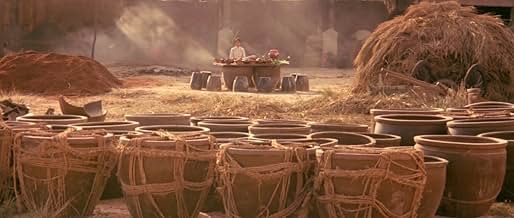
When a leprous winery owner in 1930s China dies a few days after his arranged marriage, his young widow is forced to run the winery to make a living while contending with bandits, her drunka... Read allWhen a leprous winery owner in 1930s China dies a few days after his arranged marriage, his young widow is forced to run the winery to make a living while contending with bandits, her drunkard lover, and the invading Japanese army.When a leprous winery owner in 1930s China dies a few days after his arranged marriage, his young widow is forced to run the winery to make a living while contending with bandits, her drunkard lover, and the invading Japanese army.
- Awards
- 17 wins & 7 nominations total
Rujun Teng
- Wo Luohan Yeye (Uncle Luohan)
- (as Rujun Ten)
- Director
- Writers
- All cast & crew
- Production, box office & more at IMDbPro
7.310.5K
1
2
3
4
5
6
7
8
9
10
Featured reviews
more colorful than the title suggests
The much heralded renaissance of New Chinese Cinema can be an acquired taste to many Western filmgoers, but this handsome period piece (directed by the cinematographer of 'Yellow Earth', 1984) is livelier and more accessible than most. Part folk tale, part historical drama, it tells the story of a young virgin (sold by her father into marriage with a wealthy leper, in return for a mule), who after her husband's mysterious death continues to run his successful vineyard, with help from her loyal wedding bearers. And yet for all its undeniable physical beauty and colorful action the film can be a dry experience, at least until the outbreak of the second Sino-Japanese War in the 1930s. With the Japanese occupation some emotional urgency finally breaks through the film's mantle of reserve, which up to that point had marked even the more bawdy episodes of communal singing and drinking.
The debut film of a talented but still learning director
"Red Sorghum" (1988) is the first film in a trilogy, further comprising "Ju Dou" (1990) and "Raise the red lantern" (1991). In the Netherlands the film was released after the success of the latter two.
The trilogy has coherence both with regard to the themes and the style. In all three films a young woman is married with a much older man, giving rise of course to the temptation of adultery. All three films use bright colors, in particular red. In two of them the color red is also used in the title, in "Ju Dou" the bright colors are due to the fact that the film is situated in a wool dyeing factory.
"Red Sorghum" was Zhang Yimou's debut film and (thus) also his first co-operation with lead actress Gong Li. Some lack of routine is visible by both, for example in the mixing up of genre conventions of relationship drama, Western and war movie. The last element is probably added to please the Chinese censor. In later films Zhang Yimou turned out to be more brave in this resect.
The official (old) husband of lead actress Gong Li dies early in the movie (under suspect circumstances), and she inherits his distillery. In the rest of the movie Gong Li has a relationship with two men. One is physically attractive, impulsive, showing up only now and then and the father of her child. To the other she can talk, he is toughtful, ever present and is helping to raise her child. The lead character gives the impression that she doesn't mind this division of labor, proving her to be an independent and strong woman.
The trilogy has coherence both with regard to the themes and the style. In all three films a young woman is married with a much older man, giving rise of course to the temptation of adultery. All three films use bright colors, in particular red. In two of them the color red is also used in the title, in "Ju Dou" the bright colors are due to the fact that the film is situated in a wool dyeing factory.
"Red Sorghum" was Zhang Yimou's debut film and (thus) also his first co-operation with lead actress Gong Li. Some lack of routine is visible by both, for example in the mixing up of genre conventions of relationship drama, Western and war movie. The last element is probably added to please the Chinese censor. In later films Zhang Yimou turned out to be more brave in this resect.
The official (old) husband of lead actress Gong Li dies early in the movie (under suspect circumstances), and she inherits his distillery. In the rest of the movie Gong Li has a relationship with two men. One is physically attractive, impulsive, showing up only now and then and the father of her child. To the other she can talk, he is toughtful, ever present and is helping to raise her child. The lead character gives the impression that she doesn't mind this division of labor, proving her to be an independent and strong woman.
Red Sky, Red Wine, Red Blood, Red Dust of the Earth
Red Sorghum. Red is for blood. Blood/Wine coursing through your veins. Blood Pumping Love in your heart and Courage as well. Blood of your loved ones killed in war. Blood of your enemies. Blood of your Brothers. I get it now. I remember his masterful use of color. Just like how he retells the stories in different colors for "Hero". This is how I felt after watching "Red Sorghum."
Gong Li is stunning as usual. Check out Zhang Yimou as Brother Lohan. He displays such dignity. Muscle Man quite often steals the show with his bravado. The songs are uplifting and beautiful to hear. The scenery takes you away and the fields of sorghum are alive and pulling you in like Nature Herself.
While gutwrenching like his other movies, the characters in this one are especially endearing in their loyalty to each other. What more can I say. Poetry brought to life.
Gong Li is stunning as usual. Check out Zhang Yimou as Brother Lohan. He displays such dignity. Muscle Man quite often steals the show with his bravado. The songs are uplifting and beautiful to hear. The scenery takes you away and the fields of sorghum are alive and pulling you in like Nature Herself.
While gutwrenching like his other movies, the characters in this one are especially endearing in their loyalty to each other. What more can I say. Poetry brought to life.
Joyful, painful, funny, and horrifying and why isn't it on DVD?
Credit goes to Yimou for stripping this epic 2 novel series down to this spare and gorgeous little hour and a half. For all the recent fantastic forays into Chinese fantasy, this story (which is allegedly true) shown as it is, is as close to a fairy tale as it gets, at least until the very end. Every shot is a painting. For some reason this film is still near-impossible to find on DVD. I truly hope it is not being suppressed for anti-Japanese sentiment expressed in it. That would be a terrible shame. This film was released shortly before Tienanmenn (sp) and it has a boldness and frank humor rarely seen in Chinese film since.
Life around the color red.
This film captures the Chinese landscape with a touch of love, love that the filmmakers had for their people and their culture which fuses with the sorghum fields and the folk songs they sing when they are happy or when they are in pain and anguish, beautifully. I felt the Japanese effect or the tyrannical force with which they subdued the Chinese should have been shown a little more, it all happened in a jiffy. The storytelling is pretty but fails to connect on many levels. Like the transition of a poor village girl into a strong distillery owner and the level of trust and love she is shown by the workers and the sudden infatuation that develops and is accepted between her and Yu. Also the way we are shown the attack sequence was not at all engaging, it only had slow-mo shots of people falling/running but the final shot of redness surrounding Yu and his son was brilliant. Watch it, for you'll get a peek into Chinese culture, the position of women in it, their traditions and songs and most importantly the red wine, red like blood mingling to mark a jarringly tough Chinese wartime life.
Did you know
- ConnectionsFeatured in The Turandot Project (2000)
- How long is Red Sorghum?Powered by Alexa
Details
- Release date
- Country of origin
- Languages
- Also known as
- Das rote Kornfeld
- Filming locations
- Production company
- See more company credits at IMDbPro
Box office
- Gross worldwide
- $108,371
- Runtime
- 1h 31m(91 min)
- Sound mix
- Aspect ratio
- 2.35 : 1
Contribute to this page
Suggest an edit or add missing content