

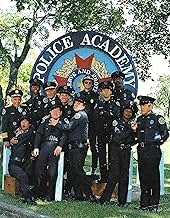
The misfit Police Academy graduates are assigned to train a group of civilian volunteers to fight crime once again plaguing the streets.The misfit Police Academy graduates are assigned to train a group of civilian volunteers to fight crime once again plaguing the streets.The misfit Police Academy graduates are assigned to train a group of civilian volunteers to fight crime once again plaguing the streets.
- Awards
- 2 nominations total



Featured reviews
I certainly laughed a bit more than I did with the previous sequels. Once again it's all a bit overcrowded, with characters from the previous 3 outings now being mixed together. Bailey is a welcome return as the antagonist, but he is joined by the sidekick of the last two films' villain. This kind of works, as we get the best of both worlds. On top of this we are also given new characters, everyday citizens wanting to help out. This looks interesting at first, with David Spade and a skateboarding buddy forced into the program, but they are soon lost in the background. An entertaining airborne finale is rather impressive as well. So, with Bailey back, and this being Guttenberg's last, this may be a good stopping point for most viewers that made it this far.
Indeed, that is the question many were asking in 1987, as the series soon turned into too much of a not so good thing. Sadly, it was only going to get worse from here. I've tried no less than three times to sit through Mission To Moscow, and it is just impossible. About the only reason to bother with episodes three through six is so you can see the final episode where Cast Member X decided they'd had enough. Or when Event Number X that was referenced in a sequel took place.
Another big problem with PA4 (and boy, there are many) is the change in target audience. Sure, episodes 1 through 3 could be enjoyed by children with two digits in their age, but the primary audience was adults who didn't have very high standards. Unfortunately, someone in the film studio must have decided that the writers have to please everybody, and so they watered down the humour as far as they could without getting a G rating. That, more than anything, is what hurts Police Academy sequels 4 onwards.
Steve Guttenberg must have taken one look at the finished product and wondered why he didn't quit about three films ago. Bob Goldthwait picks up the slack in terms of comedy, but his act is also watered down a tad too far, ditching any vocal expression of his character in favour of shouting and screaming at anyone and everyone. Which might work for a comedy about mental patients who have been neglected by the system for too long, but not when your character is meant to be a police officer. But then again, the whole premise is built on a notoriously shaky ground.
Every Police Academy film has at least one celebrity (other than George Gaynes) who wishes they had never appeared in the film. Sharon Stone gets her turn her, and despite what they say about her appearance in everything after Basic Instinct, at least she looks capable of acting. But amongst this lot, I'm sure a dead goldfish would appear to be emoting effectively.
Overall, PA4 gets a 2 out of ten from me. It stands as a good relic of what happens when you try to appeal to everyone, and it does have some genuinely funny moments, but it just cannot hold a candle to its predecessors, especially the first.
Another big problem with PA4 (and boy, there are many) is the change in target audience. Sure, episodes 1 through 3 could be enjoyed by children with two digits in their age, but the primary audience was adults who didn't have very high standards. Unfortunately, someone in the film studio must have decided that the writers have to please everybody, and so they watered down the humour as far as they could without getting a G rating. That, more than anything, is what hurts Police Academy sequels 4 onwards.
Steve Guttenberg must have taken one look at the finished product and wondered why he didn't quit about three films ago. Bob Goldthwait picks up the slack in terms of comedy, but his act is also watered down a tad too far, ditching any vocal expression of his character in favour of shouting and screaming at anyone and everyone. Which might work for a comedy about mental patients who have been neglected by the system for too long, but not when your character is meant to be a police officer. But then again, the whole premise is built on a notoriously shaky ground.
Every Police Academy film has at least one celebrity (other than George Gaynes) who wishes they had never appeared in the film. Sharon Stone gets her turn her, and despite what they say about her appearance in everything after Basic Instinct, at least she looks capable of acting. But amongst this lot, I'm sure a dead goldfish would appear to be emoting effectively.
Overall, PA4 gets a 2 out of ten from me. It stands as a good relic of what happens when you try to appeal to everyone, and it does have some genuinely funny moments, but it just cannot hold a candle to its predecessors, especially the first.
Ok, I the first three Police Academy movies were all quite good. I had a vague memory that part 4 is still somehwat good. But when watching it again, I was surprised that most that happens in the movie had been forgotten completely. I mean, the previous films felt very familiar with all the legendary jokes that seem unforgettable. This movie had also some good jokes but...I think it is more forgettable. It starts promising, introducing new interesting characters. But towards the end the plot (if there was much of it in the first place) disappears and the movie becomes quite random.
Pros: Harris from the first film is back. He's a great opposing force, better than Mauser from parts 2-3. This is also the first time Harris and Proctor work together. Harris shouting "Proctor!" is classic. Also nice to see more of Zed. The best new character is Mrs. Feldman, the old lady who has Tackleberry's attitude.
Overall it's not a very solid movie but it does have some good comedy moments. Recommended only for fans of the earlier films.
Pros: Harris from the first film is back. He's a great opposing force, better than Mauser from parts 2-3. This is also the first time Harris and Proctor work together. Harris shouting "Proctor!" is classic. Also nice to see more of Zed. The best new character is Mrs. Feldman, the old lady who has Tackleberry's attitude.
Overall it's not a very solid movie but it does have some good comedy moments. Recommended only for fans of the earlier films.
Police Academy were an almost constant feature growing up - the number of sequels watched, and in what order, was something of a badge pride in those days! For my part, my scorecard was completely out of synch - Parts 2 and 6 on VHS, the original on terrestrial, etc. Anyway, I have a bit of affection for Part 4 (for all its shortcomings) as the only chapter I ever saw in a cinema, one summer holiday in 1987, St Andrews, Fife. The story is daft, the acting variable (GW Bailey makes a welcome return, while George Gaynes aces it as usual), the jokes are hit and miss, and the series has quite clearly ran the course....but I'll always associate this one with warm summer evenings and pristine white sands. To be enjoyed as a bit of nonsensical and undemanding fun.
It's really something when a franchise begins its second trilogy. While many critics had found only the first Police Academy (1984) a mixed bag, the later sequels earned even less stellar opinions. Yet somehow, the series continued to push onward. While Police Academy 2: Their First Assignment (1985) was more or less retreading the same ground, Police Academy 3: Back in Training (1986) stepped back up to the plate for some fun. The cause of this was more of having the original cast learning new skills, which reminisced more of the first film. Here, the story is now putting them in the trainer shoes. All because of an idea their ever so absent minded commander had one day out of the blue.
Written by Gene Quintano, who also penned the prior entry, was the sole writer for this film. The story begins with Commandant Lassard (George Gaynes) having the brilliant thought of making relations better between the police and public by having a new program involving both. The program is called Citizens on Patrol (COP - how clever), and it would allow citizens to actively partake in making sure crime isn't committed. Seeing it as a lousy decision, Captain Harris (G.W. Bailey) returns with Proctor (Lance Kinsey) to fill in for Lassard as he makes his way to London to promote the concept. Meanwhile, it's up to Mahoney (Steve Guttenberg), Hightower (Bubba Smith), Jones (Michael Winslow), Tackleberry (David Graf), Hooks (Marion Ramsey), Sweetchuck (Tim Kazurinsky) and assorted others to make sure COP succeeds.
So the plot itself is really not very different. If anything the premise feels all too familiar because it's more or less a soft version of the first movie, which encouraged regular citizens to participate in the police academy. Here though, citizens do not become police officers but instead act more as like a subdivision of the department. The only new feeling is that now the original cast members are the ones doing the training, but that's where it ends. Jim Drake as the new director was okay, but there were scenes that felt too padded. What does work in the script's favor are the homecoming of familiar faces and jokes. Having G.W. Bailey come back for another entry was great because he was after all the first antagonist in the series. Plus, seeing him get acquainted with Steve Guttenberg's character brings back fun antics.
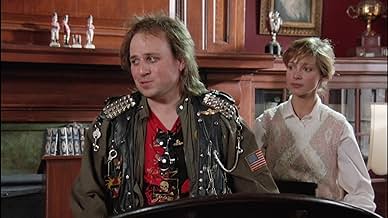
Although not all the jokes induce laughter, there are some better than average moments. One being actress Billie Bird who plays Mrs. Feldman, a charismatic old woman who enjoys the thrill of being a police officer. She produces some good laughs but she's literally one of very few new recruits in the COP program that stand out. The only other character that is a new addition and develops another character is Laura (Corinne Bohrer). While uneasy at first she develops a soft spot for the reformed gang member Zed (Bobcat Goldthwait). Aside from this though, no one else is really has development. There is however an appearance from a young Sharon Stone and a debut performance from David Spade.
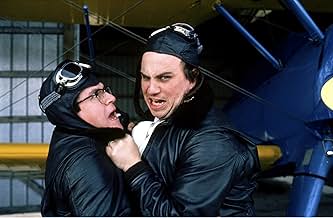
For cinematography, Robert Saad shot for the film. While he provided additional photography for the first film, he really took over in the last sequel, which was shot differently. The same could be said here. There are scenes that are filmed in the city, but Saad also captured shots from the sky and it's impressive. Figuratively and literally, Saad has visually taken the series to a new height. Music has enjoyably remained the same, with another score composed by Robert Folk. The main title theme is always jolly and the rest of scenes work where they should. Now, all that is needed since the first film are the scores released for all the sequels that came out.
If you've been enjoying the films so far even after all the character swaps, this sequel should still provide some good laughs. The cinematography is still shot well, the music remains entertaining and the reunion of Mahoney and Capt. Harris bring back so good jokes. However, the plot feels very similar to the first, very few new characters receive development and the jokes don't always work.
Written by Gene Quintano, who also penned the prior entry, was the sole writer for this film. The story begins with Commandant Lassard (George Gaynes) having the brilliant thought of making relations better between the police and public by having a new program involving both. The program is called Citizens on Patrol (COP - how clever), and it would allow citizens to actively partake in making sure crime isn't committed. Seeing it as a lousy decision, Captain Harris (G.W. Bailey) returns with Proctor (Lance Kinsey) to fill in for Lassard as he makes his way to London to promote the concept. Meanwhile, it's up to Mahoney (Steve Guttenberg), Hightower (Bubba Smith), Jones (Michael Winslow), Tackleberry (David Graf), Hooks (Marion Ramsey), Sweetchuck (Tim Kazurinsky) and assorted others to make sure COP succeeds.
So the plot itself is really not very different. If anything the premise feels all too familiar because it's more or less a soft version of the first movie, which encouraged regular citizens to participate in the police academy. Here though, citizens do not become police officers but instead act more as like a subdivision of the department. The only new feeling is that now the original cast members are the ones doing the training, but that's where it ends. Jim Drake as the new director was okay, but there were scenes that felt too padded. What does work in the script's favor are the homecoming of familiar faces and jokes. Having G.W. Bailey come back for another entry was great because he was after all the first antagonist in the series. Plus, seeing him get acquainted with Steve Guttenberg's character brings back fun antics.
Although not all the jokes induce laughter, there are some better than average moments. One being actress Billie Bird who plays Mrs. Feldman, a charismatic old woman who enjoys the thrill of being a police officer. She produces some good laughs but she's literally one of very few new recruits in the COP program that stand out. The only other character that is a new addition and develops another character is Laura (Corinne Bohrer). While uneasy at first she develops a soft spot for the reformed gang member Zed (Bobcat Goldthwait). Aside from this though, no one else is really has development. There is however an appearance from a young Sharon Stone and a debut performance from David Spade.
For cinematography, Robert Saad shot for the film. While he provided additional photography for the first film, he really took over in the last sequel, which was shot differently. The same could be said here. There are scenes that are filmed in the city, but Saad also captured shots from the sky and it's impressive. Figuratively and literally, Saad has visually taken the series to a new height. Music has enjoyably remained the same, with another score composed by Robert Folk. The main title theme is always jolly and the rest of scenes work where they should. Now, all that is needed since the first film are the scores released for all the sequels that came out.
If you've been enjoying the films so far even after all the character swaps, this sequel should still provide some good laughs. The cinematography is still shot well, the music remains entertaining and the reunion of Mahoney and Capt. Harris bring back so good jokes. However, the plot feels very similar to the first, very few new characters receive development and the jokes don't always work.


Did you know
- TriviaThe collapse of her first marriage contributed to Sharon Stone's decision to work on this movie. Of wanting to have some fun after a difficult period in her life, she said that "hanging out with a gang of comedians, it was the best therapy."
- Goofs(at around 43 mins) When Harris and Proctor enter The Blue Oyster, Proctor acts like he is unfamiliar with the venue. This is despite the fact that in Police Academy 2: Their First Assignment (1985), Proctor recited the bar's street address from memory, while in Police Academy 3: Back in Training (1986), a naked Proctor stumbled into the same building while trying to hide.
- Quotes
Captain Harris: Don't touch those! Don't you ever touch my balls without asking!
- Alternate versionsAlthough the cinema version was intact the UK video version was cut by 8 secs to remove shots of Mahoney displaying a tube of Super Glue before administering it to Harris's megaphone. The cuts were restored in the upgraded 12 certificate DVD.
- ConnectionsEdited from Police Academy 2: Their First Assignment (1985)
- SoundtracksCitizens On Patrol
Performed by Michael Winslow and The L.A. Dream Team
Produced by Steve Tyrell
Written by Michael Stuart Ani and Arthur Funaro
The L.A. Dream Team appears courtesy of MCA Records
Details
- Release date
- Country of origin
- Language
- Also known as
- Loca academia de policía IV: los ciudadanos se defienden
- Filming locations
- Gator Bowl Stadium, Jacksonville, Florida, USA(Proctor's football sideline experience)
- Production company
- See more company credits at IMDbPro
Box office
- Gross US & Canada
- $28,061,343
- Opening weekend US & Canada
- $8,482,487
- Apr 5, 1987
- Gross worldwide
- $28,061,343
Contribute to this page
Suggest an edit or add missing content