
On the maiden mission of the U.S.S. Enterprise (NCC-1701-D), an omnipotent being known as Q challenges the crew to discover the secret of a mysterious base in an advanced and civilized fashi... Read allOn the maiden mission of the U.S.S. Enterprise (NCC-1701-D), an omnipotent being known as Q challenges the crew to discover the secret of a mysterious base in an advanced and civilized fashion.On the maiden mission of the U.S.S. Enterprise (NCC-1701-D), an omnipotent being known as Q challenges the crew to discover the secret of a mysterious base in an advanced and civilized fashion.




- Mandarin Bailiff
- (as Cary-Hiroyuki)

- Main Bridge Security
- (as Timothy Dang)


- Director
- Writer
- All cast & crew
- Production, box office & more at IMDbPro
Featured reviews
Dr McCoy cameo was Amazing !
And like the last sentences Say " our next mission will be more interesting" i truly Hope so , ahah.
Riker watches Encounter at Farpoint on TV
There is a positively surreal scene where Riker is watching this very episode on TV.
In hindsight, it's okay.
As for this first episode, I remember hating it when it debuted. However, I am giving it a fair shake...and then I'll explain why I hated it!
The show begins with Captain Picard taking command of the Enterprise. Soon after, a super-being, Q, takes control of the ship and explains that humans are all savage idiots--and he advises them to go back to their own solar system...NOW. Picard, of course, doesn't comply with this decree and soon finds that Q IS pretty much all-powerful. Eventually, Q places Picard and the crew on trial--a trial that MIGHT result in their obliteration. The trial is a total farce and it's interrupted when Picard suggests that Q examine the PRESENT human race to see if it still savage--at which point Q releases everyone for them to continue their original mission to Farpoint. Could it be what they do at Farpoint determines what Q will do next?
After re-watching the show, I realize that I was a bit harsh-- though it is not a particularly outstanding episode either. While I really grew to love the Q episodes, this one is VERY preachy about how noble the human race has become--one of the more annoying aspects of the Star Trek future. Additionally, the show is a bit slow compared to later shows--but I cannot blame everyone, as the show was trying to find its way and establish itself. Worth seeing but not particularly noteworthy aside from being the first two episodes.
A so-so start for a terrific series.
Star Trek: TNG was one of my favorite TV shows growing up. Space adventures always appealed to me, but it was the cast and the concepts the show explored that often won me over. After having seen the pilot episode, a two-parter entitled Encounter at Farpoint, I see many of the qualities I enjoyed about the series, but this is a fairly subpar episode that's only occasionally compelling.
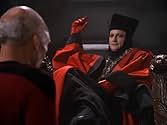
Set some 80 years after the original Star Trek (thus placing it, if I'm not mistaken, in the 24th century), the new crew of the starship Enterprise is headed by Captain Jean-Luc Picard (Patrick Stewart). The crew's assignment: to investigate Farpoint station, but before they can reach their destination they're intercepted by a god-like entity who calls "himself" Q (John De Lancey). Q has deemed the human race savage beasts and puts the Enterprise crew on trial. Their test is Farpoint and if they fail to uncover the dark secret of the station, then well...they'll assumingly receive a dreadful fate.
The first part of Encounter at Farpoint is pretty good, the characters are nicely introduced and mostly well-played by the cast. Patrick Stewart immediately stands out as the stern but well-meaning Picard. Brent Spiner is fantastic as Data, and Jonathan Frakes makes a likeable first officer as Commander Riker. Noticeably different from the original Star Trek is a larger female cast. Marina Sirtis, Gates McFadden, and Denise Crosby are all fairly attractive (Sirtis would later be a full-blown hottie by season two, and McFadden is actually the best-looking of all the Star Trek ladies right now, talk about aging gracefully; sorry, Jeri Ryan and Jolene Blalock just don't do it for me).
Unfortunately, the plot, while initially intriguing, ultimately doesn't really go anywhere and there's the certain feeling that fitting the whole story into two parts is really stretching it out. A lot of the material, obviously played for introductory purposes, could still have been cut out. In fact, all the stuff focusing on the mystery behind Farpoint barely adds up to a half-hour, excluding the really lengthy climax, which is just plain boring. When the secret of Farpoint is revealed (which you'll probably figure out before the cast does), all the conjecture and facts are messily spouted in one of those silly coversations where each character continues the sentence after the previous speaker has finished.
But Encounter at Farpoint works adequately enough as an intro to one of the best sci-fi television series, right up there with Stargate: SG-1 and the first two seasons of Sliders. Watch for Cary-Hiroyuki Tagawa as Q's bailiff.
C+: Good, but not great.
The two main plots are engaging enough. Going on commentary from Roddenberry, the Q entity was written in later at Paramount's behest but, to me, is the most amusing part of this outing. Q almost represents the studio's viewpoint - in the show, the whole human race is on trial, in reality, the entire TNG concept was on trial. His presence is a definite highlight and he would go on to be one of the most memorable characters of any Star Trek incarnation. Q's presence interweaves comfortably with 'the trial' itself which is the unravelling an enigma: how did an obviously technologically deficient race build a frontier outpost of high-technology to service the Federation, and can the mystery be solved without resorting to violent methods thereby proving Q correct in his definition of the human race as barbaric and child-like?
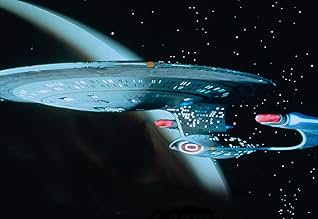
From a technical standpoint this episode is respectable. For particular commendation I would single out Industrial Light and Magic's excellent special effects work. The models of the Enterprise-D and the alien spacecraft(s) set a high watermark which remains, for me, an engrossing aspect of the show to this day. We now take complex and expensive shots like these for granted in television shows, but until TNG it wasn't all that common.
As for the performances, the cast are still tentative within their new roles, finding their comfort zones and strengths. Some of the dialogue allows them chances to connect with their characters and therefore with the audience, other sections would be better delivered tongue-in-cheek rather than with deadly earnestness, or omitted entirely. My own assumption is that at this point Roddenberry was working towards the strengths of the old cast, whom he was familiar with, expecting them to be partial clones of Kirk and crew instead of relying on his new actors to take Star Trek in interesting new directions. When he stepped down as Executive Producer and handed more responsibility to Braga (who, sadly, would go on to lose his deft touch while in control of Voyager) many of the problems were ironed out.
'Encounter At Farpoint: Parts I and II' represent some of the best moments of the first season but not necessarily the entire Next Generation run or the four films that would follow. It is abundantly obvious that the premise has great promise, but it would not be until late into the second season that consistency would improve and truly great stories would be added to the Star Trek canon.


Did you know
- TriviaDeForest Kelley's cameo as an aged McCoy was a late addition to the script and was devised by Gene Roddenberry. "It came about as a result of, I think, a meeting between him and De," remembered producer Robert H. Justman. "I think it had been on Gene's mind and he invited De to lunch and he says, 'How would you feel about it?', expecting De to say, 'No. NO' - and De said, 'I'd be honored.' And not only that, not only did he say 'I'd be honored,' but he refused to take any more than SAG scale [salary]. He could have held us up for a lot of money, and he didn't. And it was just great; it really got to me, the way he did it [the scene]. It really got to me; it was a beautiful, beautiful scene."
- GoofsWesley is dripping wet when talking to Captain Picard outside the holodeck. As holographic matter cannot exist outside of the holodeck, the water should have disappeared once he stepped through the door. However, just moments before, Data explains to Riker that the holodeck uses a combination of holograms and actual material that is materialized (similar to the way the food replicators create food) so the water could very well be real.
- Quotes
Admiral Leonard H. "Bones" McCoy: How old do you think I am, anyway?
Lt. Commander Data: 137 years, Admiral, according to Starfleet records.
Admiral Leonard H. "Bones" McCoy: Explain how you remember that so exactly!
Lt. Commander Data: I remember every fact I am exposed to, sir.
Admiral Leonard H. "Bones" McCoy: [looking at both sides of Data's head] I don't see no points on your ears, boy, but you sound like a Vulcan.
Lt. Commander Data: No, sir. I am an android.
Admiral Leonard H. "Bones" McCoy: Hmph. Almost as bad.
- Alternate versionsThe original Columbia House video release had the episode cut into two parts, as it was re-aired, while later releases has the episode in its original two hour cut that was on the Paramount Home Video release.
- ConnectionsFeatured in Star Trek: The Next Generation: Hide and Q (1987)
Details
- Release date
- Country of origin
- Official sites
- Language
- Filming locations
- Production company
- See more company credits at IMDbPro
- Runtime
- 1h 32m(92 min)
- Color
- Sound mix
- Aspect ratio
- 1.33 : 1