IMDb RATING
7.8/10
1.1K
YOUR RATING


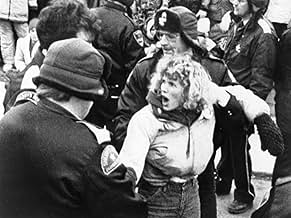
Recounts the 1985-86 strike against the Hormel Foods Corporation in Minnesota after its employees' wages and benefits were cut.Recounts the 1985-86 strike against the Hormel Foods Corporation in Minnesota after its employees' wages and benefits were cut.Recounts the 1985-86 strike against the Hormel Foods Corporation in Minnesota after its employees' wages and benefits were cut.
- Won 1 Oscar
- 12 wins & 3 nominations total



Dan Rather
- Self
- (archive footage)

Ronald Reagan
- Self
- (archive footage)
7.81.1K
1
2
3
4
5
6
7
8
9
10
Featured reviews
American labor in the 1980s
It may at times resemble an illustrated Bruce Springsteen protest ballad, but the tragedy in Barbara Kopple's Oscar winning documentary portrait of a Minnesota meat packer's strike is too rich to ignore, not unlike the film 'Roger & Me' but without Michael Moore's self-serving humor. The story begins in the mid 1980s, when the Hormel Company in Austin, Minnesota, tried to lower wages despite showing a healthy profit, leading members of Local P-9 to ignore their parent Union and hire an rhetoric spouting outside agitator (labor 'consultant' Ray Rogers), who transformed their grievance into a noble but ultimately self-defeating grassroots crusade. Kopple herself remains more or less invisible throughout the film, but her sympathy for the renegade P-9 underdogs (and her anti-Reaganomics attitude) is obvious, and she reveals the personal and civic consequences of labor disunion with heartbreaking clarity. The strike itself may not have made headlines outside the Mid West, but the story has some devastating implications for organized labor nationwide, and beyond that supplies enough drama and character to match any Hollywood blockbuster.
10jgtoms
One of the best documentaries ever made.
This film is absolutely stunning. It centers around union meatpacking workers at a Hormel plant in Austin, Minnesota in the mid-80's. The trouble started when Hormel cut worker pay from $10.69 an hour to $8.25 an hour. The problem? Hormel had just posted a net profit of $30 million. As one worker at a union meeting put it, "If we have to take a cut of $2.45 an hour when the company just made $30 million, I hate to think of what's gonna happen when they actually post a loss." With no help from their parent union, International Food and Commercial Workers Union, the local union (P-9) goes on strike alone trying to bring Hormel to its knees. Director Barbara Kopple, who also made the great "Harlan County, USA", does an outstanding job of capturing every important moment. She has the camera there at every union meeting, press release, Hormel press release, etc. She also shows the very personal aspects of a strike going into people's homes and showing their innermost feelings about what's going on. In the end, the strike is long, drawn out, and things appear bleak. The constant Minnesota cold, snow and ice are always in the background as well. If one doesn't have a greater appreciation for unions and what they have to sometimes endure after watching this film, he/she probably didn't pay very good attention.
No Retreat No Surrender
American Dream (1990)
**** (out of 4)
Barbara Kopple's Oscar-winning documentary follows a meat packing strike in Austin, MN and those familiar with the director's HARLAN COUNTY, USA will certainly have a lot to compare. This film follows the unions decision to pull their workers after Hormel reported a $29 million dollar profit and then asked their workers to take a pay cut and have their benefits reduced. While this film doesn't reach the same heights as HARLAN COUNTY, there's no question that this here is still a pretty remarkable documentary in its own right. There's no question that Kopple knows how to tell a story and more importantly find the passion, fire and energy of a story and exploit it to make sure the message of those individuals get across for the viewers. The documentary was clearly on the side of the workers as this is where we spend the majority of the running time. The first forty-minutes of the film focuses on the pre-strike as we get to know the main people involved and we get a very good idea of the working conditions in America at the time and it's clear that going on strike is very dangerous for a number of reasons. The final hour of the picture deals with the strike as the workers get dragged along for months and the end results aren't anywhere close to a happy ending. As someone who has worked for a union I can see both sides of the coin but it really does seem that the majority of the people lost here and that's a real shame. Kopple does a remarkable job at telling this story and there's no question that your attention will be glued to the film from start to finish.
**** (out of 4)
Barbara Kopple's Oscar-winning documentary follows a meat packing strike in Austin, MN and those familiar with the director's HARLAN COUNTY, USA will certainly have a lot to compare. This film follows the unions decision to pull their workers after Hormel reported a $29 million dollar profit and then asked their workers to take a pay cut and have their benefits reduced. While this film doesn't reach the same heights as HARLAN COUNTY, there's no question that this here is still a pretty remarkable documentary in its own right. There's no question that Kopple knows how to tell a story and more importantly find the passion, fire and energy of a story and exploit it to make sure the message of those individuals get across for the viewers. The documentary was clearly on the side of the workers as this is where we spend the majority of the running time. The first forty-minutes of the film focuses on the pre-strike as we get to know the main people involved and we get a very good idea of the working conditions in America at the time and it's clear that going on strike is very dangerous for a number of reasons. The final hour of the picture deals with the strike as the workers get dragged along for months and the end results aren't anywhere close to a happy ending. As someone who has worked for a union I can see both sides of the coin but it really does seem that the majority of the people lost here and that's a real shame. Kopple does a remarkable job at telling this story and there's no question that your attention will be glued to the film from start to finish.
add this to your list
the most obvious parallel is michael moore's "roger & me." both films look at one community dealing with a corporation's decision to either cut the work force (roger and me) or drastically cut its wages (american dream). michael moore interjects himself into his films a great deal - he is in front of the camera, he uses voice-overs - instead of intertitles - to fill in needed information, etc. some think this is to his detriment, but i think it is honesty...he clearly acknowledges that there is an author and that's a good thing. american dream, on the other hand, attempts to appear objective by choosing to use intertitles and keeping the filmmakers behind the camera. the storytelling and pacing of this film isn't as good as that of "roger and me," but when it comes to documentaries there is room for error in these areas. documentaries ultimately, at least for me, are judged primarily on the story they tell, more than how well they tell it; and i think that's less true for feature films. this film tells a good story. through the film we are able to see the entire process a union undertakes when they have a dispute. if you don't know much about unions then this is a great place to start. if you hate corporations then this will fuel your fire. if you like good documentaries then add this to your list. B.
Always think of this doc when I see a Hormel product at the store.
I definitely liked this documentary. I usually think of it a little when I see a Hormel product at the grocery store. It was impressively done and it really has an authentic feel to it. For some reason I have not yet seen Harlan County USA, but will certainly do so sometime this year.
I have seen this twice and it is definitely worth more than one viewing. While the tone starts as pro-union, there seems to be at least some hints about their limitations as well later in the film. I spent my childhood in a town nearly 100 miles north of Austin and the film made me appreciative that my father had access to more opportunities when he got laid off (we were much closer to the Minneapolis region than Austin). I could feel for the families of those in Austin during this film as it was primarily a one company town at that time and for all I know it may still be the case.
Documentaries work best when there is a focus on "real" people rather than well known celebrities IMO. This is evidence of that and I recommend this film.
I have seen this twice and it is definitely worth more than one viewing. While the tone starts as pro-union, there seems to be at least some hints about their limitations as well later in the film. I spent my childhood in a town nearly 100 miles north of Austin and the film made me appreciative that my father had access to more opportunities when he got laid off (we were much closer to the Minneapolis region than Austin). I could feel for the families of those in Austin during this film as it was primarily a one company town at that time and for all I know it may still be the case.
Documentaries work best when there is a focus on "real" people rather than well known celebrities IMO. This is evidence of that and I recommend this film.


Did you know
- How long is American Dream?Powered by Alexa
Details
- Release date
- Countries of origin
- Official site
- Language
- Also known as
- Американская мечта
- Filming locations
- Production companies
- See more company credits at IMDbPro
Box office
- Gross US & Canada
- $269,823
- Opening weekend US & Canada
- $9,291
- Mar 22, 1992
- Gross worldwide
- $269,823
Contribute to this page
Suggest an edit or add missing content