

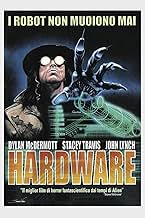
The head of a cyborg reactivates, rebuilds itself, and goes on a violent rampage in a space marine's girlfriend's apartment.The head of a cyborg reactivates, rebuilds itself, and goes on a violent rampage in a space marine's girlfriend's apartment.The head of a cyborg reactivates, rebuilds itself, and goes on a violent rampage in a space marine's girlfriend's apartment.
- Awards
- 3 wins & 4 nominations total






Susie Savage
- Chinese Family
- (as Susie Ng)
6.017.6K
1
2
3
4
5
6
7
8
9
10
Featured reviews
Some nice touches, especially with the Mark 13 derivative.
The 21st century world is a radioactive wasteland as a result of a nuclear war. A traveling scavenger comes across the remains of a cyborg named Mark 13 in the desert; He salvages pieces of it. The cyborg head ends up with a metal sculptress, who is unaware of the cyborg's infamy as a governmental killing machine project that was scrapped due to its defects. Mark 13 reconstructs itself utilizing household appliances and metal parts, and goes amok.
Hardware is a movie that relies on its post-modernistic stylings to bring out its flavor but most of the time it falls flat. It's full of oddly placed music, I heard somewhere that the director Richard Stanley used to direct music videos, so maybe that explains a few reasons as to why this movie is the way it is. The red filter used through at least 50% of the movie can become highly annoying and get in the way of viewing some potentially good, violent scenes. Also the scenes which slowly push the plots progression could have done without the distraction.
Luckily enough, when the movie really gets going (it takes almost an hour!) its quite a fun ride of just extremely painful death scenes as the clunky robot Mark-13 chases down all humans in his way.
Hardware is a movie that relies on its post-modernistic stylings to bring out its flavor but most of the time it falls flat. It's full of oddly placed music, I heard somewhere that the director Richard Stanley used to direct music videos, so maybe that explains a few reasons as to why this movie is the way it is. The red filter used through at least 50% of the movie can become highly annoying and get in the way of viewing some potentially good, violent scenes. Also the scenes which slowly push the plots progression could have done without the distraction.
Luckily enough, when the movie really gets going (it takes almost an hour!) its quite a fun ride of just extremely painful death scenes as the clunky robot Mark-13 chases down all humans in his way.
Obscure cult classic.
Hardware is a quintessential cult film. Project of a young, troublesome director that was soon to vanish from the movie-making horizon. An ambitious but low budget science fiction that taps into a particular zeitgeist. An overwrought, philosophical flick that is fascinating even if it fails to deliver any real thrills.
Based on a short 2000 AD comic strip Shock!, Hardware is low on narrative content but it exploits its post-apocalyptic setting with a confidence and fidelity. Stanley manages to work around the budget restraints and turns all London based, indoor locations into a believably devastated landscape of a civilization in retreat. Flesh is consumed by overwhelming rusting metal and slowly decays amidst the ubiquitous pollution. It's a bleak even if not entirely original vision that here is pushed to the limit of being almost unpleasantly nihilistic.
Together with work of cyberpunk literature- Gibson's Neuromancer and some defining achievements of Japanese animé like Otomo's Akira (1988) and Fukutomi's Battle Angel Alita (1993) Stanley's film is a product of its times- anxious about the state of the environment and our place in the technological civilization on the threshold of the new millennium. It perhaps couldn't be made with the same infectious desperation pouring out of the screen at any other time in the history.
What it also shares with defining it literate and cinematic contexts is the same tendency towards gratuitous symbolism. Religious connotations (both Christian and Buddhist) between characters of Moses Baxter and deadly M.A.R.K.-13 are at times heavy handed but rewarding in the scale of the whole because of the consistency with which they are used and, at times, their detailed intricacy.
Exactly because philosophical rather than the narrative layer of Hardware comes to dominate the entire feature, Stanley's film becomes so dense, impenetrable and therefore intriguing. Film's colour palette, dominated by oligochromatic browns and reds adds to the overwhelming sense of endangerment even if the script, time and time again postpones the actual danger and fails to build up any tension. Added, voyeuristic sub-plot is appropriately disturbing and intense but serves little dramatic purpose.
Film delivers gore and sex, as expected but it's nowhere near as captivating or resonant as the overarching art style. In the last third, Stanley without any moderation delivers hypnotic and grotesque imagery that leaves the viewer confused but with a dominant sense of being a witness to a wonderful and bedazzling vision.
Verdict: Hardware is best approached not as it was advertised- a sci-fi action movie but rather a complex mantra; film of unified stylistic and philosophical vision that comes close to encapsulating both entertaining and intellectual properties of a masterful sci-fi. It is too aware of its real intentions too be fully appreciated by the mainstream audience but nevertheless remains a work of an intriguing and skillful director. If you fall for its depressing tone and appreciate cyberpunk influenced issues that it tackles you might find yourself coming back to it several times, despite its shortcomings.
Based on a short 2000 AD comic strip Shock!, Hardware is low on narrative content but it exploits its post-apocalyptic setting with a confidence and fidelity. Stanley manages to work around the budget restraints and turns all London based, indoor locations into a believably devastated landscape of a civilization in retreat. Flesh is consumed by overwhelming rusting metal and slowly decays amidst the ubiquitous pollution. It's a bleak even if not entirely original vision that here is pushed to the limit of being almost unpleasantly nihilistic.
Together with work of cyberpunk literature- Gibson's Neuromancer and some defining achievements of Japanese animé like Otomo's Akira (1988) and Fukutomi's Battle Angel Alita (1993) Stanley's film is a product of its times- anxious about the state of the environment and our place in the technological civilization on the threshold of the new millennium. It perhaps couldn't be made with the same infectious desperation pouring out of the screen at any other time in the history.
What it also shares with defining it literate and cinematic contexts is the same tendency towards gratuitous symbolism. Religious connotations (both Christian and Buddhist) between characters of Moses Baxter and deadly M.A.R.K.-13 are at times heavy handed but rewarding in the scale of the whole because of the consistency with which they are used and, at times, their detailed intricacy.
Exactly because philosophical rather than the narrative layer of Hardware comes to dominate the entire feature, Stanley's film becomes so dense, impenetrable and therefore intriguing. Film's colour palette, dominated by oligochromatic browns and reds adds to the overwhelming sense of endangerment even if the script, time and time again postpones the actual danger and fails to build up any tension. Added, voyeuristic sub-plot is appropriately disturbing and intense but serves little dramatic purpose.
Film delivers gore and sex, as expected but it's nowhere near as captivating or resonant as the overarching art style. In the last third, Stanley without any moderation delivers hypnotic and grotesque imagery that leaves the viewer confused but with a dominant sense of being a witness to a wonderful and bedazzling vision.
Verdict: Hardware is best approached not as it was advertised- a sci-fi action movie but rather a complex mantra; film of unified stylistic and philosophical vision that comes close to encapsulating both entertaining and intellectual properties of a masterful sci-fi. It is too aware of its real intentions too be fully appreciated by the mainstream audience but nevertheless remains a work of an intriguing and skillful director. If you fall for its depressing tone and appreciate cyberpunk influenced issues that it tackles you might find yourself coming back to it several times, despite its shortcomings.
Beautifully filmed sci-fi masterpiece
Those judging Hardware using the same criteria for judging major Hollywood sci-fi films are missing the point entirely.
Hardware is much more an art film than it is science fiction; it merely happens to have a sci-fi theme.
Given, the plot is a little cheesy. Given, the situation fairly unbelievable. And given, there are a few holes in the story.
Almost no film has all of these elements, but Hardware has something even more important. The way the story is told is nothing short of genius. Perhaps not in the way the happenings actually unfold, but in how they are presented. Hardware is an astounding achievement in lighting, cinematography, and audio engineering. As a professional video editor myself, I can assure you that this movie benefits from an A+ editing job.
I completely agree that there are only 2 types of people: those who love Hardware, and those who simply do not get it.
From the first frame of video, this movie is a constant barrage on the eyes, ears, and mind. If nothing else, you must admire the bleak vision of a post-nuclear holocaust America presented in Hardware. Images ranging from billowing smoke stacks and butchers in apartment lobbies to toddlers physically tied to their dead parents, Stanley paints a haunting vision of the future that will not be forgotten after you press stop.
Hardware is not what you would expect to come out of Hollywood. It is what you would expect a pure artist to create. Perhaps it is better suited to fans of independent film than just sci-fi fans. Films like Terminator and Aliens might be regarded as much better sci-fi work, but I assure you that they can't touch the riskiness and edginess of Hardware in how they are presented. That is why you hear casual moviegoers complaining about this movie. For pure fans of the art behind film making, sci-fi just doesn't get any better than Hardware.
It should be noted that the excellent score does much to augment the visuals in this film. It's criminal that nobody has seen it necessary to print Hardware on DVD as I would love to experience it in Dolby 5.1.
As a final note, Hardware may not be a film everyone will enjoy. Even if you don't like it, you will become a more enlightened viewer if you can at least identify why this is such a courageous film and how it differs from the Hollywood fodder you are probably used to.
Hardware is much more an art film than it is science fiction; it merely happens to have a sci-fi theme.
Given, the plot is a little cheesy. Given, the situation fairly unbelievable. And given, there are a few holes in the story.
Almost no film has all of these elements, but Hardware has something even more important. The way the story is told is nothing short of genius. Perhaps not in the way the happenings actually unfold, but in how they are presented. Hardware is an astounding achievement in lighting, cinematography, and audio engineering. As a professional video editor myself, I can assure you that this movie benefits from an A+ editing job.
I completely agree that there are only 2 types of people: those who love Hardware, and those who simply do not get it.
From the first frame of video, this movie is a constant barrage on the eyes, ears, and mind. If nothing else, you must admire the bleak vision of a post-nuclear holocaust America presented in Hardware. Images ranging from billowing smoke stacks and butchers in apartment lobbies to toddlers physically tied to their dead parents, Stanley paints a haunting vision of the future that will not be forgotten after you press stop.
Hardware is not what you would expect to come out of Hollywood. It is what you would expect a pure artist to create. Perhaps it is better suited to fans of independent film than just sci-fi fans. Films like Terminator and Aliens might be regarded as much better sci-fi work, but I assure you that they can't touch the riskiness and edginess of Hardware in how they are presented. That is why you hear casual moviegoers complaining about this movie. For pure fans of the art behind film making, sci-fi just doesn't get any better than Hardware.
It should be noted that the excellent score does much to augment the visuals in this film. It's criminal that nobody has seen it necessary to print Hardware on DVD as I would love to experience it in Dolby 5.1.
As a final note, Hardware may not be a film everyone will enjoy. Even if you don't like it, you will become a more enlightened viewer if you can at least identify why this is such a courageous film and how it differs from the Hollywood fodder you are probably used to.
A very 1980s movie
If ever you want an example of a very 1980s movie, with soaring Pink Floyd imitation guitars, then make a note of Hardware. Hardware is actually, even at this early age, part of a robot tradition. Star Wars had been around for a while, and then there was The Black Hole (1979), Saturn 3 (1980), and Short Circuit (1986). I'm giving this movie a 7 because it entertained, but if I were a real movie critic I'd give it less. Almost all the camerawork is in a close-up range, and the robots field of vision was way too spludgey, a sort of amateur Predator vision. We needed wider shots to really see the robot, and we needed to see more of the city itself, not just the crazy lady's crazy artist's loft. Anyway, that's my take. I liked the soundtrack and the human characters, they were all really suitably post-apocalypse, and the general story made sense in a sci-fi fashion, and the ravages of the droid were suitably outrageous. I'd love to see it remade with a more modern take. This is definitely one for the archives.
Bleak View of the Future of Mankind
In a post-apocalyptic future, Earth is taken by radioactivity and the ozone depletion causes high temperatures. A nomad (Carl McCoy) wanders in the desert and finds an android head and hand. He brings the parts to sell to the seller Alvy (Mark Northover), but the soldier Moses "Mo" (Dylan McDermott) buys the head to give to his girlfriend Jill (Stacey Travis), who is an artist that makes sculptures.
Mo and his friend Shades (John Lynch) go to New York to meet Jill and she uses the head in her sculpture. Meanwhile Alvy researches the origin of the head and discovers that it belongs to the dangerous project Mark 13 that was provided with artificial intelligence and programmed to rebuild itself, but deactivated by the authorities because of its vulnerability to the rain. He summons Mo to tell his discovery and Jill is left alone with the lethal machine that is rebuilding itself with the parts she uses in her sculptures.
"Hardware" is a sci-fi B-movie with a bleak view of the future of mankind. The story is very simple and the special effects and robots are great for a movie from the 90's. Unfortunately the cinematography is too dark, but the music score is magnificent. My vote is six.
Title (Brazil): "Hardware - O Destruidor do Futuro" ("Hardware – The Destroyer of the Future")
Mo and his friend Shades (John Lynch) go to New York to meet Jill and she uses the head in her sculpture. Meanwhile Alvy researches the origin of the head and discovers that it belongs to the dangerous project Mark 13 that was provided with artificial intelligence and programmed to rebuild itself, but deactivated by the authorities because of its vulnerability to the rain. He summons Mo to tell his discovery and Jill is left alone with the lethal machine that is rebuilding itself with the parts she uses in her sculptures.
"Hardware" is a sci-fi B-movie with a bleak view of the future of mankind. The story is very simple and the special effects and robots are great for a movie from the 90's. Unfortunately the cinematography is too dark, but the music score is magnificent. My vote is six.
Title (Brazil): "Hardware - O Destruidor do Futuro" ("Hardware – The Destroyer of the Future")


Did you know
- TriviaThe nomad who unearths the MARK-13 robot is played by Carl McCoy, lead singer of the goth rock band Fields of the Nephilim, for whom Richard Stanley had previously directed two music videos and designed an album cover. According to him, McCoy's character in "Hardware" is basically the same as it was in the Nephilim work. The character, then titled Preacher Man, had a prosthetic hand, yellow contact lenses and wore an old black coat with a cowboy hat.
- GoofsWhen the droid rebuilds itself, it picks up a circular saw. When it uses that circular saw as a weapon later, it is completely different design, with an all different cutting disk.
- Alternate versionsThe film was heavily cut to receive an M rating for its Australian theatrical run. The cuts were later restored for the R rated video release.
- ConnectionsEdited into Brave (1994)
- SoundtracksThe Order of Death
Written by John Lydon, Keith Levene and Martin Atkins
Performed by Public Image Ltd.
Published by EMI Songs Ltd/Virgin Music (Publishers) Ltd/Complete Music Ltd.
Details
- Release date
- Country of origin
- Languages
- Also known as
- M.A.R.K. 13 - Hardware
- Filming locations
- Production companies
- See more company credits at IMDbPro
Box office
- Budget
- $1,500,000 (estimated)
- Gross US & Canada
- $5,728,953
- Opening weekend US & Canada
- $2,381,285
- Sep 16, 1990
- Gross worldwide
- $5,729,735
- Runtime
- 1h 34m(94 min)
- Color
- Sound mix
- Aspect ratio
- 1.85 : 1
Contribute to this page
Suggest an edit or add missing content