IMDb RATING
5.7/10
2.2K
YOUR RATING

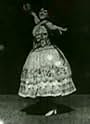
Performing on what looks like a small wooden stage, wearing a dress with a hoop skirt and white high-heeled pumps, Carmencita does a dance with kicks and twirls, a smile always on her face.Performing on what looks like a small wooden stage, wearing a dress with a hoop skirt and white high-heeled pumps, Carmencita does a dance with kicks and twirls, a smile always on her face.Performing on what looks like a small wooden stage, wearing a dress with a hoop skirt and white high-heeled pumps, Carmencita does a dance with kicks and twirls, a smile always on her face.
- Director
- Stars

Featured reviews
In Carmencita, we get the story of a dance, and that's all. It's a great thing that the first woman who was ever photographed on celluloid was seen doing what she loves, doing it relatively well (I can't judge how the dancing was by 1894 standards, but she never appears to slip up), and is not being exploited for the sake of it. Here is a MOTION PICTURE, so here's motion and here's a picture of it. Simple. Awesome. I hope women seeing it today are empowered by it. Or if they want to scream "Patriarchy" and be mad that it's not showing a woman doing something that isn't meant to only appeal to men I understand. But it is splendid and exciting to see, especially in the not-quite 24 frame per second film speed it has been preserved at, and I think it's amazing to watch past the film history of it.
PS: on IMDb this is title url 0000001
PS: on IMDb this is title url 0000001
Objectively, there's nothing really WRONG with this film. It sets out to do something extremely simple, and it achieves that goal flawlessly, but that goal isn't really compelling unless one accounts for the film's age. It is said that this isn't only one of the first films ever made, but also one of the earliest films to feature a female "star" I suppose. I'm not sure how true this claim is, but it's not very hard for me to believe. The actress featured in this film is rather charming and dances in a vivid and exuberant manner, making this film be one of slight excitement thanks to the wild, cheerful movements made. It'definitely be really boring if it were an hour, but films of such a length were unheard of back in this day, so dwelling on such hypothetical situations is quite pointless. All in all, this is a pretty enjoyable way to spend less than a minute of your time and is recommended for fans of film in general as it is short and enjoyable enough to intrigue almost anyone.
Carmencita (1894)
*** 1/2 (out of 4)
Infamous Edison short, which features the title dancer, quite famous at the time, doing one of her dances. The film runs only 24-seconds but who today could really imagine how much trouble this film would get into with such a short running time. The movie was famous because it came under a lot of censorship issues wherever it would be played. The most famous incident happened in Boston where it was pulled from theaters after a preacher complained that it was sinful. We only see a brief bit of the dancer's leg (below the knee) so that should tell you something. There's certainly nothing great here but from a historical standpoint this is a very important film.
*** 1/2 (out of 4)
Infamous Edison short, which features the title dancer, quite famous at the time, doing one of her dances. The film runs only 24-seconds but who today could really imagine how much trouble this film would get into with such a short running time. The movie was famous because it came under a lot of censorship issues wherever it would be played. The most famous incident happened in Boston where it was pulled from theaters after a preacher complained that it was sinful. We only see a brief bit of the dancer's leg (below the knee) so that should tell you something. There's certainly nothing great here but from a historical standpoint this is a very important film.
This short film was included several years ago in a documentary about Thomas Edison and his early movie-making experiments. It's timeless - an absolute classic!
The video itself is jumpy and splotchy, and primitive by even the earliest silent film standards. But by anyone's measure, the dancer is amazingly good, and this peek into the distant past is well worth watching, if the opportunity arises.
It would be nice if someone put together for commercial sale a collection of very early experimental film projects like this one. Few are likely to be as fascinating as this, but it's amazing to see how dramatically video technology has changed - and how relatively little change there has been in our entertainment preferences.
The video itself is jumpy and splotchy, and primitive by even the earliest silent film standards. But by anyone's measure, the dancer is amazingly good, and this peek into the distant past is well worth watching, if the opportunity arises.
It would be nice if someone put together for commercial sale a collection of very early experimental film projects like this one. Few are likely to be as fascinating as this, but it's amazing to see how dramatically video technology has changed - and how relatively little change there has been in our entertainment preferences.
Here's a perfect example of the pitfalls of writing about films: especially films from the earliest days of the cinema. The other IMDb'ers who have posted reviews of Carmencita's performance for Thomas Edison's Kinetograph camera are apparently reviewing footage from Edison Motion Picture #28, which has been reissued on DVD as part of "Edison: The Invention of the Movies". Well, I am likewise reviewing Carmencita's performance for Edison's Kinetograph. However, the performance I saw (and which I'm reviewing) was a different performance by the same dancer, filmed on the same occasion -- the second week of March 1894 -- but photographed on a different negative and not included in the DVD.
I saw this film (the one I'm reviewing, mind) in October 2006 at the Cinema Muto festival in Sacile, Italy. The print screened at Sacile was retrieved from the National Fairground Archive in Sheffield, England. (WKL Dickson, who shot many films for Edison, was an Englishman; he shipped prints of many of his Edison films to Britain.) When the Sheffield print was found, it was at first assumed to be one more copy of the existing Carmencita footage (the one on the DVD). However, after restoration, it was discovered that this was a 'lost' movie which no living person knew had ever existed in the first place: a completely different take of Carmencita's performance, differing significantly from the 'known' version. Since Edison's catalogue lists only one version, this 'lost' film has been provisionally titled "Carmencita #2" and catalogued as EMP 28.1.
This is certainly not a 'belly dance', despite a previous IMDb'er's comment. Carmencita's performance here is virtually identical to the one in the DVD version, with one interesting difference: in the version found at Sheffield and screened at Sacile (the one I saw), the señorita concludes her performance by curtseying to the camera (or to its operator?) and offering a moue.
Frame-by-frame comparisons make it clear that these are two separate 'takes': two completely different pieces of footage of the same dancer giving similar but not identical performances. I'd be keen to learn which one was shot first. Carmencita's acknowledgment in the Sheffield version might imply that this was the conclusion of her performance, therefore the final take. Or perhaps this was her first take, and Dickson may have felt that Carmencita's gesture -- appropriate enough for a live audience watching a stage performance -- was inappropriate for a movie, and he required her to do a retake. Barring authorisation for a trip yesterwards to March 1894 (grease up the time-portal!), it's unlikely that anyone will ever know which version was shot first.
On its own merits as an historic artefact, I'll rate "Carmencita #2" 6 points out of 10 ... plus one point extra (7 total) because this film and its twin sister -- placed side by side -- serve as a caution to those who would review old-time movies, or who would criticise other reviewers' film scholarship: sometimes the version which you saw, and the version which I saw, really are NOT the same movie!
I saw this film (the one I'm reviewing, mind) in October 2006 at the Cinema Muto festival in Sacile, Italy. The print screened at Sacile was retrieved from the National Fairground Archive in Sheffield, England. (WKL Dickson, who shot many films for Edison, was an Englishman; he shipped prints of many of his Edison films to Britain.) When the Sheffield print was found, it was at first assumed to be one more copy of the existing Carmencita footage (the one on the DVD). However, after restoration, it was discovered that this was a 'lost' movie which no living person knew had ever existed in the first place: a completely different take of Carmencita's performance, differing significantly from the 'known' version. Since Edison's catalogue lists only one version, this 'lost' film has been provisionally titled "Carmencita #2" and catalogued as EMP 28.1.
This is certainly not a 'belly dance', despite a previous IMDb'er's comment. Carmencita's performance here is virtually identical to the one in the DVD version, with one interesting difference: in the version found at Sheffield and screened at Sacile (the one I saw), the señorita concludes her performance by curtseying to the camera (or to its operator?) and offering a moue.
Frame-by-frame comparisons make it clear that these are two separate 'takes': two completely different pieces of footage of the same dancer giving similar but not identical performances. I'd be keen to learn which one was shot first. Carmencita's acknowledgment in the Sheffield version might imply that this was the conclusion of her performance, therefore the final take. Or perhaps this was her first take, and Dickson may have felt that Carmencita's gesture -- appropriate enough for a live audience watching a stage performance -- was inappropriate for a movie, and he required her to do a retake. Barring authorisation for a trip yesterwards to March 1894 (grease up the time-portal!), it's unlikely that anyone will ever know which version was shot first.
On its own merits as an historic artefact, I'll rate "Carmencita #2" 6 points out of 10 ... plus one point extra (7 total) because this film and its twin sister -- placed side by side -- serve as a caution to those who would review old-time movies, or who would criticise other reviewers' film scholarship: sometimes the version which you saw, and the version which I saw, really are NOT the same movie!


Did you know
- TriviaOn IMDb, this film is numbered as tt0000001.
- ConnectionsFeatured in Edison: The Invention of the Movies (2005)
Details
- Runtime
- 1m
- Color
- Sound mix
- Aspect ratio
- 1.33 : 1
Contribute to this page
Suggest an edit or add missing content