IMDb RATING
6.1/10
1.2K
YOUR RATING

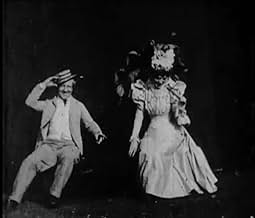
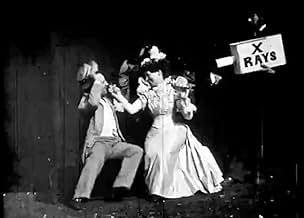
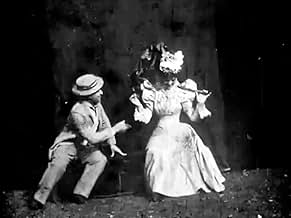
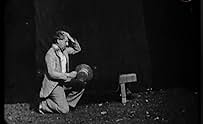
A man and woman are flirting when a professor turns on an X-ray machine, revealing their insides. After turning it off again the two have a dispute and break up.A man and woman are flirting when a professor turns on an X-ray machine, revealing their insides. After turning it off again the two have a dispute and break up.A man and woman are flirting when a professor turns on an X-ray machine, revealing their insides. After turning it off again the two have a dispute and break up.
- Director
- Stars


6.11.1K
1
2
3
4
5
6
7
8
9
10
Featured reviews
X-Rays, Man
There really isn't enough to say for a review, si ce its only 45 seconds long, but its definitely worth watching. The skeleton costumes were pretty amusing.
Technique as Grammar .... well, not yet
Although almost completely forgotten today, George A. Smith was quite possibly the key individual for the development of modern film grammar. This title is usually reserved for D.W. Griffith, but most of the grammar of cutting and camera placement were developed by Mr. Smith -- Griffith regularized the grammar, a major point, and made some brilliant films. However, Mr. Smith had largely left such issues behind by that point, being more interested in developing Kinemacolor, probably the first successful natural movie film color system. Then along came Dr. Kalmus with Technicolor, and there is something else that Smith isn't remembered for. Ay wheel.
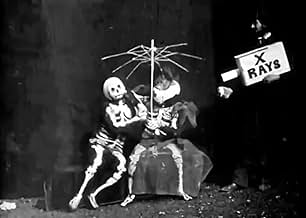
As for this short subject, it is a racy one for 1897, showing a couple sparking, when along comes a man with an X-Ray machine. One zap and suddenly we are looking at a couple of intertwined skeletons and umbrella ribs.
For 1897 this is moderately advanced, even though Melies was doing such things regularly. And the camera cut that produces the effect is not intended as a grammatical punctuation, but more on the order of a scientific magic trick. It wouldn't be until the following year that we would see a clearly developing film grammar out of Mr. Smith....
As for this short subject, it is a racy one for 1897, showing a couple sparking, when along comes a man with an X-Ray machine. One zap and suddenly we are looking at a couple of intertwined skeletons and umbrella ribs.
For 1897 this is moderately advanced, even though Melies was doing such things regularly. And the camera cut that produces the effect is not intended as a grammatical punctuation, but more on the order of a scientific magic trick. It wouldn't be until the following year that we would see a clearly developing film grammar out of Mr. Smith....
Nice Science Fiction
X-Ray Fiend, The (1897)
*** (out of 4)
Forgotten sci-fi/comedy about a man and woman who are flirting with one another when another man comes up to them with an x-ray machine, zaps them and turns them into skeletons. This "trick" movie was clearly influenced by the work of Georges Melies but it still has enough charm to make it worth viewing. The interesting thing about this film is that it features x-rays not too long after they were actually discovered so we have a very early "idea" of what they are and how to use them. Obviously the way they're used here makes the film science fiction but at the same time it's a fun idea and one that makes for some good entertainment. At only 45-seconds the film doesn't last too long so don't expect any type of long-running story. Instead, we get a simple joke but the effects are nicely done and in the end this is certainly worth watching (on YouTube of course).
*** (out of 4)
Forgotten sci-fi/comedy about a man and woman who are flirting with one another when another man comes up to them with an x-ray machine, zaps them and turns them into skeletons. This "trick" movie was clearly influenced by the work of Georges Melies but it still has enough charm to make it worth viewing. The interesting thing about this film is that it features x-rays not too long after they were actually discovered so we have a very early "idea" of what they are and how to use them. Obviously the way they're used here makes the film science fiction but at the same time it's a fun idea and one that makes for some good entertainment. At only 45-seconds the film doesn't last too long so don't expect any type of long-running story. Instead, we get a simple joke but the effects are nicely done and in the end this is certainly worth watching (on YouTube of course).
10hlxaxa
With The X-Ray Fiend, cinema stops being just a medium for recording the visible and becomes a magic mirror for scientific imagination, hidden desire, and technical fantasy
Some films open doors to narrative. Others to drama. Others still, to laughter. But The X-Ray Fiend, released in 1897, does something even more singular: it opens the door to the invisible, inviting late 19th-century viewers to see-with the eyes of fantasy-what reality had previously kept hidden. In just 44 seconds, George Albert Smith achieves a remarkable feat: fusing science, humor, and visual effect into an early and visionary visual allegory, making it one of the very first trick films in cinema history-and among the first to use image overlay to create narrative illusion.
The film presents a well-dressed couple sitting side by side when, suddenly, a "technician" appears with an X-ray machine and points it at them. Instantly, their bodies transform into skeletons-first the woman, then the man. They continue their gestures-the skeletal woman with her umbrella, the man still flirting-as if their bones had unveiled a new layer of identity and desire. Then, just as quickly, everything returns to normal. Short, direct, and ingenious.
At its core, The X-Ray Fiend is a burlesque scientific fantasy. In 1895, X-rays had just been discovered by Wilhelm Röntgen. In less than two years, they were already being used as aesthetic and dramatic inspiration in film-a pace of artistic appropriation that still astonishes. Smith, with his sensitivity to the magical and the illusory, understood that cinema was more than a window to the world-it was a tool to reveal what the naked eye could not.
Technically, the film is notable. Smith employs an ingenious and pioneering editing effect: he first films the actors in action wearing their original costumes, then shoots them again-repeating the same gestures-wearing painted skeleton costumes. In editing, he stitches these shots together to create the illusion of transformation-one of the earliest visual tricks in cinema. The result is rudimentary, yes, but absolutely revolutionary in its ambition. Smith anticipates, decades ahead of time, an entire lineage of visual effects based on photographic composition-from Méliès to modern CGI, there is a direct echo in this first manipulation of the cinematic image.
But what captivates most about The X-Ray Fiend is not just the technique-it's the idea behind it: cinema's ability to unveil. The film plays with the voyeuristic gaze, the desire to see beyond the clothes, beyond appearances-into the interior. It's a small gesture of scientific mischief, but also an aesthetic provocation: what if we could, through a lens, see the essence of everything?
And there's humor-a strange, almost macabre humor-that foreshadows cinema's long fascination with skeletons as both symbols of death and sources of laughter. After all, a dancing body reduced to animated bones becomes both comic and unsettling. This duality would be explored for decades in cartoons, comedies, and horror films alike.
George Albert Smith, a key figure in Britain's "Brighton School" of early cinema, reveals here his precocious genius. In The X-Ray Fiend, he doesn't just entertain-he expands the very boundaries of what cinema can be. More than a technical curiosity, this film is a miniature revolution of the imagination: the first time cinema projects, quite literally, the invisible.
With The X-Ray Fiend, cinema stops being just a medium for recording the visible and becomes a magic mirror for scientific imagination, hidden desire, and technical fantasy. Forty-four seconds that foretold decades of tricks, illusions, and visual wonders. From this moment on, nothing on screen would be merely what it seemed.
And that-like the X-ray itself-is precisely what cinema teaches us to see.
Original review in portuguese on substack.
The film presents a well-dressed couple sitting side by side when, suddenly, a "technician" appears with an X-ray machine and points it at them. Instantly, their bodies transform into skeletons-first the woman, then the man. They continue their gestures-the skeletal woman with her umbrella, the man still flirting-as if their bones had unveiled a new layer of identity and desire. Then, just as quickly, everything returns to normal. Short, direct, and ingenious.
At its core, The X-Ray Fiend is a burlesque scientific fantasy. In 1895, X-rays had just been discovered by Wilhelm Röntgen. In less than two years, they were already being used as aesthetic and dramatic inspiration in film-a pace of artistic appropriation that still astonishes. Smith, with his sensitivity to the magical and the illusory, understood that cinema was more than a window to the world-it was a tool to reveal what the naked eye could not.
Technically, the film is notable. Smith employs an ingenious and pioneering editing effect: he first films the actors in action wearing their original costumes, then shoots them again-repeating the same gestures-wearing painted skeleton costumes. In editing, he stitches these shots together to create the illusion of transformation-one of the earliest visual tricks in cinema. The result is rudimentary, yes, but absolutely revolutionary in its ambition. Smith anticipates, decades ahead of time, an entire lineage of visual effects based on photographic composition-from Méliès to modern CGI, there is a direct echo in this first manipulation of the cinematic image.
But what captivates most about The X-Ray Fiend is not just the technique-it's the idea behind it: cinema's ability to unveil. The film plays with the voyeuristic gaze, the desire to see beyond the clothes, beyond appearances-into the interior. It's a small gesture of scientific mischief, but also an aesthetic provocation: what if we could, through a lens, see the essence of everything?
And there's humor-a strange, almost macabre humor-that foreshadows cinema's long fascination with skeletons as both symbols of death and sources of laughter. After all, a dancing body reduced to animated bones becomes both comic and unsettling. This duality would be explored for decades in cartoons, comedies, and horror films alike.
George Albert Smith, a key figure in Britain's "Brighton School" of early cinema, reveals here his precocious genius. In The X-Ray Fiend, he doesn't just entertain-he expands the very boundaries of what cinema can be. More than a technical curiosity, this film is a miniature revolution of the imagination: the first time cinema projects, quite literally, the invisible.
With The X-Ray Fiend, cinema stops being just a medium for recording the visible and becomes a magic mirror for scientific imagination, hidden desire, and technical fantasy. Forty-four seconds that foretold decades of tricks, illusions, and visual wonders. From this moment on, nothing on screen would be merely what it seemed.
And that-like the X-ray itself-is precisely what cinema teaches us to see.
Original review in portuguese on substack.
His hand bone's connected to her thigh bone
'The X-Ray Fiend' is a very short film produced and directed by the Victorian showman George Albert Smith. This is a 'trick' film: one of many such films made before 1910, inspired by the movies of Georges Melies, in which the very thin plot of the film is merely a vehicle for trick photography. 'The X-Ray Fiend' is more interesting than most other films of this genre, because it deals with a recent scientific discovery. Wilhelm Roengten had discovered x-rays in November 1895 (about sixteen months before this movie was made): 'The X-Ray Fiend' deals satirically with Roentgen's discovery at a time when it was still new and miraculous.
In this short film, a young couple are embracing: this by itself was a fairly strong image for the sedate filmgoers of 1897. They are so rapt in each other's attentions that they fail to notice a bizarre-looking professor who arrives, toting a weird apparatus which he aims at them. This turns out to be an x-ray projector. When the professor switches it on, the outer bodies of the man and woman turn invisible, and now we see their skeletons. The two skeletons are still embracing, blissfully unaware of their transformation.
It would have been more interesting if the x-ray projector had worked more gradually, so that we first see the couple's clothing fading away to reveal their naked bodies underneath ... followed by the fading of their flesh to reveal their musculature, and only then skeletonising them. No such luck.
This is a crude film, with trickery that is very obvious from our modern standpoint, but it has some historical value, and it's so bizarre that it still retains some humour. I'll rate this movie 4 points out of 10.
In this short film, a young couple are embracing: this by itself was a fairly strong image for the sedate filmgoers of 1897. They are so rapt in each other's attentions that they fail to notice a bizarre-looking professor who arrives, toting a weird apparatus which he aims at them. This turns out to be an x-ray projector. When the professor switches it on, the outer bodies of the man and woman turn invisible, and now we see their skeletons. The two skeletons are still embracing, blissfully unaware of their transformation.
It would have been more interesting if the x-ray projector had worked more gradually, so that we first see the couple's clothing fading away to reveal their naked bodies underneath ... followed by the fading of their flesh to reveal their musculature, and only then skeletonising them. No such luck.
This is a crude film, with trickery that is very obvious from our modern standpoint, but it has some historical value, and it's so bizarre that it still retains some humour. I'll rate this movie 4 points out of 10.


Details
- Runtime
- 1m
- Color
- Sound mix
Contribute to this page
Suggest an edit or add missing content