IMDb RATING
6.2/10
1.5K
YOUR RATING

A religious woman seeks to save her people from destruction by seducing and murdering the enemy leader, but her plans get complicated once she falls for him.A religious woman seeks to save her people from destruction by seducing and murdering the enemy leader, but her plans get complicated once she falls for him.A religious woman seeks to save her people from destruction by seducing and murdering the enemy leader, but her plans get complicated once she falls for him.




Lionel Barrymore
- Extra
- (uncredited)

Clara T. Bracy
- Bethulian
- (uncredited)
Kathleen Butler
- Bethulian
- (uncredited)
William J. Butler
- Bethulian
- (uncredited)

Christy Cabanne
- Extra
- (unconfirmed)
- (uncredited)

William A. Carroll
- Assyrian Soldier
- (uncredited)

Edward Dillon
- Extra
- (unconfirmed)
- (uncredited)

Louise Emmons
- Bethulian Begging for Food
- (uncredited)
6.21.5K
1
2
3
4
5
6
7
8
9
10
Featured reviews
Griffith's Admirable Attempt at a Full-length Feature
Judith of Bethulia tells the story of the Assyrian attack on the Israelite city of Bethulia led by Holofernes (Henry Walthall), and devout widow Judith (Blanche Sweet) who is to be the savior of her people.
Judith of Bethulia is the precursor to Griffith epics such as Intolerance and Birth of a Nation. The film itself somehow lacks the harmony that the following films do, but this was Griffith's first attempt at a full-length feature (though it was his second to be released), and for that props must be given. In fact, he composed it without the knowledge Biograph, for the company had decided against producing anything longer than two reels. Biograph refused to release the film until 1914, by which time Griffith had left the studio.
It is evident that the finished product is not what Griffith intended. The subplot between lovers Naomi (Mae Marsh) and Nathan (Robert Harron) is somewhat abandoned for the primary action between Judith and Holofernes, and then is re-acknowledged and tied up very quickly. His impeccable story telling and ability to evoke emotion are evident as always and the film is very engaging, but I cannot help but feel that the film is lacking in some aspect. The sets and costumes are however gorgeous as are the performances by the cast. Had Biograph been initially supportive of Griffith's dream, I believe the film could have been a masterpiece equaling Intolerance. We are instead left with a beautiful early attempt at such an epic.
Judith of Bethulia is the precursor to Griffith epics such as Intolerance and Birth of a Nation. The film itself somehow lacks the harmony that the following films do, but this was Griffith's first attempt at a full-length feature (though it was his second to be released), and for that props must be given. In fact, he composed it without the knowledge Biograph, for the company had decided against producing anything longer than two reels. Biograph refused to release the film until 1914, by which time Griffith had left the studio.
It is evident that the finished product is not what Griffith intended. The subplot between lovers Naomi (Mae Marsh) and Nathan (Robert Harron) is somewhat abandoned for the primary action between Judith and Holofernes, and then is re-acknowledged and tied up very quickly. His impeccable story telling and ability to evoke emotion are evident as always and the film is very engaging, but I cannot help but feel that the film is lacking in some aspect. The sets and costumes are however gorgeous as are the performances by the cast. Had Biograph been initially supportive of Griffith's dream, I believe the film could have been a masterpiece equaling Intolerance. We are instead left with a beautiful early attempt at such an epic.
Griffith Makes it Reels
Upon release, the said to be the longest film feature ever - the biblical-era "Judith of Bethulia". Notably directed by D.W. Griffith, it's really not as good as some of his previous releases; in hindsight, its length is perhaps its most remembered feature.
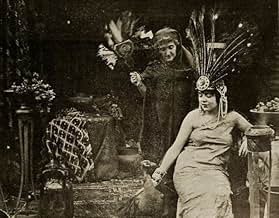
The story centers on Judith (Blanche Sweet) courageously figuring to save her city (Bethulia) from the invading army of the conqueror Holofernes (Henry B. Walthall). To wit, Ms. Sweet dresses herself up in order to seduce Mr. Walthall. She looks more ridiculous than seductive, with what looks like a peacock on her head. Walthall's other ladies, and eunuch (!), look more fetching.
A marvelous actor, Walthall doesn't have much to do in "Judith". The acting honors are stolen, early on, by Mae Marsh and Robert Harron, perhaps because they were directed to walk around without over-emoting. There are some exciting battle sequences.
****** Judith of Bethulia (3/8/14) D.W. Griffith ~ Blanche Sweet, Henry B. Walthall, Mae Marsh, Robert Harron
The story centers on Judith (Blanche Sweet) courageously figuring to save her city (Bethulia) from the invading army of the conqueror Holofernes (Henry B. Walthall). To wit, Ms. Sweet dresses herself up in order to seduce Mr. Walthall. She looks more ridiculous than seductive, with what looks like a peacock on her head. Walthall's other ladies, and eunuch (!), look more fetching.
A marvelous actor, Walthall doesn't have much to do in "Judith". The acting honors are stolen, early on, by Mae Marsh and Robert Harron, perhaps because they were directed to walk around without over-emoting. There are some exciting battle sequences.
****** Judith of Bethulia (3/8/14) D.W. Griffith ~ Blanche Sweet, Henry B. Walthall, Mae Marsh, Robert Harron
The wheels of a cinema revolution beginning to churn.
D.W. Griffith fuses Thomas Bailey Aldrich's long poem of Judith's story with its basis in the Apocrypha to derive this somewhat austere and powerful film of the widow's noble sacrifice to save her besieged city and its inhabitants from an invading Assyrian army, led by Holofernes. With JUDITH as Griffith's first feature length effort, he turns away from the commercial needs of the Biograph Company, the management of which desires to maintain its policy of making only one and two reelers, and his expenditure of $36000 is double the amount budgeted, reflecting his expanded use of sets and extras and providing the requisite exercise in preparation for his next major work: BIRTH OF A NATION, made as a free agent. Eighteen year old Blanche Sweet's performance is striking as she utilizes all of her wide range of expressivity, uncommon in one so young, to mirror the emotions of a woman who is physically attracted to a man, Henry Walthall as Holofernes, toward whom her only possible final act will be his death by her hand, as depicted in many a well-known painting. The supporting cast serves the sparsely titled production well, with emotional performances from Mae Marsh and Robert Harron as endangered lovers, and among the many bit players who animate the work may be seen Lionel Barrymore, Harry Carey, Antonio Moreno and Lillian and Dorothy Gish as victims of the invaders. This version is the four reeler rather than the one of six reels released later and is Griffith's answer to the full-length epics which were being imported from Europe; its release was delayed a year by Biograph to ensure that the director had left its employ, but this brought scant gain to the company: Biograph was soon defunct, while Griffith's star was rising.
Stunning Blanche Sweet
The first feature-length film from DW Griffith, JUDITH OF BETHULIA tells the story of a young widow who saves her city (Bethulia) from the Assyrians by an act of treachery.
It's a warm-up for Griffith's masterpiece, INTOLERANCE, a few years later but still has merit of its own despite hammy acting and lackluster sets.
Blanche Sweet (then 18) stars as Judith and is very pretty but the acting style (it is 1914 after all) is still crude with waving arms and long dramatic poses. Henry B. Walthall is the head of the Assyrian army, Mae Marsh and Robert Harron play the young lovers, Lillian Gish is a young mother, Dorothy Gish is a young cripple, Kate Bruce is the loyal maid, Harry Carey is the traitor.
The extras (in heavy makeup) include Lionel Barrymore, Antonio Moreno, Elmo Lincoln, Mary Gish (mother of the stars), and someone named J. Jiquel Lanoe who is quite excellent as the head eunuch.
Certainly worth a look but this seems very amateurish compared to what was coming. The film is also famous for going well over budget and getting Griffith fired from Biograph Studio.
It's a warm-up for Griffith's masterpiece, INTOLERANCE, a few years later but still has merit of its own despite hammy acting and lackluster sets.
Blanche Sweet (then 18) stars as Judith and is very pretty but the acting style (it is 1914 after all) is still crude with waving arms and long dramatic poses. Henry B. Walthall is the head of the Assyrian army, Mae Marsh and Robert Harron play the young lovers, Lillian Gish is a young mother, Dorothy Gish is a young cripple, Kate Bruce is the loyal maid, Harry Carey is the traitor.
The extras (in heavy makeup) include Lionel Barrymore, Antonio Moreno, Elmo Lincoln, Mary Gish (mother of the stars), and someone named J. Jiquel Lanoe who is quite excellent as the head eunuch.
Certainly worth a look but this seems very amateurish compared to what was coming. The film is also famous for going well over budget and getting Griffith fired from Biograph Studio.
JUDITH OF BETHULIA (D. W. Griffith, 1914) **1/2
This was something of a milestone – denoting a leap for pioneer D.W. Griffith from his customary one or two-reelers to a then considerable length of 49 minutes in this version (its length may vary on account of differing speeds utilized during projection of Silent movies) as well as from a modern-day, or at least American, setting towards apparently unlimited scope. In that regard alone, JUDITH OF BETHULIA is worthy of attention – but Griffith's Victorian sensibilities (which he could never, or would not, shake off) still ground it into the antediluvian quality of film-making which is perhaps the most common objection raised by certain viewers nowadays to watching Silent pictures! Anyway, this was obviously inspired by the Old Testament tale in which a saintly woman sacrifices her dignity in order to release the Jewish people (depicted as long-bearded stereotypes which would not go down well today!) from oppression by the Assyrian army: she ingratiates herself within the affections of King Holofernes, whom she gets drunk one night and decapitates – after which the invaders disperse. Apart from a lengthy offensive outside the city walls, the running-time is padded-out with the plight of a young couple (the boy is a brave warrior and the girl eventually enslaved inside the enemy camp) and, also appearing from time to time, is Lillian Gish in a typical role symbolizing motherhood. Unfortunately, the print I acquired of this 95-year old title was extremely fuzzy – rendering the elaborate and often chaotic visuals even harder to make out – and it was accompanied besides by one of the most incongruous scores I have ever heard, approximating to a circus jingle (complete with laugh track!) which one finds at its most jubilant when the on-screen events seem to demand emotions of an entirely different nature!!


Did you know
- TriviaAlthough the film was completed in 1913, Biograph delayed its release until 1914, after D. W. Griffith left the company, so that it would not have to pay him in a profit-sharing agreement they had.
- GoofsWhen Judith goes out into the city and begins to bless the young mother's baby, an extra enters the shot in the left foreground, blocking the action. She or he quickly retreats back out of view, as someone obviously yelled out.
- ConnectionsEdited into Her Condoned Sin (1917)
Details
Box office
- Budget
- $40,000 (estimated)
- Runtime
- 1h 1m(61 min)
- Color
- Sound mix
- Aspect ratio
- 1.33 : 1
Contribute to this page
Suggest an edit or add missing content