
A restless young man travels west, encountering adventure, romance, and danger.A restless young man travels west, encountering adventure, romance, and danger.A restless young man travels west, encountering adventure, romance, and danger.


- Director
- Writers
- All cast & crew
- Production, box office & more at IMDbPro
6.6376
1
2
3
4
5
6
7
8
9
10
Featured reviews
Fairbanks before his prime time period in the '20s...
DOUGLAS FAIRBANKS was quite the swashbuckler of his era in the 1920s, especially during the time of his biggest triumphs in ROBIN HOOD, THE THIEF OF BAGDAD, THE MARK OF ZORRO and THE BLACK PIRATE.
But this is an early relic from his silent screen career as early as 1917, and, of course, has to be judged by today's standards of film-making for any potential viewers outside of curious film buffs who want to see it.
Fairbanks was athletic and agile enough, but always looked middle-aged, even though here he's only 34. Furthermore, he looked husky rather than trim--unlike his son, Douglas Fairbanks, Jr., a much better looking man. But his physical prowess is amazing. He clambers over fences, cars, horses in a mere jump. He climbs up over anything in his way with the ease of a monkey swinging through trees, exuberantly smiling while he struts his way through whatever impediment is in his way.
And the film itself, for a relic that was filmed in 1917, is in amazingly good condition, fully restored and with a jaunty background score that is not jarring and obtrusive the way so many of the silent film scores were.
The story is really two stories that run concurrently: the D'Artagnan legend is illustrated in a few brief scenes of derring-do with Fairbanks rescuing a damsel in distress. The young Kansas man who desperately wants to leave his provincial roots (in a scene deliriously overplayed by Fairbanks) is also anxious to have a life of adventure and romance, like D'Artagnan. His father and mother give him their blessing and send him on his way--and the rest of the plot is predictable but fun to watch as he finds his own damsel in distress to rescue from a villainous man.
Fun, and thin on plot--but it does move as briskly as Fairbanks himself. Amusing to realize that only twenty years later, his son, Douglas Fairbanks, Jr. would be in a little swashbuckler called THE PRISONER OF ZENDA.
But this is an early relic from his silent screen career as early as 1917, and, of course, has to be judged by today's standards of film-making for any potential viewers outside of curious film buffs who want to see it.
Fairbanks was athletic and agile enough, but always looked middle-aged, even though here he's only 34. Furthermore, he looked husky rather than trim--unlike his son, Douglas Fairbanks, Jr., a much better looking man. But his physical prowess is amazing. He clambers over fences, cars, horses in a mere jump. He climbs up over anything in his way with the ease of a monkey swinging through trees, exuberantly smiling while he struts his way through whatever impediment is in his way.
And the film itself, for a relic that was filmed in 1917, is in amazingly good condition, fully restored and with a jaunty background score that is not jarring and obtrusive the way so many of the silent film scores were.
The story is really two stories that run concurrently: the D'Artagnan legend is illustrated in a few brief scenes of derring-do with Fairbanks rescuing a damsel in distress. The young Kansas man who desperately wants to leave his provincial roots (in a scene deliriously overplayed by Fairbanks) is also anxious to have a life of adventure and romance, like D'Artagnan. His father and mother give him their blessing and send him on his way--and the rest of the plot is predictable but fun to watch as he finds his own damsel in distress to rescue from a villainous man.
Fun, and thin on plot--but it does move as briskly as Fairbanks himself. Amusing to realize that only twenty years later, his son, Douglas Fairbanks, Jr. would be in a little swashbuckler called THE PRISONER OF ZENDA.
Doug's Arizona Adventure
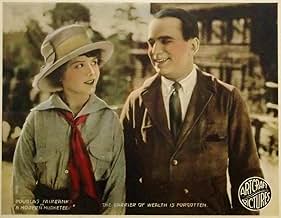
Boyish adventurer Douglas Fairbanks (as Ned Thacker) imagines himself as an Alexandre Dumas-like "D'Artagnan of Kansas", but local town-folk aren't taken by his chivalrous "Three Musketeers" routine. On the road seeking greener pastures, Mr. Fairbanks meets sweet young Marjorie Daw (as Elsie Dodge). She is promised, however, to middle-aged millionaire Eugene Ormonde (as Forrest Vandeteer). Their love story takes a back seat to Fairbanks' athletic antics, with trusty Tully Marshall (as James Brown) providing his usual good support.
Tully comes in handy when Navajo nasty Frank Campeau (as Chin-de-dah) goes out looking for a "white woman" for sex - of course, she's also Fairbanks' choice for a mate. A Native American Indian, Mr. Campeau greets Fairbanks by saying "How," and ends up with egg on his face. The cast and crew stay at the El Tovar Hotel, with the backdrop of Arizona's "Grand Canyon" providing an exciting location for Fairbanks and company. "A Modern Musketeer" was missing a couple of reels until recently. Now, a full-length restoration is available.
***** A Modern Musketeer (12/30/17) Allan Dwan ~ Douglas Fairbanks, Marjorie Daw, Tully Marshall, Frank Campeau
Tully comes in handy when Navajo nasty Frank Campeau (as Chin-de-dah) goes out looking for a "white woman" for sex - of course, she's also Fairbanks' choice for a mate. A Native American Indian, Mr. Campeau greets Fairbanks by saying "How," and ends up with egg on his face. The cast and crew stay at the El Tovar Hotel, with the backdrop of Arizona's "Grand Canyon" providing an exciting location for Fairbanks and company. "A Modern Musketeer" was missing a couple of reels until recently. Now, a full-length restoration is available.
***** A Modern Musketeer (12/30/17) Allan Dwan ~ Douglas Fairbanks, Marjorie Daw, Tully Marshall, Frank Campeau
Things to Come
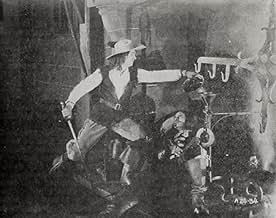
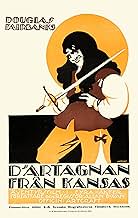
This Douglas Fairbanks vehicle has been noted for its scenes of Fairbanks dressed as D'Artagnan ("The Three Musketeers") anticipating the star's later redirection of his career in the 1920s to more prestigious, costume/historical swashbucklers. Otherwise, "A Modern Musketeer" is similar to the usual modern comedies Fairbanks made before "The Mark of Zorro" and "The Three Musketeers" transformed his career. His scenes as D'Artagnan are only a small part of the picture-mostly the opening sequence where Doug swordfights every man in a tavern to humorously retrieve a lady's handkerchief. Framing this sequence, Fairbanks literally winks at the camera, which the Flicker Alley commentary suggests was to reassure audiences that they were watching the same old Doug, who had by this time firmly established a popular comedic screen persona.
I like Fairbanks's comedies and have viewed about every complete one I could find on home video, but, admittedly, even the best formulas eventually get tiresome and in need of some revision and innovation. The first part of "A Modern Musketeer" is, thus, interestingly unusual. Besides the opening swashbuckling, other sequences seem to be in non-chronological order: first, there's a mythological past of D'Artagnan with a modern sense of humor, then a near-contemporary scene where modern Doug destroys another, but modern, tavern, as he again knocks men about to defend a woman's honor, followed by the cyclone scene of Doug's character's birth and, then, another near-present scene on a streetcar involving giving up seats for ladies. After this, we mostly follow the main chronological story as our hero leaves home and eventually saves the day at the Grand Canyon.
As in his other comedies, Fairbanks is established as out-of-place in modern society, for his restless exuberance and chivalry at the expense of clobbering any fellow seeming to be in his way. The film suggests that this kind of man was more at home in the past, such as in the case of D'Artagnan. The setting of historical swashbucklers befitted Fairbanks's persona, whereas the modern comedies found their comedy in Fairbanks's awkwardness in modern times and his transformation within those constraints. He doesn't belong in his small hometown in Kansas, so he leaves for adventure.
Overall, this is a good Fairbanks comedy. It's the earliest one I've seen directed by Allan Dwan, who was taking over for John Emerson as the star's main director. Apparently, scenarist and title writer Anita Loos had also already departed from Fairbanks's team of filmmakers, but her influence continued to be seen in witty title cards such as this one: "After Fording the desert-- Note:--please pardon the pun." The "note" part, as the DVD commentary points out, is a clever jab at D.W. Griffith, who included historical footnotes, often dubiously, in title cards for his historical epics, such as "The Birth of a Nation".
Some final technical notes: the tornado scene features some decent special effects for 1917, including the use of miniatures. Lots of structures fall over and apart, but there isn't nearly enough dust blowing around to make the scene more realistic. This sequence and the dam break climax in Fairbanks's "When the Clouds Roll by" seem to have had a strong influence on Buster Keaton, who included similar scenes in his later comedies. Additionally, the direction and editing are generally sharp here, as in other Fairbanks's films, but there is one particularly sloppy match-on-action cut about 30 minutes in where there's a temporal replay as the scene cuts to a closer view. Finally, the photography of the Grand Canyon is pretty good.
I like Fairbanks's comedies and have viewed about every complete one I could find on home video, but, admittedly, even the best formulas eventually get tiresome and in need of some revision and innovation. The first part of "A Modern Musketeer" is, thus, interestingly unusual. Besides the opening swashbuckling, other sequences seem to be in non-chronological order: first, there's a mythological past of D'Artagnan with a modern sense of humor, then a near-contemporary scene where modern Doug destroys another, but modern, tavern, as he again knocks men about to defend a woman's honor, followed by the cyclone scene of Doug's character's birth and, then, another near-present scene on a streetcar involving giving up seats for ladies. After this, we mostly follow the main chronological story as our hero leaves home and eventually saves the day at the Grand Canyon.
As in his other comedies, Fairbanks is established as out-of-place in modern society, for his restless exuberance and chivalry at the expense of clobbering any fellow seeming to be in his way. The film suggests that this kind of man was more at home in the past, such as in the case of D'Artagnan. The setting of historical swashbucklers befitted Fairbanks's persona, whereas the modern comedies found their comedy in Fairbanks's awkwardness in modern times and his transformation within those constraints. He doesn't belong in his small hometown in Kansas, so he leaves for adventure.
Overall, this is a good Fairbanks comedy. It's the earliest one I've seen directed by Allan Dwan, who was taking over for John Emerson as the star's main director. Apparently, scenarist and title writer Anita Loos had also already departed from Fairbanks's team of filmmakers, but her influence continued to be seen in witty title cards such as this one: "After Fording the desert-- Note:--please pardon the pun." The "note" part, as the DVD commentary points out, is a clever jab at D.W. Griffith, who included historical footnotes, often dubiously, in title cards for his historical epics, such as "The Birth of a Nation".
Some final technical notes: the tornado scene features some decent special effects for 1917, including the use of miniatures. Lots of structures fall over and apart, but there isn't nearly enough dust blowing around to make the scene more realistic. This sequence and the dam break climax in Fairbanks's "When the Clouds Roll by" seem to have had a strong influence on Buster Keaton, who included similar scenes in his later comedies. Additionally, the direction and editing are generally sharp here, as in other Fairbanks's films, but there is one particularly sloppy match-on-action cut about 30 minutes in where there's a temporal replay as the scene cuts to a closer view. Finally, the photography of the Grand Canyon is pretty good.
A Chivalrous Man
This will be one of the more enjoyable silent movies you'll come across - restored by the Danish Film Institute and of very good quality, and starring one of the greats of the silent era - Douglas Fairbanks, Sr. - as Ned Thacker, a man raised in Kansas being read the stories of D'Artagnan by his mother, and who grows up to be a modern day version of the musketeer, defending the honour of women at every step.
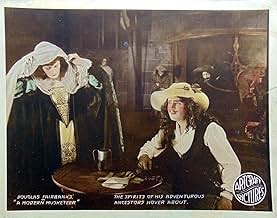
The movie opens with two really good fight scenes - a swashbuckling look back at D'Artagnan (also played by Fairbanks) as he fights to re-claim a woman's handkerchief, and our first look at Thatcher in a bar-room brawl as he defends the honour of a woman he thought was being treated poorly by her male companion. These were both fun scenes, and I enjoyed the unexpected humour as we got a glimpse of how Ned started his career as a chivalrous man by being arrested on a streetcar as he demands that a man give up his seat for two women, only to discover that the man was the chief of police! So the story had a good start.
If it lost its way a bit, it was in the decision to then focus exclusively on Ned's pursuit of Elsie Dodge (Marjorie Daw) - a young woman being forced by her mother into a relationship with a rich man in order to help pay bills. I thought the story might have been more effective if it had continued to be a series of vignettes of Thacker defending women in various circumstances. The move into the Grand Canyon, and the introduction of the bad Indian Chin-de-dah (Frank Campeau) - who fancies himself a king and decides he's going to kidnap and marry Elsie - struck me as an unnecessary diversion, which ended up as far more than a diversion - it becomes the story.
Still, if that goes a little too far, this was still a fun movie. There's no doubt about that. I enjoyed Fairbanks. Overall I thought both the movie and Fairbanks had the feel of something you might have seen remade by Bob Hope in the 1940's - a light, silly, Western-oriented comedy. A typical line, for example, that I could easily have seen put on Hope's mouth (which, of course, in this is simply a caption) comes as Ned and Elsie look at the splendour of the Grand Canyon and Ned says "Golly. A gully." That's the sort of light comedy I hear coming from Hope's mouth. This has a lot of that, and some good action scenes, and those opening fight scenes that really do draw you in. (7/10)
The movie opens with two really good fight scenes - a swashbuckling look back at D'Artagnan (also played by Fairbanks) as he fights to re-claim a woman's handkerchief, and our first look at Thatcher in a bar-room brawl as he defends the honour of a woman he thought was being treated poorly by her male companion. These were both fun scenes, and I enjoyed the unexpected humour as we got a glimpse of how Ned started his career as a chivalrous man by being arrested on a streetcar as he demands that a man give up his seat for two women, only to discover that the man was the chief of police! So the story had a good start.
If it lost its way a bit, it was in the decision to then focus exclusively on Ned's pursuit of Elsie Dodge (Marjorie Daw) - a young woman being forced by her mother into a relationship with a rich man in order to help pay bills. I thought the story might have been more effective if it had continued to be a series of vignettes of Thacker defending women in various circumstances. The move into the Grand Canyon, and the introduction of the bad Indian Chin-de-dah (Frank Campeau) - who fancies himself a king and decides he's going to kidnap and marry Elsie - struck me as an unnecessary diversion, which ended up as far more than a diversion - it becomes the story.
Still, if that goes a little too far, this was still a fun movie. There's no doubt about that. I enjoyed Fairbanks. Overall I thought both the movie and Fairbanks had the feel of something you might have seen remade by Bob Hope in the 1940's - a light, silly, Western-oriented comedy. A typical line, for example, that I could easily have seen put on Hope's mouth (which, of course, in this is simply a caption) comes as Ned and Elsie look at the splendour of the Grand Canyon and Ned says "Golly. A gully." That's the sort of light comedy I hear coming from Hope's mouth. This has a lot of that, and some good action scenes, and those opening fight scenes that really do draw you in. (7/10)
Good Action
Modern Musketeer, The (1917)
*** (out of 4)
Fun silent film has Douglas Fairbanks playing a man living in Kansas with his parents who dreams of a more exciting life. Ever since he was a child his mother read to him The Three Musketeers so as an adult he grows tired of his town and heads out west in hopes of romance and adventure. Until recently the second half of this film was lost but it was eventually found and the film recently premiered on Turner Classic Movies. A lot of lost movies that get found are usually big letdowns but this film here actually is pretty good and should keep action fans entertained. The film opens up with a wild, ten minute sequence, which contains just about every type of action you can imagine. We have wild fist fights, broken glasses and various other items. The lively action at the start of the film makes the movie slow down a tad too much in the middle but the movie ends with more great action as Fairbanks must battle Indians. Fairbanks is very energetic in his role and makes a great character here. Another bonus is a terrific wind storm that happens at the start of the film and the special effects here of the city being blown down are very good for their time. Future director Victor Fleming worked as the cinematographer.
*** (out of 4)
Fun silent film has Douglas Fairbanks playing a man living in Kansas with his parents who dreams of a more exciting life. Ever since he was a child his mother read to him The Three Musketeers so as an adult he grows tired of his town and heads out west in hopes of romance and adventure. Until recently the second half of this film was lost but it was eventually found and the film recently premiered on Turner Classic Movies. A lot of lost movies that get found are usually big letdowns but this film here actually is pretty good and should keep action fans entertained. The film opens up with a wild, ten minute sequence, which contains just about every type of action you can imagine. We have wild fist fights, broken glasses and various other items. The lively action at the start of the film makes the movie slow down a tad too much in the middle but the movie ends with more great action as Fairbanks must battle Indians. Fairbanks is very energetic in his role and makes a great character here. Another bonus is a terrific wind storm that happens at the start of the film and the special effects here of the city being blown down are very good for their time. Future director Victor Fleming worked as the cinematographer.


Did you know
- TriviaMarjorie Daw and Kathleen Kirkham, daughter and mother, were seven years apart in age. Daw was only 15(!) when this film was made, which means that she was closer in age to the actress playing her mother than she was to the actor playing her leading man (Douglas Fairbanks was 18 years her senior).
- GoofsWhen Chin-de-dah leads Vandeteer and Elsie through the Canyon, the shadows of the cameraman and another crew member are visible on the ground.
- Crazy creditsExcept for Douglas Fairbanks, whose name appears above the title, there is no cast list. Actors are introduced by intertitle cards just before they appear on the screen. The IMDb cast list therefore uses this "order of appearance" sequence.
- Alternate versionsIn 2006, the Danish Film Institute copyrighted a 68-minute version of this film, with a musical score played by the Mont Alto Orchestra. Additional restoration and music credits stretch the time to 69 minutes.
- ConnectionsReferenced in Chaplin (1992)
Details
- Runtime
- 1h 8m(68 min)
- Sound mix
- Aspect ratio
- 1.33 : 1
Contribute to this page
Suggest an edit or add missing content