
When the king is drugged and abducted by his ambitious brother, a lookalike relative must take his place to keep the evil sibling off the throne.When the king is drugged and abducted by his ambitious brother, a lookalike relative must take his place to keep the evil sibling off the throne.When the king is drugged and abducted by his ambitious brother, a lookalike relative must take his place to keep the evil sibling off the throne.
- Awards
- 1 win total


Ramon Novarro
- Rupert of Hentzau
- (as Ramon Samaniegos)


Fairfax Burger
- Bersonin
- (as Fairfax Burgher)
S.E. Jennings
- De Gautet
- (as Al Jennings)
Ted Billings
- Train Passenger Eating Banana
- (uncredited)

Carrie Daumery
- Lady-in-Waiting
- (uncredited)
Bynunsky Hyman
- Coronation Parade Spectator
- (uncredited)

Eric Mayne
- Lord Burlesdon - Rudolf's Brother
- (uncredited)

Lon Poff
- Archbishop
- (uncredited)
- Director
- Writers
- All cast & crew
- Production, box office & more at IMDbPro
6.8593
1
2
3
4
5
6
7
8
9
10
Featured reviews
"While you're unhung, Rentzau, hell lacks its master"
A retiring English country gentleman, Rassendyll, is mistaken for his distant cousin, King Rudolph of Ruritania. When the king is taken hostage by his jealous brother, Black Michael, Rassendyll agrees to act as the king in the coronation ceremony.
It takes a long time for this version of 'The Prisoner of Zenda' to get moving. The first hour or so is stodgy and less than riveting film-making, and then it gradually picks up momentum, and the last half hour packs a decent punch, especially action-wise. But all in all, a rather more lackluster, even crude entertainment than I had expected after the exhilarating 'Four Horsemen of the Apocalypse', also by Rex Ingram.
The script is largely at fault, with the scenes so disjointedly put together that it does not in long stretches make a lot of sense. It has the makings of some interesting psychological insights, but does not explore them. I would have made more - MUCH more - out of the fact that for a long while Black Michael seems a pretty decent fellow, genuinely in love with Antoinette and understandably preoccupied about leaving the fate of his country to his feeble-minded brother. But Ingram makes nothing of it and seems curiously uninspired.
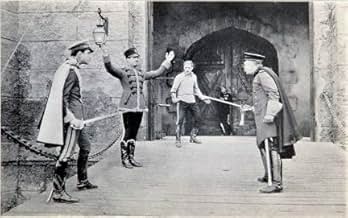
The youngish Lewis Stone is an earnest Rassendyll/Rudolph, and sort of holds his own in the climactic sword-fight with, among others, Ramon Novarro. And now we are getting somewhere. This is Novarro's film. He was hardly a star when it was made, and his role does not take up a lot of screen time, but Novarro eats up the scenery with his monocled, slick diabolism. "While you're unhung, Rentzau, hell lacks its master!", Stone says, and right he is. Novarro is pure evil, and a delight to watch.
It takes a long time for this version of 'The Prisoner of Zenda' to get moving. The first hour or so is stodgy and less than riveting film-making, and then it gradually picks up momentum, and the last half hour packs a decent punch, especially action-wise. But all in all, a rather more lackluster, even crude entertainment than I had expected after the exhilarating 'Four Horsemen of the Apocalypse', also by Rex Ingram.
The script is largely at fault, with the scenes so disjointedly put together that it does not in long stretches make a lot of sense. It has the makings of some interesting psychological insights, but does not explore them. I would have made more - MUCH more - out of the fact that for a long while Black Michael seems a pretty decent fellow, genuinely in love with Antoinette and understandably preoccupied about leaving the fate of his country to his feeble-minded brother. But Ingram makes nothing of it and seems curiously uninspired.
The youngish Lewis Stone is an earnest Rassendyll/Rudolph, and sort of holds his own in the climactic sword-fight with, among others, Ramon Novarro. And now we are getting somewhere. This is Novarro's film. He was hardly a star when it was made, and his role does not take up a lot of screen time, but Novarro eats up the scenery with his monocled, slick diabolism. "While you're unhung, Rentzau, hell lacks its master!", Stone says, and right he is. Novarro is pure evil, and a delight to watch.
Evil Ramon sparks disappointing Ingram film.
Rex Ingram was one of the great visual stylists of the silent cinema, but his version of "The Prisoner of Zenda" is a little slow and ponderous and visually not as interesting as other Ingram films. But it's still pretty good with strong performances from Ingram's wife Alice Terry and the marvellous Lewis Stone. Although Ramon Novarro has top billing, Stone actually has the lead role - Ramon's role is a supporting one - an evil nobleman. But he is splendid - darkly handsome with a little beard and a monocle - and convincingly evil. It is interesting to see him before he became type-cast as the energetic sweet boy - he shows here that he had more range as an actor than he was allowed to show.
The entire supporting cast is excellent and, although the sets are ordinary, the costumes are very fine. I expected more from Ingram, but this film is still worthwhile. Does anyone know if the Ingram - Novarro "Scaramouche" is still in existence?
The entire supporting cast is excellent and, although the sets are ordinary, the costumes are very fine. I expected more from Ingram, but this film is still worthwhile. Does anyone know if the Ingram - Novarro "Scaramouche" is still in existence?
Excellent Silent Swashbuckler
Rudolf V, the King of Ruritania, has been kidnapped by Black Michael, his evil half-brother, and locked in the dungeon of the fortress of Zenda on the eve of his coronation. By a wild twist of fate, it falls upon a look alike distant cousin, the Englishman Rassendyll, to impersonate the king and effect his rescue before either one or both of them are killed by Black Michael or his henchman, Rupert of Hentzau. With two beautiful women complicating matters, and danger lurking at every turn, how can THE PRISONER OF ZENDA possibly be saved?
It is unfortunate that this fine silent film is completely overshadowed by its 1937 talkie remake starring Ronald Colman. It is also unfair. Silent films & talkies are two different art forms and should not be put into competition against each other. Each art form is perfect in its own way. And so it is with the 1922 PRISONER OF ZENDA. Excitingly produced, with excellent production values & good acting, this movie stands on its own merits and on its own feet.
Those familiar with Lewis Stone only as a fine character actor during his talkie career at MGM may be surprised to see him here as a romantic lead, and in a swashbuckler no less. But he is very good in his dual roles of Rudolf & Rassendyll. Strangely, at times he closely resembles Colman, but this is a coincidence no one could anticipate.
This was also the breakout picture for Ramon Novarro. Born to a large wealthy family in Mexico, he had arrived in California as a 15-year old looking to become a singer. That led him into dancing & finally to acting and the movies. Working incredibly hard for years, and largely supporting his family (driven North by Revolution) he finally caught the eye of director Rex Ingram. In ZENDA, the 22-year old Novarro plays rascally Rupert, who, with his little beard & moustache & face wreathed in constant cigarette smoke, looks quite sardonic. He does very well with the unsympathetic character. Playing a mid-European, Novarro begins a career which would have him acting every sort of ethnic role, from Hebrew, to Polynesian, to Chinese.
The rest of the cast all lend able support: Stuart Holmes as the wicked Black Michael; Alice Terry as the beautiful Princess Flavia; Barbara La Marr as the lovely Antoinette de Mauban, desperately in love with Michael; and Robert Edeson & Malcolm McGregor as two staunchly loyal officers of the king. Little comedian Snitz Edwards has a small role as a funny butler.
It is unfortunate that this fine silent film is completely overshadowed by its 1937 talkie remake starring Ronald Colman. It is also unfair. Silent films & talkies are two different art forms and should not be put into competition against each other. Each art form is perfect in its own way. And so it is with the 1922 PRISONER OF ZENDA. Excitingly produced, with excellent production values & good acting, this movie stands on its own merits and on its own feet.
Those familiar with Lewis Stone only as a fine character actor during his talkie career at MGM may be surprised to see him here as a romantic lead, and in a swashbuckler no less. But he is very good in his dual roles of Rudolf & Rassendyll. Strangely, at times he closely resembles Colman, but this is a coincidence no one could anticipate.
This was also the breakout picture for Ramon Novarro. Born to a large wealthy family in Mexico, he had arrived in California as a 15-year old looking to become a singer. That led him into dancing & finally to acting and the movies. Working incredibly hard for years, and largely supporting his family (driven North by Revolution) he finally caught the eye of director Rex Ingram. In ZENDA, the 22-year old Novarro plays rascally Rupert, who, with his little beard & moustache & face wreathed in constant cigarette smoke, looks quite sardonic. He does very well with the unsympathetic character. Playing a mid-European, Novarro begins a career which would have him acting every sort of ethnic role, from Hebrew, to Polynesian, to Chinese.
The rest of the cast all lend able support: Stuart Holmes as the wicked Black Michael; Alice Terry as the beautiful Princess Flavia; Barbara La Marr as the lovely Antoinette de Mauban, desperately in love with Michael; and Robert Edeson & Malcolm McGregor as two staunchly loyal officers of the king. Little comedian Snitz Edwards has a small role as a funny butler.
Overlong spectacle
Rex Ingram was one of the finest directors of the silent era, but unfortunately, he is little remembered today. His most famous film is The Four Horsemen of the Apocalypse, a box office smash in 1920 which put Italian immigrant Rudolph Valentino on the road to full-blown stardom. This 1922 adaptation of The Prisoner of Zenda is one of his better known films among silent movie geeks, but I would not count it among his most outstanding.
There's good scenery and spectacle, and Lewis Stone makes good as the lead. The standout of the cast is without a doubt a young Ramon Novarro as the roguish Rupert of Hentzau. Unfortunately, the rest of the cast is not so memorable. The film is also overlong and the comic relief was mildly painful at best.
Overall, it's watchable, but you'll be better served by watching the 1937 remake. If you want outstanding Ingram, then see Scaramouche or Four Horsemen.
There's good scenery and spectacle, and Lewis Stone makes good as the lead. The standout of the cast is without a doubt a young Ramon Novarro as the roguish Rupert of Hentzau. Unfortunately, the rest of the cast is not so memorable. The film is also overlong and the comic relief was mildly painful at best.
Overall, it's watchable, but you'll be better served by watching the 1937 remake. If you want outstanding Ingram, then see Scaramouche or Four Horsemen.
Very impressive for 1922
Can you imagine the perpetually tired Lewis Stone in The Prisoner of Zenda? He has to play the senior advisor to the king, right? He's far too old and patriarchal to play the lead. . . So one would think. Well, in 1922, Lew was neither old, fatherly, nor tired. He played the dual leads, and he was given a brown wig! Full of energy, wonderful expressions to communicate to the audience without words, and the ability to both perform stunts and woo a fair maiden, Lew takes charge and acts like a leading man.
If you've never seen any of the movie versions or read the book, the story is very exciting. Just before a king's coronation, his evil brother plans to drug and kidnap him so that he can't be crowned the king. However, the king's faithful aides find a lookalike, completely by accident, and get him to impersonate the king during the coronation! If you've seen the modern-day comedy Dave, starring Kevin Kline, you'll have a basic understanding of the story.
I've seen three versions of this movie, and while the 1937 version is the best, this one is extremely impressive. It's amazing to see what Hollywood was capable of in 1922: the costumes, the sets, the elaborate action scenes with moats, drawbridges, and swordfights. At almost two hours, this is a lengthy silent movie, and there are quite a lot of title cards for you to read, but if you know the story, you won't be lost. Those who don't like silent movies will be incredibly bored, but if you like the change of pace and different way of storytelling, this is one worth watching, if only to see what Lewis Stone looks like with brown hair. It doesn't feel like it was made so early in the decade; if it had a 1928 timestamp on it, I'd believe it.
If you've never seen any of the movie versions or read the book, the story is very exciting. Just before a king's coronation, his evil brother plans to drug and kidnap him so that he can't be crowned the king. However, the king's faithful aides find a lookalike, completely by accident, and get him to impersonate the king during the coronation! If you've seen the modern-day comedy Dave, starring Kevin Kline, you'll have a basic understanding of the story.
I've seen three versions of this movie, and while the 1937 version is the best, this one is extremely impressive. It's amazing to see what Hollywood was capable of in 1922: the costumes, the sets, the elaborate action scenes with moats, drawbridges, and swordfights. At almost two hours, this is a lengthy silent movie, and there are quite a lot of title cards for you to read, but if you know the story, you won't be lost. Those who don't like silent movies will be incredibly bored, but if you like the change of pace and different way of storytelling, this is one worth watching, if only to see what Lewis Stone looks like with brown hair. It doesn't feel like it was made so early in the decade; if it had a 1928 timestamp on it, I'd believe it.


Did you know
- TriviaA few days before shooting was to start, director Rex Ingram realized that Metro had forgotten to order costumes for Lewis Stone. The desperate director frantically phoned Stone and asked if he still had the costumes from the stage version. Luckily the actor had them stored in his attic.
- GoofsDuring the climactic fight scene, a stool is kicked over twice.
- Quotes
[intertitles]
Rudolf Rassendyll: While you're unhung, Hentzau, hell lacks its master!
- Alternate versionsThe Turner library print is a re-release of the original version, with an uncredited piano music score and a running time of 113 minutes. Its opening credits were changed to list Ramon Novarro first, as he was then very popular, and also uses the name he is now known by. Also credited onscreen was John George and Snitz Edwards.
- ConnectionsFeatured in Cinéman (2009)
- SoundtracksZenda
Music and Lyrics by Louis Breau and Ernst Luz
Details
- Release date
- Country of origin
- Language
- Also known as
- Fången på Zenda
- Production company
- See more company credits at IMDbPro
Box office
- Budget
- $323,062 (estimated)
- Runtime
- 2h 5m(125 min)
- Color
- Sound mix
- Aspect ratio
- 1.33 : 1
Contribute to this page
Suggest an edit or add missing content