
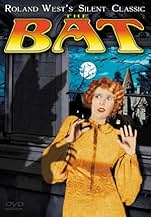
A masked criminal who dresses like a giant bat terrorizes the guests at an old house rented by a mystery writer.A masked criminal who dresses like a giant bat terrorizes the guests at an old house rented by a mystery writer.A masked criminal who dresses like a giant bat terrorizes the guests at an old house rented by a mystery writer.
- Awards
- 2 wins total





George Beranger
- Gideon Bell
- (as André de Béranger)


Arthur Housman
- Richard Fleming
- (as Arthur Houseman)


Sôjin Kamiyama
- Billy - The Butler
- (as Sojin Kamiyama)


Stanton Heck
- Police Officer
- (uncredited)
6.51K
1
2
3
4
5
6
7
8
9
10
Featured reviews
THE BAT (Roland West, 1926) ***
Like WEST OF ZANZIBAR (1928), this was a much-desired Silent ‘horror’ classic even if I had already watched the plot in action, so to speak, via a couple of Sound remakes – the 1930 version (from the same director!) and a later one made in 1959. Actually, this first adaptation of a popular ‘old dark house’-type play of the 1920s – when these proliferated in both mediums – was long considered a lost film; I watched it, in fact, via a serviceable 16mm print which suffered from constant (though not overly distracting) combing whenever characters moved!
To get back to the later versions, I’ve enjoyed THE BAT WHISPERS (1930) twice in its “Grandeur” i.e. early Widescreen format – I own the now out-of-print Image/Milestone DVD (which also includes the alternate “Standard” edition filmed simultaneously by a different cinematographer, but I’ve yet to check it out). Now, the film seems to elicit mixed reactions from most viewers (including myself): that is to say, being impressed with its distinctive visuals (spare but stylish production design, clever models – both qualities also evident in the original – and fluid, ground-breaking camera-work) yet being put off by the unfortunately archaic comedy relief supplied by an ugly and diminutive middle-aged maid (still, this ‘fraidy cat’ figure was something of a pre-requisite for the subgenre concerned). The 1959 film was a major disappointment on first viewing (dubbed in Italian) – despite the presence of an icon like Vincent Price; I do recall liking it a bit more in English (re-watched by way of a budget DVD I rented), but the result still lagged far behind either Roland West version!
Now that I’ve caught up with the original as well, I can safely say that it more than holds its own alongside THE BAT WHISPERS; I’m not always partial to directors remaking their own work but, in spite of my even greater reservations about the maid’s histrionics in the later version (remember that we can also hear her now and, therefore, is all the more liable to get on one’s nerves!), as I said, the gliding cinematography – presumably intended to emulate the movements of a real bat – was a lot more pronounced in the remake…where we also had archetypal lines (missing from the 1926 film) such as “Reach for the ceiling!” that were even parodied by Tex Avery in the cartoon short WHO KILLED WHO? (1943). The intricacies of the plot – revolving around a remote country estate which is gradually inundated by people (relatives of the current elderly female tenant, the doctor charged with her care, employees of the house’s recently murdered banker owner accused of embezzling funds, police officers on the trail of arch-criminal “The Bat” whose intended crime at the bank was anticipated but who has followed the culprit to the premises, etc.) – are pretty much identical, and the result equally entertaining. Incidentally, while the villain here sports a grotesque bat mask, in the 1930 film he exchanges this for a black cape (thus both helped give cartoon artist Bob Kane the idea for Batman, extending also to that character’s trademark ‘Bat Signal’!).
It’s been some time since my last viewing of THE BAT WHISPERS, so I’m understandably fuzzy about some aspects: I know the villain adopts a particular disguise in order to roam freely about the house – but he goes by different names in each version (the one from the remake is also present in the original but it turns out not to be him after all and is, in fact, a bit of a buffoon!); both, then, feature a suave male lead – Tullio Carminati (in his first American film and looking an awful lot like Rudolf Kleine-Rogge!) here and Chester Morris in the 1930 version (I’ll be seeing him presently in another title by director West, the noir precursor ALIBI [1929]). For the record and, as far as I can recall, the only other films in this vein from the Silent era I’ve watched were the interesting but lesser THE MONSTER (1925; yet another Roland West picture – with Lon Chaney, no less, though their individual styles didn’t really jell) and two outstanding efforts by similarly gifted film-makers, namely Paul Leni’s THE CAT AND THE CANARY (1927; itself adapted three more times for the screen!) and Benjamin Christensen’s SEVEN FOOTPRINTS TO Satan (1929; which is an even rarer title than THE BAT – since the copy I own only carries Italian intertitles which, luckily, I’m able to understand).
Trivia: leading lady Jewel Carmen was married to her director at the time; apparently, the couple remained on friendly terms after their separation and she would, in fact, become involved in a restaurant business with him and future companion Thelma Todd (a venture which, however, ended badly with the latter’s notorious and still unsolved mysterious demise in 1935!).
To get back to the later versions, I’ve enjoyed THE BAT WHISPERS (1930) twice in its “Grandeur” i.e. early Widescreen format – I own the now out-of-print Image/Milestone DVD (which also includes the alternate “Standard” edition filmed simultaneously by a different cinematographer, but I’ve yet to check it out). Now, the film seems to elicit mixed reactions from most viewers (including myself): that is to say, being impressed with its distinctive visuals (spare but stylish production design, clever models – both qualities also evident in the original – and fluid, ground-breaking camera-work) yet being put off by the unfortunately archaic comedy relief supplied by an ugly and diminutive middle-aged maid (still, this ‘fraidy cat’ figure was something of a pre-requisite for the subgenre concerned). The 1959 film was a major disappointment on first viewing (dubbed in Italian) – despite the presence of an icon like Vincent Price; I do recall liking it a bit more in English (re-watched by way of a budget DVD I rented), but the result still lagged far behind either Roland West version!
Now that I’ve caught up with the original as well, I can safely say that it more than holds its own alongside THE BAT WHISPERS; I’m not always partial to directors remaking their own work but, in spite of my even greater reservations about the maid’s histrionics in the later version (remember that we can also hear her now and, therefore, is all the more liable to get on one’s nerves!), as I said, the gliding cinematography – presumably intended to emulate the movements of a real bat – was a lot more pronounced in the remake…where we also had archetypal lines (missing from the 1926 film) such as “Reach for the ceiling!” that were even parodied by Tex Avery in the cartoon short WHO KILLED WHO? (1943). The intricacies of the plot – revolving around a remote country estate which is gradually inundated by people (relatives of the current elderly female tenant, the doctor charged with her care, employees of the house’s recently murdered banker owner accused of embezzling funds, police officers on the trail of arch-criminal “The Bat” whose intended crime at the bank was anticipated but who has followed the culprit to the premises, etc.) – are pretty much identical, and the result equally entertaining. Incidentally, while the villain here sports a grotesque bat mask, in the 1930 film he exchanges this for a black cape (thus both helped give cartoon artist Bob Kane the idea for Batman, extending also to that character’s trademark ‘Bat Signal’!).
It’s been some time since my last viewing of THE BAT WHISPERS, so I’m understandably fuzzy about some aspects: I know the villain adopts a particular disguise in order to roam freely about the house – but he goes by different names in each version (the one from the remake is also present in the original but it turns out not to be him after all and is, in fact, a bit of a buffoon!); both, then, feature a suave male lead – Tullio Carminati (in his first American film and looking an awful lot like Rudolf Kleine-Rogge!) here and Chester Morris in the 1930 version (I’ll be seeing him presently in another title by director West, the noir precursor ALIBI [1929]). For the record and, as far as I can recall, the only other films in this vein from the Silent era I’ve watched were the interesting but lesser THE MONSTER (1925; yet another Roland West picture – with Lon Chaney, no less, though their individual styles didn’t really jell) and two outstanding efforts by similarly gifted film-makers, namely Paul Leni’s THE CAT AND THE CANARY (1927; itself adapted three more times for the screen!) and Benjamin Christensen’s SEVEN FOOTPRINTS TO Satan (1929; which is an even rarer title than THE BAT – since the copy I own only carries Italian intertitles which, luckily, I’m able to understand).
Trivia: leading lady Jewel Carmen was married to her director at the time; apparently, the couple remained on friendly terms after their separation and she would, in fact, become involved in a restaurant business with him and future companion Thelma Todd (a venture which, however, ended badly with the latter’s notorious and still unsolved mysterious demise in 1935!).
Great Genre-Mix which forecastes BATMAN
THE BAT forecastes BATMAN in more than one detail. The sets look a lot like Gothan City. And even the Batsignal is here - but this Batman is one bad dude.
I said genre-mix in the one line summary, because it's mainly an old dark house movie, but also contains elements of fantasy (the title giving supervillain can fly etc.) and comedy (which is partly outdated and silly). The sad thing about the film are it's racistic undertones toward japanese people. But everything else is great, especially the FX, the set and the cinematography.
If you like old dark house-films (incl. hidden chambers and secret doorways), this one for you.
I said genre-mix in the one line summary, because it's mainly an old dark house movie, but also contains elements of fantasy (the title giving supervillain can fly etc.) and comedy (which is partly outdated and silly). The sad thing about the film are it's racistic undertones toward japanese people. But everything else is great, especially the FX, the set and the cinematography.
If you like old dark house-films (incl. hidden chambers and secret doorways), this one for you.
Bat Attack...
This superb silent thriller finds the malevolent fiend of the title lurking about in a dark mansion, competing with -as well as terrifying!- a host of treasure hunters, cops, and family members. Everyone is desperately searching for almost a quarter of a million dollars (a fortune in 1926) in embezzled money.
Director Roland West creates an unsettling atmosphere, using the grand, creepy sets and wonderful Menzies miniatures to full effect.
THE BAT is a twisty tale with a surprise ending, perfectly overblown characters, and a memorable villain.
See if you can guess the Bat's true identity by movie's end...
Director Roland West creates an unsettling atmosphere, using the grand, creepy sets and wonderful Menzies miniatures to full effect.
THE BAT is a twisty tale with a surprise ending, perfectly overblown characters, and a memorable villain.
See if you can guess the Bat's true identity by movie's end...
A good version of the story
This film, like the play that it comes from asked the audience to keep the secret of the Bat secret so I will do the same and so I'll only speak in generalities.
One of the grand old dark house films this is the story of the super criminal known as The Bat and his attempt to steal a great fortune.
This film isn't the best ever made. The passage of time has diminished its impact a bit. Part of the problem is that at times the film has to wrestle with its stage origins, things seem to stagnate and you become bored. However at other times this film soars with a visual style that has rarely been matched. The mask of the villain for example hasn't been equaled. Thankfully its always watchable.
Certainly worth a look.
One of the grand old dark house films this is the story of the super criminal known as The Bat and his attempt to steal a great fortune.
This film isn't the best ever made. The passage of time has diminished its impact a bit. Part of the problem is that at times the film has to wrestle with its stage origins, things seem to stagnate and you become bored. However at other times this film soars with a visual style that has rarely been matched. The mask of the villain for example hasn't been equaled. Thankfully its always watchable.
Certainly worth a look.
Very Good Quality Print
There certainly is a lot happening in this film. Trap doors. Secret passages. Staircases. A "Bat" man. A hysterical maid who screams and leaps and circles and points. She must have been totally worn out when this film ended. Having seen the later version, I kind of knew the ropes a little bit. The idea is to get people out of an old mansion in order to grab a bunch of money that was embezzled from a local bank. The title character harasses the inhabitants, but doesn't know he has a real foe in the tough, matronly, unflappable owner of the mansion. She holds her own no matter what transpires. We have lots of suspects and that bat costume is pretty good. We can see elements of the Batman character of the early comic books. For a silent film this is very high quality and wears very well.


Did you know
- TriviaThis film was highly regarded for its visuals, especially for its cinematography, elaborate sets and special effects. Roland West could only top it by remaking it four years later as The Bat Whispers (1930) with sound and in an early 70mm process.
- ConnectionsFeatured in Batman and Robin and the Other Super Heroes (1989)
- How long is The Bat?Powered by Alexa
Details
- Release date
- Country of origin
- Language
- Also known as
- El murciélago
- Production company
- See more company credits at IMDbPro
- Runtime
- 1h 26m(86 min)
- Sound mix
- Aspect ratio
- 1.33 : 1
Contribute to this page
Suggest an edit or add missing content