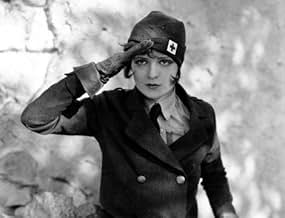
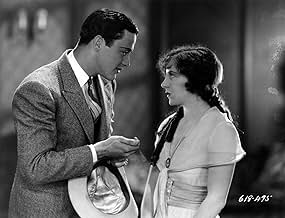
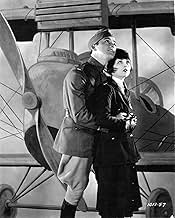
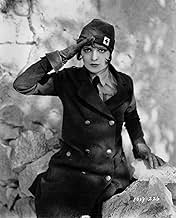
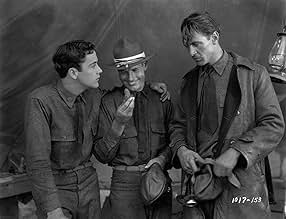
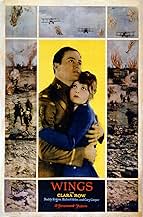
Two young men, one rich, one middle class, who are in love with the same woman, become fighter pilots in World War I.Two young men, one rich, one middle class, who are in love with the same woman, become fighter pilots in World War I.Two young men, one rich, one middle class, who are in love with the same woman, become fighter pilots in World War I.
- Won 2 Oscars
- 9 wins & 1 nomination total
Charles 'Buddy' Rogers
- Jack Powell
- (as Charles Rogers)
Charles Barton
- Soldier Flirting with Mary
- (uncredited)
Thomas Carr
- Aviator
- (uncredited)
Thomas Carrigan
- Undetermined Role
- (uncredited)
Margery Chapin
- Peasant Woman
- (uncredited)
Andy Clark
- Undetermined Role
- (uncredited)
7.515.8K
1
2
3
4
5
6
7
8
9
10
Featured reviews
VHS version with Theater Organ music track
For a feeling of what the silents were really like, look for the version of this film with Gaylord Carter performing the score on a Wurlitzer Theater Organ. Carter recorded this version in the 1980's when he was in his 80's. Amazing performance - basically 120 minutes of live, somewhat improvised music with establihed themes for each character. Incidental music was improvised live combining themes from the various characters.
Carter was one of the last musicians that performed during the silent era. Very few musicians understand how difficult this art form was, and Gaylor was one of the best. Each showing of the film was an original, never before heard version due to the improvisational nature of the music. The stamina required to play live music, on 3, 4 or even 5 keyboards with a pedal board and dozens of stops, thousands of pipes for over two hours cannot be overstated. Especially when one of these performers were expected to do so 3 or more times a day!
Orchestras are all well and good, but few theaters could afford them - Wurlitzer (and a few other companies) sold 40,000 instruments to theaters world wide during the 20's, and chances are, 90% of screenings of this film were accompanied by a theater organ.
Carter was one of the last musicians that performed during the silent era. Very few musicians understand how difficult this art form was, and Gaylor was one of the best. Each showing of the film was an original, never before heard version due to the improvisational nature of the music. The stamina required to play live music, on 3, 4 or even 5 keyboards with a pedal board and dozens of stops, thousands of pipes for over two hours cannot be overstated. Especially when one of these performers were expected to do so 3 or more times a day!
Orchestras are all well and good, but few theaters could afford them - Wurlitzer (and a few other companies) sold 40,000 instruments to theaters world wide during the 20's, and chances are, 90% of screenings of this film were accompanied by a theater organ.
Stunning aerial photography, truly moving
David's expressions, when he is saying good-by to his family, are absolutely wrenching. The only one who overacts is Clara Bow, but she's supposed to be the bubbly, irrepressible girl-next-door, so I give her a pass.
(Was the yellow colorization added to flames then or recently? I found it distracting.)
The uniforms are perfectly detailed too, perhaps because the actual war was so recently in people's memories. Modern movie-makers have gotten very careless about uniform details, I think because they assume no one will notice.
Wonderful scene in the Folies Bergere -- note the female couple at one table in the opening clip -- nothing is new under the sun.
Beautifully digitalized restoration,astonishingly crisp. What a national treasure!
(Was the yellow colorization added to flames then or recently? I found it distracting.)
The uniforms are perfectly detailed too, perhaps because the actual war was so recently in people's memories. Modern movie-makers have gotten very careless about uniform details, I think because they assume no one will notice.
Wonderful scene in the Folies Bergere -- note the female couple at one table in the opening clip -- nothing is new under the sun.
Beautifully digitalized restoration,astonishingly crisp. What a national treasure!
Dated, true...but entertaining
You could justifiably criticize WINGS lesser moments: the naive, "gee-whiz" dialog...the less than comedic "champagne" sequence in Paris...any of the romantic scenes...the idealized view of military life.... But as light entertainment, WINGS manages to hold its own, despite the passage of years. The battle scenes, easily the highlight of the film, may not have the intensity of later films, but the narrative is clear and precise. And this was not meant to be the last word in documentary accuracy: it's an adventure film tinged with romance, with engaging aerial fight scenes that capture your attention whenever they occur.
And personally, I felt that the music from the Wurlitzer organ tied together the film's various themes, musical and narrative, quite tidily.
Photography nice story
My cousin Clifford M. Blackstone Sr. was the person who filmed the flight scenes in this movie. His son Cliff sent me photographs of his Dad filming this movie as well as a few others with Paramount Studios. Cliff said his Dad was put in an airplane and sent up in the air to crank out all those amazing flight scenes. He said his Dad told him he wasn't even secured in the plane. Cliff Blackstone Sr. is from Mercer County, PA and Cliff Jr. says his Dad was the man who created the zoom lens. Just a side bar, Clara Bow, the lead actress in Wings, had a hairdresser Maryl who Clara introduced to Cliff Sr. Cliff Sr. married Maryl and they had Cliff Jr. It is really a nice story.
A Stunning Achievement
Famous of course for winning the first Oscar for best film, WINGS is also one hell of a good film. Spectacular aerial photography highlights the terrific performances of the three leads: Clara Bow, Buddy Rogers, and Richard Arlen. Director William Wellman creates a solid and moving anti-war statement as he shows us the brutality and stupidity of war, its waste of youth, and its power to destroy the lives of all involved.
The film starts with star-crossed lovers in a small town in America. Bow loves Rogers but he loves Jobyna Ralston. Ralston loves Arlen and he loves her but through a mistake, Arlen thinks she loves Rogers. Then the boys go off to war. The outgoing Rogers thinks the war will be an adventure; the shy Arlen goes off, leaving his devastated parents who cannot express their emotions. Bow soon goes off to be an ambulance driver. Ralston stays homes and waits.
The story follows the rivalry and growing friendship of the boys as they head for war. The story ends in yet another bitter mistake. The viewer is as emotionally drained by the end of this film as the parents were at the beginning.
El Brendel provides some comedy relief. Roscoe Karns has a small part. Henry B. Walthall and Julia Swayne Gordon are the parents. And Gary Cooper has one brief scene with Rogers and Arlen. The scene in which he turns and flashes that famous smile as he exits the tent supposedly made him a star.
Clara Bow is solid as the spirited home-town girl who chases Rogers to no avail. She's gorgeous here and she is even moreso in the Paris scene where the matron lets her borrow a snappy and dazzling dress. Few women in film history have been able to be so sexually charismatic as Clara Bow. She's also a good actress.
Richard Arlen and Buddy Rogers give their best performances here. Each takes turns as the center of attention as they become men during the grueling war. Their flight scenes are incredibly well done. Arlen's flight scene as he races toward the American lines is amazing.
Jobyna Ralston has a rare memorable film not working with Harold Lloyd. And Henry B. Walthall is quietly grand as the crippled father.
Wellman's direction and the camera work of Harry Perry are beyond perfection. The aerial battles are breathtaking as are the scenes where they blow up the German blimps. There's also one astounding scene in the beginning of the film where Ralston and Arlen are in a swing. The camera is mounted in a stationary position in front of the actors so we see the scene as though we are in the swing with them. Then suddenly in the background we see Rogers in his jalopy pulling up in the street. The swing stops and Ralston gets out and runs to Rogers (in the background) while we see the close-up of Arlen as he twists in the swing seat and turns to watch them. It's an amazing scene and all one shot.
This film is a must see.
The film starts with star-crossed lovers in a small town in America. Bow loves Rogers but he loves Jobyna Ralston. Ralston loves Arlen and he loves her but through a mistake, Arlen thinks she loves Rogers. Then the boys go off to war. The outgoing Rogers thinks the war will be an adventure; the shy Arlen goes off, leaving his devastated parents who cannot express their emotions. Bow soon goes off to be an ambulance driver. Ralston stays homes and waits.
The story follows the rivalry and growing friendship of the boys as they head for war. The story ends in yet another bitter mistake. The viewer is as emotionally drained by the end of this film as the parents were at the beginning.
El Brendel provides some comedy relief. Roscoe Karns has a small part. Henry B. Walthall and Julia Swayne Gordon are the parents. And Gary Cooper has one brief scene with Rogers and Arlen. The scene in which he turns and flashes that famous smile as he exits the tent supposedly made him a star.
Clara Bow is solid as the spirited home-town girl who chases Rogers to no avail. She's gorgeous here and she is even moreso in the Paris scene where the matron lets her borrow a snappy and dazzling dress. Few women in film history have been able to be so sexually charismatic as Clara Bow. She's also a good actress.
Richard Arlen and Buddy Rogers give their best performances here. Each takes turns as the center of attention as they become men during the grueling war. Their flight scenes are incredibly well done. Arlen's flight scene as he races toward the American lines is amazing.
Jobyna Ralston has a rare memorable film not working with Harold Lloyd. And Henry B. Walthall is quietly grand as the crippled father.
Wellman's direction and the camera work of Harry Perry are beyond perfection. The aerial battles are breathtaking as are the scenes where they blow up the German blimps. There's also one astounding scene in the beginning of the film where Ralston and Arlen are in a swing. The camera is mounted in a stationary position in front of the actors so we see the scene as though we are in the swing with them. Then suddenly in the background we see Rogers in his jalopy pulling up in the street. The swing stops and Ralston gets out and runs to Rogers (in the background) while we see the close-up of Arlen as he twists in the swing seat and turns to watch them. It's an amazing scene and all one shot.
This film is a must see.
Oscars Best Picture Winners, Ranked
See the complete list of Oscars Best Picture winners, ranked by IMDb ratings.
Did you know
- TriviaWas lost for decades until 1992, when a copy was discovered languishing in the Cinematheque Francaise film archive in Paris, France.
- GoofsThe film is set during the years 1917-1918, but most of the female civilian clothes and hairstyles are contemporary with the late 1920s, particularly the clothes worn by Clara Bow in the home sequences and in the Folies Bergère sequence. Bow and almost all the other female characters have bobbed hair, common in 1927 but almost non-existent during World War One.
- Quotes
Sergeant in Mervale: Hey, if youse guys need kissin' *I'll* kiss you - wit' a gun-butt!
- Alternate versionsSome showings have trimmed Clara Bow's brief topless scene.
- ConnectionsEdited into The Eagle and the Hawk (1933)
- SoundtracksThe Star Spangled Banner
(credited on 2012 restored score only)
Written by John Stafford Smith & Francis Scott Key
- How long is Wings?Powered by Alexa
Details
Box office
- Budget
- $2,000,000 (estimated)
- Gross worldwide
- $1,684
- Runtime
- 2h 24m(144 min)
- Color
- Sound mix
- Aspect ratio
- 1.33 : 1
Contribute to this page
Suggest an edit or add missing content