
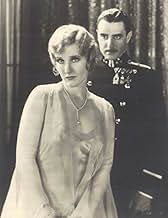
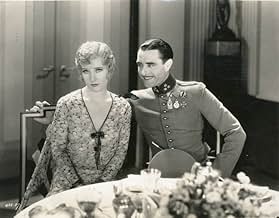
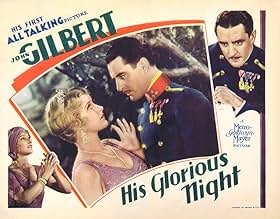
A princess must end her affair with a guard captain for an arranged marriage. He threatens to pose as a con man and expose their relationship unless allowed one night with her.A princess must end her affair with a guard captain for an arranged marriage. He threatens to pose as a con man and expose their relationship unless allowed one night with her.A princess must end her affair with a guard captain for an arranged marriage. He threatens to pose as a con man and expose their relationship unless allowed one night with her.
- Director
- Writers
- Stars




Agostino Borgato
- Waiter
- (uncredited)

Carrie Daumery
- Race Spectator
- (uncredited)

Adolph Faylauer
- Race Spectator
- (uncredited)
Curt Furberg
- Race Spectator
- (uncredited)
- Director
- Writers
- All cast & crew
- Production, box office & more at IMDbPro
5.6128
1
2
3
4
5
6
7
8
9
10
Featured reviews
Out Came Talk, Talk, Talk
HIS GLORIOUS NIGHT is deadly dull as directed by Lionel Barrymore. This film is based on a play by Molnar with all the liveliness of a dictionary. After a decent opening that introduces the main characters and has John Gilbert as the dashing Captain Kovacs winning a horse race (obviously speeded up), it settles into a static, music-less, slog of talk.
Remember what Norma Desmond said. "So they opened their big mouths and out came talk, talk, talk!" She obviously saw this film. Basic plot has Gilbert as the dashing captain who is romancing a princess (Catherine Dale Owen). But the mother does not approve and so has a crony spill the beans that Gilbert is the son of a shoemaker. "You peasant!" she cries.
To get even Gilbert spreads a false rumor that he's actually a fraud and that he's really a notorious swindler posing as a Captain (apparently worse than being a peasant). Once the princess and mother (Nance O'Neil) get wind of this they are terrified of an embarrassing scandal. The mother tries to marry off the daughter to the limp Tyrrell Davis and it almost works. But Gilbert has the fun of calling their bluff and admitting that he's really just a peasant (not a swindler). Faced with Davis over Gilbert, Owen comes to her meager senses and humiliates herself by chasing after Gilbert.
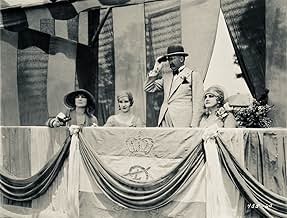
This is shot with almost no camera movement. The actors sit around talking. On the sidelines are a humorous older count and his wife (Richard Carle, Eva Dennison) and the ambitious Americans (Hedda Hopper and her daughter Doris Hill). Gustav von Seyffertitiz plays the gossiping crony.
Gilbert's voice is fine, maybe a little sing-songy. It's the material that lacks. The film was a modest hit. There is an "I LOVE YOU bit a la Singin' in the Rain but it's said off camera while the lovers are in the bushes.
John Gilbert gets a pass; Lionel Barrymore gets a fail.
Remember what Norma Desmond said. "So they opened their big mouths and out came talk, talk, talk!" She obviously saw this film. Basic plot has Gilbert as the dashing captain who is romancing a princess (Catherine Dale Owen). But the mother does not approve and so has a crony spill the beans that Gilbert is the son of a shoemaker. "You peasant!" she cries.
To get even Gilbert spreads a false rumor that he's actually a fraud and that he's really a notorious swindler posing as a Captain (apparently worse than being a peasant). Once the princess and mother (Nance O'Neil) get wind of this they are terrified of an embarrassing scandal. The mother tries to marry off the daughter to the limp Tyrrell Davis and it almost works. But Gilbert has the fun of calling their bluff and admitting that he's really just a peasant (not a swindler). Faced with Davis over Gilbert, Owen comes to her meager senses and humiliates herself by chasing after Gilbert.
This is shot with almost no camera movement. The actors sit around talking. On the sidelines are a humorous older count and his wife (Richard Carle, Eva Dennison) and the ambitious Americans (Hedda Hopper and her daughter Doris Hill). Gustav von Seyffertitiz plays the gossiping crony.
Gilbert's voice is fine, maybe a little sing-songy. It's the material that lacks. The film was a modest hit. There is an "I LOVE YOU bit a la Singin' in the Rain but it's said off camera while the lovers are in the bushes.
John Gilbert gets a pass; Lionel Barrymore gets a fail.
There's lots of blame to go around here
In an obscure European kingdom, the princess Orsini (Catherine Dale Owen) carries on a clandestine affair with the dashing Captain Kovacs. Her mother apparently knows all about this romance, and convinces her to break it off given that the princess is to soon be engaged to Prince Luigi Caprilli (Tyrell Davis) as part of an arrangement between her kingdom and his. Afterwards, news comes to the princess that Kovacs is actually a famous confidence artist and that, as a result, unwanted publicity may come to the kingdom and perhaps bring the relationship between Kovacs and the princess to light. Complications ensue.
This is the talkie debut of John Gilbert, the film that allegedly brought down his career, and yet I really don't see anything wrong with his voice given what he has to work with as far as dialogue, which at times is ridiculous. But then I already knew what John Gilbert sounded like. Maybe people were expecting something like Clark Gables growly low pitched voice? At any rate, Gilbert had leading roles at MGM for four more years through 1933 and had a leading role in his last film in 1934, so it's not like this film completely ruined him.
Like most early talkie films the thing is entirely too talkie. There is tons of dialogue that really serves no purpose and many scenes are over long and tiresome. The princess and her mother have the most screen time, and they seem more like much older sister and much younger sister than mother and daughter given their casual way with each other.
Tyrell Davis is excellent in his small role as Prince Luigi, Princess Orsini's betrothed. He is terrific at being as desirable as a plate of cold scrambled eggs. MGM made good use of this lack of chemistry between Davis and Owens when they teamed them in another early talkie the following year - "Strictly Unconventional" in which their lack of chemistry is the central theme.
If you are an early talkie fan or just curious about this important entry in John Gilbert's filmography I'd recommend it, but do realize that pacing wise it is a long hard slog.
This is the talkie debut of John Gilbert, the film that allegedly brought down his career, and yet I really don't see anything wrong with his voice given what he has to work with as far as dialogue, which at times is ridiculous. But then I already knew what John Gilbert sounded like. Maybe people were expecting something like Clark Gables growly low pitched voice? At any rate, Gilbert had leading roles at MGM for four more years through 1933 and had a leading role in his last film in 1934, so it's not like this film completely ruined him.
Like most early talkie films the thing is entirely too talkie. There is tons of dialogue that really serves no purpose and many scenes are over long and tiresome. The princess and her mother have the most screen time, and they seem more like much older sister and much younger sister than mother and daughter given their casual way with each other.
Tyrell Davis is excellent in his small role as Prince Luigi, Princess Orsini's betrothed. He is terrific at being as desirable as a plate of cold scrambled eggs. MGM made good use of this lack of chemistry between Davis and Owens when they teamed them in another early talkie the following year - "Strictly Unconventional" in which their lack of chemistry is the central theme.
If you are an early talkie fan or just curious about this important entry in John Gilbert's filmography I'd recommend it, but do realize that pacing wise it is a long hard slog.
Miss Owen Stinks Up The Joint
Princess Catherine Dale Owen breaks off her affair with dashing officer John Gilbert to facilitate her marriage to Prince Tyrell Davis, using the excuse he is actually a commoner. Then it turns out he is not just a commoner, but a convicted swindler.
Based on a Molnar play that played 37 shows on Broadway, this movie suffers from a lot of common problems of movies from 1929, particularly from MGM. It is visually inert, people talk very loudly so they can be heard on the primitive sound equipment. Add to that the fact it isn't a very good play, and you are already operating under a handicap, it's hard to think of anything good to say about it.
But wait! There's more! This is the legendary stinker that demonstrated that either John Gilbert had a high, squeaky voice or Louis Mayer had the sound department wreck the recording because he hated Gilbert. It was so ludicrous that it was used as the model of the botched early talkie film in SINGIN' IN THE RAIN.
Guess what! Gilbert's voice is perfectly fine. Instead, it's Miss Owen who offers an annoyingly bad performance, one a four-year-old might offer in reprimanding a stuffed bear at a tea party in her nursery. She may be excused in part because the dialogue is poor, but she spends most of her time gazing off to the left, seemingly unengaged with her fellow players. That must be blamed for the director of this movie, Lionel Barrymore.
Based on a Molnar play that played 37 shows on Broadway, this movie suffers from a lot of common problems of movies from 1929, particularly from MGM. It is visually inert, people talk very loudly so they can be heard on the primitive sound equipment. Add to that the fact it isn't a very good play, and you are already operating under a handicap, it's hard to think of anything good to say about it.
But wait! There's more! This is the legendary stinker that demonstrated that either John Gilbert had a high, squeaky voice or Louis Mayer had the sound department wreck the recording because he hated Gilbert. It was so ludicrous that it was used as the model of the botched early talkie film in SINGIN' IN THE RAIN.
Guess what! Gilbert's voice is perfectly fine. Instead, it's Miss Owen who offers an annoyingly bad performance, one a four-year-old might offer in reprimanding a stuffed bear at a tea party in her nursery. She may be excused in part because the dialogue is poor, but she spends most of her time gazing off to the left, seemingly unengaged with her fellow players. That must be blamed for the director of this movie, Lionel Barrymore.
Grading on a curve, it ain't bad
Okay, I've been hearing for decades about what a catastrophe this is, that Gilbert has a feminine voice. That's absolute nonsense.
First off, it's an early talkie. Secondly, Gilbert's voice was fine. If you've seen any of his later pictures, his voice sounds the same.
The single greatest shortcoming is that it's based on a stage play. Given the technology of the day, it's never able to rise above that. The dialogue and pacing and plodding. The performances look like early melodrama.
Compare this to another star of the silent screen. Mary Pickford's "Coquette" is unwatchable. She won an Oscar for her performance. Gilbert got slapped down for this much better movie.
First off, it's an early talkie. Secondly, Gilbert's voice was fine. If you've seen any of his later pictures, his voice sounds the same.
The single greatest shortcoming is that it's based on a stage play. Given the technology of the day, it's never able to rise above that. The dialogue and pacing and plodding. The performances look like early melodrama.
Compare this to another star of the silent screen. Mary Pickford's "Coquette" is unwatchable. She won an Oscar for her performance. Gilbert got slapped down for this much better movie.
Not John Gilbert's Fault
This early talkie fails, not because of John Gilbert's voice, but because of the stiff, stagey performance of co-star Catherine Dale Owen as Princess Orsolini. In almost every scene she faces stiffly forward, slightly looking off camera left/stage right, and barely acknowledges anyone else in the scene. Her delivery is a one-note haughtiness as if the world must revolve around her and her apparent embarrassment at being made a fool of by the duplicitous Captain Kovacs (John Gilbert). All of the other main characters - her mother, the elderly Sargent or General who summons Captain Kovacs to her room, and Captain Kovacs, John Gilbert - play their parts naturally with believable reactions and vocal modulations.
"Singing in the Rain"'s mocking of this film is spot on in the Lina Lamont (Jean Hagen) character whose voice and mannerisms parody Catherine Dale Owen here, and in the awfully cheesy dialogue Don Lockwood (Gene Kelly) is given to deliver in his first talkie, "The Dueling Cavalier". Poor John Gilbert deserved better than this - his voice is fine, even as he plays his part in this overly melodramatic script.
"Singing in the Rain"'s mocking of this film is spot on in the Lina Lamont (Jean Hagen) character whose voice and mannerisms parody Catherine Dale Owen here, and in the awfully cheesy dialogue Don Lockwood (Gene Kelly) is given to deliver in his first talkie, "The Dueling Cavalier". Poor John Gilbert deserved better than this - his voice is fine, even as he plays his part in this overly melodramatic script.


Did you know
- TriviaThe filming of the movie and its disastrous reception were one of the main inspirations for the film Singin' in the Rain (1952).
- Alternate versionsRESTORATION PROLOGUE: "When His Glorious Night was sold by M-G-M to Paramount for a remake (A Breath of Scandal - 1960), the original 1929 camera negative was stored in the vaults, unseen for almost hundred years, apart from a short extract used in When the Lion Roars." "Now fully restored, the film that served as a basis for Singin' in the Rain and once again be seen." "His Glorious Night could not have been restored without the cooperation, support, and guidance of Paramount Pictures, Library of Congress, The Film Preserve, Ltd & The Maltese Film Works."
- ConnectionsAlternate-language version of Olimpia (1930)
Details
- Release date
- Country of origin
- Languages
- Also known as
- Ladrón de amor
- Filming locations
- Production company
- See more company credits at IMDbPro
- Runtime
- 1h 20m(80 min)
- Color
- Aspect ratio
- 1.20 : 1
Contribute to this page
Suggest an edit or add missing content