IMDb RATING
6.7/10
1.8K
YOUR RATING

A rotund bandleader leads a series of theatrical sketches, dance numbers, special effects, and animated segments.A rotund bandleader leads a series of theatrical sketches, dance numbers, special effects, and animated segments.A rotund bandleader leads a series of theatrical sketches, dance numbers, special effects, and animated segments.
- Directors
- Writers
- Stars
- Won 1 Oscar
- 4 wins total
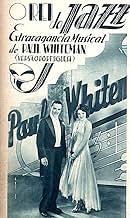
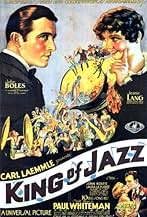
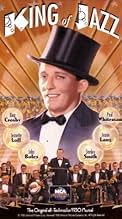


Harry Barris
- One of the Rhythm Boys
- (as The Rhythm Boys)

Bing Crosby
- One of the Rhythm Boys
- (as The Rhythm Boys)
Al Rinker
- One of the Rhythm Boys
- (as The Rhythm Boys)


Carla Laemmle
- Chorine
- (as Beth Laemmle)


- Directors
- Writers
- All cast & crew
- Production, box office & more at IMDbPro
6.71.8K
1
2
3
4
5
6
7
8
9
10
Featured reviews
Terrific! (in an old-fashioned sense)
"King Of Jazz" is a museum piece. Let's face it, anyone under 50 probably never heard of Paul Whiteman, and anyone under 40 only knows Bing Crosby from his Christmas album. That leaves the rest of us.
For The Rest Of Us, it doesn't get any better than "King Of Jazz". That, of course, was Paul Whiteman, rotund band leader of a bygone era who is the nominal star of this film. He was not an actor, and so the film is given over to actors and other entertainers. The accent here is on 'entertainer', as this movie is festooned with lots and lots of them.
Ever see Bing Crosby with his real hair? Ever see the Radio City Rockettes, thunder-thighed in the late 20's? Ever see George Gershwin in a movie? How about vaudevillian Al Norman with his rubber-legged dancing? It's all here, in a non-stop revue of old and almost-forgotten songs and dance numbers (there are 18 in all), interspersed with blackouts and comedy skits. Plus, it's in color (sort of) - actually, it's primitive 2 strip color.
I could go on and on but if you are a hard-core movie fan or a film historian, "King Of Jazz" is for you. The jokes are stale, the singers still trilled their 'R's, and the gowns in the bridal number are so out of style they are probably coming back. The overall effect was both sheer delight and visually overwhelming and I wished it would never end. It is available only on VHS and hasn't been seen on TV in years. It is a must for The Rest Of Us.
P.S. Ever see Paul Whiteman tap dance?
For The Rest Of Us, it doesn't get any better than "King Of Jazz". That, of course, was Paul Whiteman, rotund band leader of a bygone era who is the nominal star of this film. He was not an actor, and so the film is given over to actors and other entertainers. The accent here is on 'entertainer', as this movie is festooned with lots and lots of them.
Ever see Bing Crosby with his real hair? Ever see the Radio City Rockettes, thunder-thighed in the late 20's? Ever see George Gershwin in a movie? How about vaudevillian Al Norman with his rubber-legged dancing? It's all here, in a non-stop revue of old and almost-forgotten songs and dance numbers (there are 18 in all), interspersed with blackouts and comedy skits. Plus, it's in color (sort of) - actually, it's primitive 2 strip color.
I could go on and on but if you are a hard-core movie fan or a film historian, "King Of Jazz" is for you. The jokes are stale, the singers still trilled their 'R's, and the gowns in the bridal number are so out of style they are probably coming back. The overall effect was both sheer delight and visually overwhelming and I wished it would never end. It is available only on VHS and hasn't been seen on TV in years. It is a must for The Rest Of Us.
P.S. Ever see Paul Whiteman tap dance?
The Paul Whiteman Scrapbook
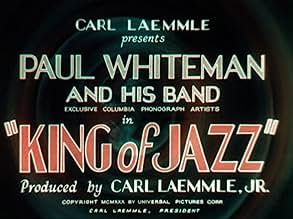
THE KING OF JAZZ (Universal, 1930), directed by John Murray Anderson, is the fourth and final of Hollywood's all star musical revues during the 1929-30 season, and ranks the most impressive of the four, outdoing MGM's THE Hollywood REVUE OF 1929 (1929); Warners THE SHOW OF SHOWS (1929) and PARAMOUNT ON PARADE (1930). Filmed in early two-strip Technicolor, it is fortunate to have survived after all these years considering how many early color movies are either lost or have survived in black-and-white format only. The title character goes to band-leader, Paul Whiteman, in his feature movie debut, but THE KING OF JAZZ is remembered today as the motion picture debut of Bing Crosby, who, in reality, mainly appears as part of the Rhythm Boys in some musical skits.
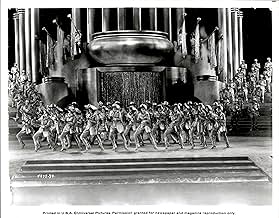
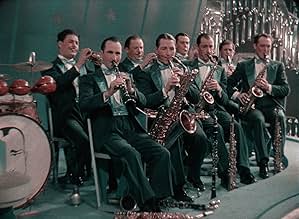
Virtually plotless, the revue begins with Crosby's off-screen vocalizing of "Music Hath Charms" during the opening credits. This is followed by Charles Irwin standing in as master of ceremonies who tells how Paul Whiteman became crowned "The King of Jazz." A cartoon segment follows (compliments of Walter Lantz, the creator of Woody Woodpecker), showing Whiteman himself hunting in darkest Africa being chased by a lion, to then sooth the savage beast by violin playing to the tune, "Music Hath Charms". After an elephant squirts water through its trunk on a monkey up a tree, the angry monkey throws a coconut towards the elephant, which, in turn, hits Whiteman's head, bumping it into the form of a crown. Then comes the introduction of the Paul Whiteman Band, presenting themselves individually playing tunes with their instruments. Production numbers and comedy skits follow. The most striking numbers are: "The Bridal Veil" the ten minute spectacle of Whiteman conducting his orchestra to George Gershwin's "Rhapsody in Blue," and the "Happy Feet" number, sung by The Sisters "G", with chorus girls descending onto a large-scale miniature of New York City, highlighted by the eccentric rubber-legged dancing by Al Norman.
Other songs presented include: "The Lord Delivered Daniel" (sung by the cartoonish Paul Whiteman) "Mississippi Mud" and "So the Bluebirds and the Blackbirds Got Together" (both sung by The Rhythm Boys: Bing Crosby, Harry Barris and Al Rinker); "It Happened in Monterey" (sung by John Boles); "Oh, How I Would Like to Own a Fish Store" (sung by Jack White); "A Bench in the Park" (sung by Glenn Tryon and Laura LaPlante, The Brox Sisters and the Rhythm Boys); "Ragamuffin Romeo" (sung by Jeanie Lang); "I Like to Do Things for You" (sung by Jeanie Lang to Paul Whiteman; Grace Hayes and William Kent; danced by Tommy Atkins Sextette with Nell O'Day); "Has Anyone Here Seen Nellie?" (sung by Churchill Ross, John Arledge, Frank Leslie and Walter Brennan with his wriggling ear); "The Song of the Dawn" (sung by John Boles); and the finale, "The Melting Pot Medley." Brief comedy skits include THE DAILY MEOW with Laura LaPlante, Jeanie Lang, Merna Kennedy, Grace Hayes and Kathryn Crawford; IN CONFERENCE with Glenn Tryon, Laura LaPlante and Merna Kennedy; SPRING TIME with Slim Summerville, Yola d'Avril and Walter Brennan; ALL NOISY ON THE EASTERN FRONT with Yola d'Avril, Slim Summerville, Walter Brennan, others; FOREVER MORE with William Kent as the drunk, and Walter Brennan as the butler; the risqué, A MEETING WITH FATHER with Slim Summerville meeting his future father-in-law (Otis Harlan) and how he feels about his bride-to-be, and so much more. There's also Joe Venito playing his wild violin to the tune, "Pop Goes the Weasal."
Unseen for many years, THE KING OF JAZZ was presented on television during the early years of cable TV circa 1984, and soon after distributed on video cassette, compliments of MCA/Universal with excellent visuals. For a while, THE KING OF JAZZ did enjoy frequent revivals on American Movie Classics (1989-1990) before color restoration and edited skits restored on DVD in 2018, the same 97 minute edition broadcast March 4, 2019, on Turner Classic Movies.
The biggest surprise about this revue is that it was released by Universal, the studio not known for lavish musicals. Aside from lavishness, it's quite advanced, especially with its camera angles/techniques which remains impressive even today. The comedy skits might seem out of date, but are just a reminder as to what vaudeville was like and the humor that made its audiences chuckle back in the day. Even similar comedy skits of long ago are still being used today, especially by stand-up comics or on current TV shows that try to make old material fresh and original.
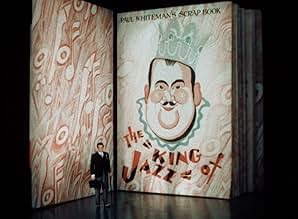
One final note: the special effects. Although not a first in early sound cinema, the early portion of the film where Paul Whiteman introduces his orchestra by opening his suitcase, from which many tiny musicians emerge in front of the life-size face of Whiteman as he watches from behind, then growing to normal size, is quite impressive, considering the time frame this was made. Remember, this wasn't done by computers as it would be today.
THE KING OF JAZZ has many bonuses to impress a first-time viewer. The production gets better with each passing comedy skit and musical numbers. And for die-hard Bing Crosby fans, even if the famous crooner doesn't have enough screen time to call his own, there's enough entertainment here performed by others to go around. (***)
Virtually plotless, the revue begins with Crosby's off-screen vocalizing of "Music Hath Charms" during the opening credits. This is followed by Charles Irwin standing in as master of ceremonies who tells how Paul Whiteman became crowned "The King of Jazz." A cartoon segment follows (compliments of Walter Lantz, the creator of Woody Woodpecker), showing Whiteman himself hunting in darkest Africa being chased by a lion, to then sooth the savage beast by violin playing to the tune, "Music Hath Charms". After an elephant squirts water through its trunk on a monkey up a tree, the angry monkey throws a coconut towards the elephant, which, in turn, hits Whiteman's head, bumping it into the form of a crown. Then comes the introduction of the Paul Whiteman Band, presenting themselves individually playing tunes with their instruments. Production numbers and comedy skits follow. The most striking numbers are: "The Bridal Veil" the ten minute spectacle of Whiteman conducting his orchestra to George Gershwin's "Rhapsody in Blue," and the "Happy Feet" number, sung by The Sisters "G", with chorus girls descending onto a large-scale miniature of New York City, highlighted by the eccentric rubber-legged dancing by Al Norman.
Other songs presented include: "The Lord Delivered Daniel" (sung by the cartoonish Paul Whiteman) "Mississippi Mud" and "So the Bluebirds and the Blackbirds Got Together" (both sung by The Rhythm Boys: Bing Crosby, Harry Barris and Al Rinker); "It Happened in Monterey" (sung by John Boles); "Oh, How I Would Like to Own a Fish Store" (sung by Jack White); "A Bench in the Park" (sung by Glenn Tryon and Laura LaPlante, The Brox Sisters and the Rhythm Boys); "Ragamuffin Romeo" (sung by Jeanie Lang); "I Like to Do Things for You" (sung by Jeanie Lang to Paul Whiteman; Grace Hayes and William Kent; danced by Tommy Atkins Sextette with Nell O'Day); "Has Anyone Here Seen Nellie?" (sung by Churchill Ross, John Arledge, Frank Leslie and Walter Brennan with his wriggling ear); "The Song of the Dawn" (sung by John Boles); and the finale, "The Melting Pot Medley." Brief comedy skits include THE DAILY MEOW with Laura LaPlante, Jeanie Lang, Merna Kennedy, Grace Hayes and Kathryn Crawford; IN CONFERENCE with Glenn Tryon, Laura LaPlante and Merna Kennedy; SPRING TIME with Slim Summerville, Yola d'Avril and Walter Brennan; ALL NOISY ON THE EASTERN FRONT with Yola d'Avril, Slim Summerville, Walter Brennan, others; FOREVER MORE with William Kent as the drunk, and Walter Brennan as the butler; the risqué, A MEETING WITH FATHER with Slim Summerville meeting his future father-in-law (Otis Harlan) and how he feels about his bride-to-be, and so much more. There's also Joe Venito playing his wild violin to the tune, "Pop Goes the Weasal."
Unseen for many years, THE KING OF JAZZ was presented on television during the early years of cable TV circa 1984, and soon after distributed on video cassette, compliments of MCA/Universal with excellent visuals. For a while, THE KING OF JAZZ did enjoy frequent revivals on American Movie Classics (1989-1990) before color restoration and edited skits restored on DVD in 2018, the same 97 minute edition broadcast March 4, 2019, on Turner Classic Movies.
The biggest surprise about this revue is that it was released by Universal, the studio not known for lavish musicals. Aside from lavishness, it's quite advanced, especially with its camera angles/techniques which remains impressive even today. The comedy skits might seem out of date, but are just a reminder as to what vaudeville was like and the humor that made its audiences chuckle back in the day. Even similar comedy skits of long ago are still being used today, especially by stand-up comics or on current TV shows that try to make old material fresh and original.
One final note: the special effects. Although not a first in early sound cinema, the early portion of the film where Paul Whiteman introduces his orchestra by opening his suitcase, from which many tiny musicians emerge in front of the life-size face of Whiteman as he watches from behind, then growing to normal size, is quite impressive, considering the time frame this was made. Remember, this wasn't done by computers as it would be today.
THE KING OF JAZZ has many bonuses to impress a first-time viewer. The production gets better with each passing comedy skit and musical numbers. And for die-hard Bing Crosby fans, even if the famous crooner doesn't have enough screen time to call his own, there's enough entertainment here performed by others to go around. (***)
fascinating
This has an animation and in-camera tricks introduction. The main body is a big musical presenting band leader Paul Whiteman as The King of Jazz. It's an early musical a few years after the introduction of sound. It's a series of musical numbers on a big stage setting. It's a large production but there is no overarching connecting plot. The main connecting device is a giant book that is flipped to get to the next chapter. It's also in Technicolor. There are comedic interstitial scenes. As a historical document, it is absolutely fascinating. It's almost Vaudeville on film in that it's just a lot of performers performing on stage. It is a movie of a bygone era. It's also the first film with Bing Crosby. It was a bit of a failure at the time which may be due to a flood of similar musicals. It's a scattershot of lavish musical scenes without much connective tissue. By the midway point, any novelty is worn out as it all becomes more and more of the same fascinating nothingness. It has no story and it's not concentrating on any single character other than Paul Whiteman who is mostly simply a face. This may not be a great film but it is a fascinating one.
It Hath Charms
Today's audiences could not possibly have any idea of how big in every way Paul Whiteman was during the 1920s. Radio was in its infancy and Paul Whiteman's band was the first orchestra to achieve popularity through that medium. Whiteman records were the biggest sellers of their time. And The King of Jazz was his auspicious debut in motion pictures.
The King of Jazz was also how Whiteman billed himself. He was maybe taking a bit much on to himself with that one, he surely didn't have anything to do with the development of jazz as an art form. But he did help a great deal to popularize it with a wider {white} audience. That was primarily done with that famous jazz concert that Whiteman gave in the mid twenties where George Gershwin's Rhapsody In Blue made its debut. And Rhapsody is reprised here in the movie.
Whiteman's greatest contribution may have been the training of the greatest group of musicians ever. At one time or other, the Dorsey Brothers, Benny Goodman, Bix Biederbecke and so many others were members of the Whiteman orchestra. And of course he was the very first band to hire a vocalist specifically for that role. Previously singers were just musicians who just stopped playing and sang a chorus or two.
Whiteman hired a trio, the Rhythm Boys whose lead singer was Bing Crosby. They are prominent in the film and in fact Bing Crosby made his singing film debut here over the opening credits as he sang Music Hath Charms. He was Whiteman's biggest discovery.
The film is just a musical review done in the style of some of the great musical reviews of the time like the Ziegfeld Follies, Earl Carroll's Vanities, George White's Scandals. Some of the acts are better than others, but's The King of Jazz encapsulates a great era in show business.
The biggest song from the film was It Happened in Monterey sung by John Boles who was Universal's biggest musical star at that point. Boles also got to do the film's finale, The Song of the Dawn, when Crosby who was guzzling a little too much bathtub gin got himself arrested and missed doing the finale which he was scheduled for.
Shortly after recording some of the songs from The King of Jazz the Rhythm Boys left Whiteman and broke up soon after that. Bing Crosby would be heard from again.
For a wonderful piece of nostalgia and filmed in early technicolor at that as an added treat, you can't beat The King of Jazz.
The King of Jazz was also how Whiteman billed himself. He was maybe taking a bit much on to himself with that one, he surely didn't have anything to do with the development of jazz as an art form. But he did help a great deal to popularize it with a wider {white} audience. That was primarily done with that famous jazz concert that Whiteman gave in the mid twenties where George Gershwin's Rhapsody In Blue made its debut. And Rhapsody is reprised here in the movie.
Whiteman's greatest contribution may have been the training of the greatest group of musicians ever. At one time or other, the Dorsey Brothers, Benny Goodman, Bix Biederbecke and so many others were members of the Whiteman orchestra. And of course he was the very first band to hire a vocalist specifically for that role. Previously singers were just musicians who just stopped playing and sang a chorus or two.
Whiteman hired a trio, the Rhythm Boys whose lead singer was Bing Crosby. They are prominent in the film and in fact Bing Crosby made his singing film debut here over the opening credits as he sang Music Hath Charms. He was Whiteman's biggest discovery.
The film is just a musical review done in the style of some of the great musical reviews of the time like the Ziegfeld Follies, Earl Carroll's Vanities, George White's Scandals. Some of the acts are better than others, but's The King of Jazz encapsulates a great era in show business.
The biggest song from the film was It Happened in Monterey sung by John Boles who was Universal's biggest musical star at that point. Boles also got to do the film's finale, The Song of the Dawn, when Crosby who was guzzling a little too much bathtub gin got himself arrested and missed doing the finale which he was scheduled for.
Shortly after recording some of the songs from The King of Jazz the Rhythm Boys left Whiteman and broke up soon after that. Bing Crosby would be heard from again.
For a wonderful piece of nostalgia and filmed in early technicolor at that as an added treat, you can't beat The King of Jazz.
A terrific early technicolor musical!
When I first saw this film, I was amazed at some parts and extremely disappointed at others. To be sure, the comedy acts are absolutely abysmal. (Audiences in 1930 didn't find them any funnier than audiences today, so don't feel too bad about hating them.) Also, a lot of the vocalists are grating and painful to listen to. Of course, the parts where the film really shines are the parts that feature the magnificent Paul Whiteman orchestra. This band has been unfairly maligned because although Paul Whiteman was titled "The King of Jazz", his orchestra was not a jazz band per se. But man, were they ever good musicians! Just get a load of the "Meet the Boys" segment towards the beginning...Harry Goldfield doing his best Henry Busse impersonation, Joe Venuti and Eddie Lang playing "Wildcat" in one of their few film appearances, the entire violin section playing a lovely rendition of Caprice Viennois, Chester Hazlett and Roy Bargy doing a pretty rendition of Nola, followed by Wilbur Hall's trombone virtuosity display on the same number. (And let's not forget little Mike Pingitore on "Linger Awhile"!)
Oh yes, and did I mention it has Bing Crosby's first appearance in a feature film? He's with the Rhythm Boys, and man, those guys are HOT! Just get a load of them on "Happy Feet". And check out eccentric dancer Al Norman if you want to see something really crazy.
Last but not least, I would like to mention Wilbur Hall's wonderful trick violin act, and, might I add, the most unique rendition of a Sousa march you'll ever hear in your lifetime. (You haven't heard "The Stars and Stripes Forever" until you've heard it on a bicycle pump!)
Go get yourself a copy and have fun!
Oh yes, and did I mention it has Bing Crosby's first appearance in a feature film? He's with the Rhythm Boys, and man, those guys are HOT! Just get a load of them on "Happy Feet". And check out eccentric dancer Al Norman if you want to see something really crazy.
Last but not least, I would like to mention Wilbur Hall's wonderful trick violin act, and, might I add, the most unique rendition of a Sousa march you'll ever hear in your lifetime. (You haven't heard "The Stars and Stripes Forever" until you've heard it on a bicycle pump!)
Go get yourself a copy and have fun!


Did you know
- TriviaThe animation sequence, created by Walter Lantz, was the first Technicolor animation ever produced.
- GoofsIn the introduction to ''Ladies of the Press" Grace Hayes is listed as 'Third Reporter' and Kathryn Crawford is listed as 'Fourth Reporter'. This is the reverse of the actual case. Grace Hayes is easily recognizable as the 'Rough Wife' in "Do Things for You". She is the fourth and final reporter in the skit.
- Quotes
Announcer: You don't mean to tell me that you are well-versed in the intricacies of the art of Terpsichore?
Paul Whiteman: No, but I can dance.
- Alternate versionsRestored in 2016 with a running time of 99 minutes. This version replicates the scene continuity of the 1930 release version, including about a minute of exit music. A small amount of footage was not found and is covered by still photographs. This is the version that played at the Museum of Modern Art and Film Forum in 2016, and was released by the Criterion Collection on Blu-ray and DVD in 2018.
- ConnectionsFeatured in The All Talking, All Singing, All Dancing Show (1973)
- SoundtracksRhapsody in Blue
(uncredited)
Music by George Gershwin
Played briefly during the opening credits
Played by Paul Whiteman and Orchestra (as "The Paul Whiteman Orchestra") during the production number
Performed by Roy Bargy (piano)
Danced by Jacques Cartier with clarinet, along with the Russell Markert Girls and The Sisters G
- How long is King of Jazz?Powered by Alexa
Details
- Release date
- Country of origin
- Languages
- Also known as
- The King of Jazz Revue
- Filming locations
- Production company
- See more company credits at IMDbPro
Box office
- Budget
- $2,000,000 (estimated)
- Runtime
- 1h 39m(99 min)
Contribute to this page
Suggest an edit or add missing content