IMDb RATING
7.2/10
7.9K
YOUR RATING
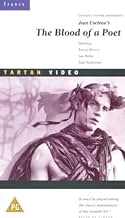
Told in four episodes - an unnamed artist is transported through a mirror into another dimension, where he travels through various bizarre scenarios.Told in four episodes - an unnamed artist is transported through a mirror into another dimension, where he travels through various bizarre scenarios.Told in four episodes - an unnamed artist is transported through a mirror into another dimension, where he travels through various bizarre scenarios.
- Awards
- 1 win total
- Director
- Writer
- All cast & crew
- Production, box office & more at IMDbPro
7.27.8K
1
2
3
4
5
6
7
8
9
10
Featured reviews
A masterpiece of the avant-garde
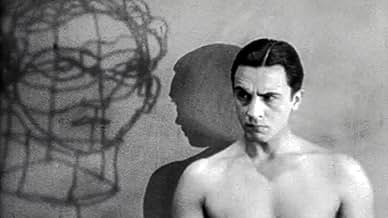
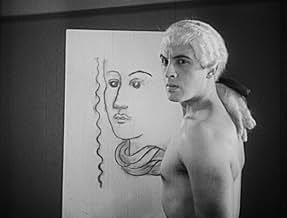
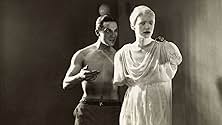
A masterpiece of the avant-garde, Jean Cocteau's "The Blood of a Poet" demonstrates not just an extraordinary imagination at work but remarkable technical skill as well and you must remember that this was also Cocteau's first film. A young artist, (Enrique Rivera), brings a statue to life, on her instructions enters a mirror, (a sequence he was later to develop in "Orphee"), and finds himself in a strange hotel where nothing is real. Plot-wise, that's it but the imagery shows just what cinema was capable of even as early as 1932.
You could say it was also decidedly homoerotic. Cocteau's artist, his poet, is shirtless almost throughout and Cocteau puts great emphasis on his physicality at least until the midway point when the poet becomes a card player in full evening dress and the statue, his partner and film becomes a surreal satire on the bourgeoisie, (his object of desire is now a young, black angel). Of course, looking for any kind of meaning in a film like this is basically pointless; just give your soul over to it and hopefully you will find Cocteau's soul gazing back at you.
Yes, Very Surreal.
Cocteau's first feature certainly reflects the early idealism of cinema, that "we can do it!" spirit that made early artists truly believe in the potential of cinema as a medium to trump all other arts. Thematically similar to the more famous surrealist work "Un chien Andalou," "Le sang d'un poete" is a chroma-key free-for all, with talking hands, statues that come to life, and banal bourgeoise cardgames transpiring on children's corpses. It's hard to watch at times, made even harder by what I think is a terribly distracting score (to the point where I just turned the sound off and enjoyed the film as a silent with subtitles.) However, by the end one realises Cocteau's heartfelt audacity, and the true spirit of the early cinema artists who wanted to do things with film that nobody has the cojones to try today.
A seminal work in experimentalist cinema; why does it seem like we've fallen way behind?
A strange and baffling film for fans of surrealism mainly
Surrealist cinema was at the height of its powers between the mid 1920's to the mid 1930's. For obvious reasons, the silent era had been particularly well suited to visually strong films. Like Luis Buñuel's L'âge d'or, The Blood of a Poet is one of the later films from this period. And both incorporate limited sound. In the case of this movie it is mainly music, with a little synchronised dialogue. It's a film that gives the impression of having an overall purpose and meaning but I have to admit, I really have no idea what it was. I found it baffling but interesting enough in a strange dream-like way. And at 50 minutes it hardly overstays its welcome. It's consistently well photographed and there are memorable sequences such as the hotel of strange rooms and the falling into a mirror moment. So, mainly, the film was of interest to me as an example of creative surrealism. But as to what it means? Ah, well, your own your own there I'm afraid
unforgettable imagery of a poet
This film could very well have been made in collaboration with Luis Bunuel (Un Chien Andalou '29, L'Age D'Or '30), but it is less experimental and I don't think Cocteau takes full advantage of the screen time: the pace is low and there are no really shocking elements. I have to admit it could be a little shorter (despite it's only 60 minutes). That's not because Cocteau really needs much time, but because it's just slow. But then again, aren't most of his films and does it matter? The cinematography in by Georges Perinal (Le Million, The Fallen Idol) and the music sufficiently contribute to the fabulous imagery. See this film.
There is a similar snowball-throwing scene in this film which was used also in 'Les Enfants Terrible' (Melville, 1950) which was also written by Cocteau as you can see from the title sequence, and was created by Jean-Pierre Melville (Le Samourai, Un Flic) with the famous Cocteau-atmosphere.
10 points out of 10 :-)
There is a similar snowball-throwing scene in this film which was used also in 'Les Enfants Terrible' (Melville, 1950) which was also written by Cocteau as you can see from the title sequence, and was created by Jean-Pierre Melville (Le Samourai, Un Flic) with the famous Cocteau-atmosphere.
10 points out of 10 :-)
surrealistic masterpiece:cocteau belonged more in film than literature
A magical little movie that, as another reviewer so well put it, 'means itself'. the imaginatively tame and purely cerebral, of course, shouldn't touch it. i don't much like cocteau's literary work and find it on the whole to be labored, monotonous, pretentious and boring. his verbal 'surrealism' never seemed to me to be worthy of the name, it just seemed like incomprehensible,almost annoyingly sarcastic jargon that made my eyes water. (like some of beckett's stuff.) but cinematically, i can't deny that he could pull it off--and how. i may not be a fan, but i recognize visual surreality when i see it, being an avowed surrealism addict. this one ranks up there with some of bunuel and bergman's stuff in terms of its sheer fascination and genuine merit, and as soon as i finished watching it i watched it again almost immediately. i repeat, don't even bothering trying to interpret it intellectually or rationally, and this applies to surrealist film as a whole. it appeals to the unconscious mind and the imagination, not to reason. (david lynch is the jean cocteau of our time!) A must.
Did you know
- TriviaBecause of the October 1930 scandal around Luis Buñuel's L'Age d'Or (1930) - another film financed by Le Vicomte de Noailles and Marie-Laure de Noailles, the Paris premiere of this film was delayed until January 1932.
- ConnectionsFeatured in Jean Cocteau: Autoportrait d'un inconnu (1983)
- How long is The Blood of a Poet?Powered by Alexa
Details
- Release date
- Country of origin
- Languages
- Also known as
- Das Blut eines Dichters
- Production company
- See more company credits at IMDbPro
- Runtime
- 55m
- Color
- Aspect ratio
- 1.37 : 1
Contribute to this page
Suggest an edit or add missing content