
The Gangster Macheath secretly marries the daughter of beggar king Peachum. When Peachum finds out, he instructs the police chief Brown to arrest and hang Macheath. If not, all the beggars o... Read allThe Gangster Macheath secretly marries the daughter of beggar king Peachum. When Peachum finds out, he instructs the police chief Brown to arrest and hang Macheath. If not, all the beggars of Soho will disturb the upcoming coronation.The Gangster Macheath secretly marries the daughter of beggar king Peachum. When Peachum finds out, he instructs the police chief Brown to arrest and hang Macheath. If not, all the beggars of Soho will disturb the upcoming coronation.
- Awards
- 1 win total


- Jenny
- (as Lotte Lenja)


- Polly Peachum
- (as Mlle. Florelle)


- Smith
- (as Wladimir Sokoloff)
- Chanteur de rues
- (as Bill-Bocketts)


- Mendiant
- (as Gaillard)
Featured reviews
Rather a disappointment
Many reviewers here seem to take the London location too seriously. That's just a relic of the John Gay original (The Beggar's Opera): it is most clearly meant to be a satire on Weimar Republic Germany. That's why the Nazis banned it. The real corruption is in the official institutions of power, not in the relatively benign underworld (which reappears in very similar shape and form in Fritz Lange's "M".) Those who don't know Brecht's translations of Gay's original names and texts should learn that MacHeath becomes 'Mackie Messer' (messer mean 'knife' in German, thus 'Mack the Knife'.)
The best thing about the film, is probably the documentary record it contains of just how the original audiences would have seen the story, and how the original performers would have rendered the songs. I particularly liked the Moritaet-Saenger and his incredible trilled "Rs" in the opening scene.
Life is Money, Food, Sex, Nothing
I've seen Die 3groschenoper a number of times now, but this was my 1st visit to the French version, my first impressions being favourable as it is an exact scene-for-scene re-run after all - for the story refer to everyone's comments for 3G. The French runs 7 minutes faster - is that just down to the language differences? I wonder how many of the background extras acted in both (and did they get paid for 2 movies!), but the speaking parts of course were handed to French actors and actresses - the whole reason why this talkie was made. I can almost get by in French - but German is a real tongue-twister for me, so to me a lot of the earthy harshness and Weimar cynicism is lost here for a typically French airy artiness, even down to the song lyrics. Without that overpowering cynicism it becomes for me simply a very good film, not a great one like the simultaneous original. Otoh it's easier to follow, meaning it enlightened me on some aspects of the German release I'd struggled over. Here, in the English translation of the French the people in the shadows ultimately "melt away" - I prefer the "lost to sight" translation of the German. Etherial compared to material.
If you enjoyed 3G then you're sure to enjoy this. Overall, for an Englishman a very enjoyable (French) curio, but for instance if I ever feel that I need a shot of Cynical Sleazy Singing I'll be heading back to Ernst Busch, Carole Neher, Lotte Lenya and Co.
Outbrechts Brecht
And I write this from a country that experiences an eerily similar situation almost a century later, is ravaged by recession, well-to-do people of three years ago are now sleeping in benches, and that horror and despair has brought actual neo-Nazis in the parliament and racial hate in the streets. So, this hits unexpectedly close to home, and makes me lament that we don't have talents of Pabst's calibre.
Ingenious moments in this extremely cynical vision of a world ruled by money include a 'king of beggars' who runs a powerful beggar-union of fake beggars, and a crook who is sprung from prison only to discover he is president of a London bank.
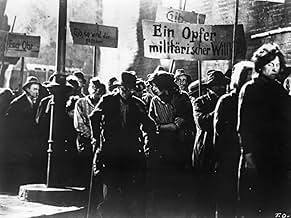
Pabst plays free and loose with Brecht's text, drops several musical numbers, and makes at least two powerful additions of his own: his ire is aimed at both left and right, with the beggar-union clearly standing in for socialists (their slogans include "give to be given back") who exploit the despair of the people for petty gains, and goes on to show a public riot (only threatened in Brecht) that ends not in triumphant Soviet-revolution but failure and obscurity.
The guy (with his team of close collaborators) was a genius, just not necessarily in this field.
Individual scenes are superb, but the whole feels sluggish and protracted. Scenes open several moments before we need the information and end several moments later. And for a film like this, you need a Marx Bros - Dr. Strangelove madcap rhythm to keep the zap of ferocious energy from dissipating.
But you just need to look at the opening to see what these guys were capable of, what astounding visual language they had refined.
The sparsity works because they're not going for comedic effect yet. It could be the opening to any type of film, say a melodrama. We are introduced to our crook through a public show in the Italian manner, sung and pointing to illustrated panels of the action (our film), and go on to meet him as he courts and swiftly convinces a young girl to marriage. All of that happens in a matter of minutes, no more than four scenes tops. There is a minimum of dialogue. The courting - a dance of seduction - happens in a dance club, and is actually shown as other couples dancing. We don't hear what he says to her, only lips moving. We only find out later (maybe) when she sings about it.
Pabst was the master of allusive filmmaking in the late silent era. You just can't afford to miss his Diary of a Lost Girl.
These days, Eisenstein is the backbone of MTV. You can see Riefenstahl's mark all over the coverage of sports and public events. Expressionism has been made cute and pop. Unlike them, this mode of using a scene to portray unseen bits of narrative that would have been wholly ordinary if simply shown is still new and untapped.
Pabst's bitter musical
A giant of early European talkies, this musical has much to recommend to a viewer looking at it after seven decades. An adaptation with songs of John Gay's The Beggar's Opera', it deals with the underworld of crooks, moneylenders, and cut-throats.
Chief of note in the varied cast are Rudolf Forster as Mackie, Carola Neher as Polly, Fritz Rasp as Peachum, and Ernst Busch as the Street Singer. This movie is one of bitterness and foreboding, and it is excellent.
Life is Money, Food, Sex, Nothing
The Guild Of Thieves' leader gets married to the Guild of Beggars' leader's daughter, causing friction between the two highly organised and respected professions, but inertia in the police who are in the Thieves' power. Prostitution, aberration, bigamy, thievery, extortion, bribery, corruption (and complete cynically cheerful indifference to it all), you name it it's here - after all it is all that Man can do! Laconic-looking Ernst Busch's searing inter-ditties leave you with the distinct impression that someone was rather tired with the world! The savage sounding German words spew out, whilst reading the English subtitles is sometimes heavy going in digesting all of the conceptual opinions in time to digest the next. Would that Bobby Darin had got his tonsils round a few more of the extraordinary gossamer Brecht/Weill songs from this! Lotte Lenya sparkled doing her Pirate Jenny number, being just a part of my favourite bit in the idling whorehouse.
All of the people involved in 3G are "lost to sight", except to the handful of Artheads who occasionally hold cultural revivals of Weill, Brecht or Pabst. There was a memorable series of events in London in 2000 to mark the 50th anniversary of Weill's death, but 99.99% of the general public passed it by.
Soon we will all be lost to sight too, along with all of our fractious opinions and silly vices.


Did you know
- TriviaThe film was banned by the Nazi Party in 1933 and prints of the film were destroyed. The film was restored and reconstructed in the 1960s.
- Quotes
Peachum: You too wish to be part of this splendid occasion. You, poorest of the poor, who'd long ago have perished in the sewers of Turnbridge if I hadn't spent sleepless nights devising a way to wring a few pence out of your poverty. For I've shown that the rich of this world have no qualms about causing misery but can't bear the sight of it. They have hard hearts but weak nerves. Well, we won't spare their nerves today! By the thousands we'll tear at their nerves, for our rags do not conceal our wounds!
- Alternate versionsThere is an Italian edition of this film on DVD, distributed by DNA srl, "L'OPERA DA TRE SOLDI (1931) + HANGMEN ALSO DIE (Anche i boia muoiono, 1943)" (2 Films on a single DVD), re-edited with the contribution of film historian Riccardo Cusin. This version is also available for streaming on some platforms.
- ConnectionsFeatured in Portrait of Valeska Gert (1977)
- SoundtracksLa Complainte de Mackie
(Die Moritat von Mackie Messer)
Music by Kurt Weill
German lyrics by Bertolt Brecht
French lyrics by André Mauprey
Performed by Florelle
- How long is The Threepenny Opera?Powered by Alexa
Details
- Runtime
- 1h 44m(104 min)
- Color
- Aspect ratio
- 1.20 : 1
- 1.33 : 1