
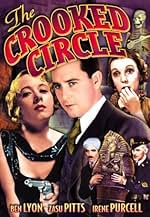
A group of amateur detectives sets out to expose The Crooked Circle, a secretive group of hooded occultists.A group of amateur detectives sets out to expose The Crooked Circle, a secretive group of hooded occultists.A group of amateur detectives sets out to expose The Crooked Circle, a secretive group of hooded occultists.





Raymond Hatton
- Harmon (The Hermit)
- (as Ray Hatton)


Berton Churchill
- Col. Walters
- (as Burton Churchill)


Paul Panzer
- Cult Member
- (uncredited)
- Director
- Writers
- All cast & crew
- Production, box office & more at IMDbPro
5.3417
1
2
3
4
5
6
7
8
9
10
Featured reviews
Typical old dark house comedy-mystery
The Crooked Circle is a film that has a lot more potential than it fully realizes. It starts with an intriguing scene with a group of black hooded individuals in an underground room. These shady characters are the Crooked Circle and they are planning revenge on a group of amateur sleuths called the Sphinx Club. Now this set-up makes it sound like the movie could go in an interesting direction with both these groups fighting against each other. Unfortunately, the focus is subsequently too often on comedy, rather than suspense.
The film takes the form of the old dark house format which was hugely popular in the 1930's. The house itself is full of the usual array of secret passageways, trap-doors and hidden rooms that was part and parcel in these movies. The mystery isn't ultimately too compelling, although there is a reasonable twist near the end. It's as creaky as you would expect but not without some charm.
The film takes the form of the old dark house format which was hugely popular in the 1930's. The house itself is full of the usual array of secret passageways, trap-doors and hidden rooms that was part and parcel in these movies. The mystery isn't ultimately too compelling, although there is a reasonable twist near the end. It's as creaky as you would expect but not without some charm.
"A fight to the knife and a knife to the hilt!"
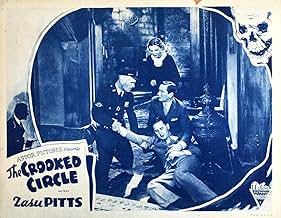
Bruce `Lucky' Humberstone's THE CROOKED CIRCLE begins with that eponymous quintet of `counterfeiters and thieves deluxe' pledging their dark allegiance (`To do for each other, to avenge any brother, a fight to the knife and a knife to the hilt!'), drawing lots from a hinged skull for the honor of bringing to ground Colonel Wolters, leader of an affluent band of amateur criminologists known as The Sphinx Club. In its second half, the film adheres faithfully to the established spookhouse syllabus (sliding panels, trap doors, and an attic stuffed with skeletons, sarcophaguses and Oriental objets d'art), with director Humberstone maximizing the felonious, comic and preternatural possibilities, all nicely complemented by the amusing dialogue of playwright Ralph Spence (THE GORILLA) and Tim Whelan. Rounding out the roster of red herrings, henchmen and gawkers are WHITE ZOMBIE's Robert Frazer, the ever-quivery Zasu Pitts (`There's a ghost in this house and when he plays the violin, something always happens to somebody!'), James Gleason as a malaprop-prone New Yawk flatfoot, KING KONG's Frank Reicher, and `queer-acting hunchback' Raymond Hatton (later the sour Farmer Larkin of INVASION OF THE SAUCER MEN). It's corny and creaky and good old fashioned fun for those hip to the charms of Poverty Row whodunits. See for yourself!
Warring Clubs
By 1930, film was already a living, breathing organism that was manipulating artists and audiences in its quest to survive and grow. From 1932 to 1938, that organism tried a number of potential branches of evolution before settling on one main one. But during that period, many experiments can be viewed, experiments that did not blossom and quickly became extinct.
Sadly, this exemplifies one of them and it is such a perfect example, such a pure specimen, it really must be seen if only for history. I'm increasingly convinced that we cannot be fully in the film experience until we have shared in some of its failed attempts.
What characterizes this is extreme abstraction. The basis is the detective story, a basis that is so strong in narrative appeal it survives today as the root of most film. But this experiment abstracts it extremely.
The bad guys are not just bad, but have a club. The good guys are not just good and smart, but they have a club too. The two clubs are at war, mostly it seems because that's what two groups do: define the other as the enemy and adopt roles accordingly.
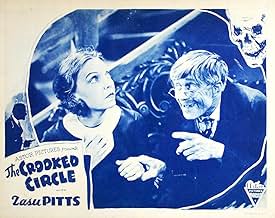
The setting is abstract too: a "haunted" mansion with trap doors, secret passages, resident hunchback, disembodied music, skeletons (that predictably catch on the girl's dress) and blackouts. There's a very, very clever twist in the story too, one you know is there but you just can't pin down until it happens.
Zazu Pitts does a spooked housekeeper whose voice would be appropriated for Olive Oyl who would make her first appearance the following year.
Ted's Evaluation -- 3 of 3: Worth watching.
Sadly, this exemplifies one of them and it is such a perfect example, such a pure specimen, it really must be seen if only for history. I'm increasingly convinced that we cannot be fully in the film experience until we have shared in some of its failed attempts.
What characterizes this is extreme abstraction. The basis is the detective story, a basis that is so strong in narrative appeal it survives today as the root of most film. But this experiment abstracts it extremely.
The bad guys are not just bad, but have a club. The good guys are not just good and smart, but they have a club too. The two clubs are at war, mostly it seems because that's what two groups do: define the other as the enemy and adopt roles accordingly.
The setting is abstract too: a "haunted" mansion with trap doors, secret passages, resident hunchback, disembodied music, skeletons (that predictably catch on the girl's dress) and blackouts. There's a very, very clever twist in the story too, one you know is there but you just can't pin down until it happens.
Zazu Pitts does a spooked housekeeper whose voice would be appropriated for Olive Oyl who would make her first appearance the following year.
Ted's Evaluation -- 3 of 3: Worth watching.
Crooked movie
I tried to watch it because it is an early Bruce Humbertsone's film, a director whose filmography will become a little more known during the forties and fifties with the likes of I WAKE UP SCREAMING, TEN WANTED MEN, THE PURPLE MASK and some Tarzan adveture yarns. I am not fond of those all alike thirties mystery flicks, talkative, mostly comedies, and boring for me. So, maybe I am not the best reviewer for this kind of stuff. But if you are courageous enough, go, don't bother my review. It is rare, short and maybe you belong to those who can enjoy it. I don't know very much the actors except maybe Zasu Pitts.
Creaky Good Comedy
"The Sphinx Club is a group of amateur detectives who are the bitter rivals of The Crooked Circle, a collection of hooded villains. After The Sphinx Club aids the authorities in catching and imprisoning a member of The Crooked Circle, the evil gang swears revenge by targeting Colonel Walters, a well-known member of The Sphinx Club. Will the Sphinx Club be able to protect Colonel Walters or will The Crooked Circle succeed in their quest to kill him?" asks the DVD sleeve.
The threatened Sphinx Club member, Berton Churchill (as Theodore Walters) is pretty good - but, he is not the focus of this comedy-mystery. Instead, we get zany Zasu Pitts (as Nora Rafferty) complaining to Christian Rub (as Old Dan) about living in spooky "Melody Manor". Ms. Pitts does her best "Olive Oyl" (from "Popeye") dress and voice. And, as a bonus, Mr. Rub responds with his "Gepetto" (from "Pinocchio"). You won't see "Olive Oyl" and "Gepetto" in too many movies!
Meanwhile, Ben Lyon (as Brand Osborne) is preparing to resign from the Sphinx Club. His replacement is foreboding Indian C. Henry Gordon (as Yoganda), who warns, "Evil is on the way." When Gordon arrives at "Melody Manor", Pitts looks at his turban and says: "I'm sorry you got a headache sir, shall I get you a Bromo-Seltzer?" Others in the funny cast: cop James Gleason ("Here Comes Mr. Jordan"), hermit Raymond Hatton ("The Whispering Chorus"), and gay Roscoe Karns ("It Happened One Night").
****** The Crooked Circle (9/25/32) Bruce Humberstone ~ Ben Lyon, Zasu Pitts, C. Henry Gordon, Christian Rub
The threatened Sphinx Club member, Berton Churchill (as Theodore Walters) is pretty good - but, he is not the focus of this comedy-mystery. Instead, we get zany Zasu Pitts (as Nora Rafferty) complaining to Christian Rub (as Old Dan) about living in spooky "Melody Manor". Ms. Pitts does her best "Olive Oyl" (from "Popeye") dress and voice. And, as a bonus, Mr. Rub responds with his "Gepetto" (from "Pinocchio"). You won't see "Olive Oyl" and "Gepetto" in too many movies!
Meanwhile, Ben Lyon (as Brand Osborne) is preparing to resign from the Sphinx Club. His replacement is foreboding Indian C. Henry Gordon (as Yoganda), who warns, "Evil is on the way." When Gordon arrives at "Melody Manor", Pitts looks at his turban and says: "I'm sorry you got a headache sir, shall I get you a Bromo-Seltzer?" Others in the funny cast: cop James Gleason ("Here Comes Mr. Jordan"), hermit Raymond Hatton ("The Whispering Chorus"), and gay Roscoe Karns ("It Happened One Night").
****** The Crooked Circle (9/25/32) Bruce Humberstone ~ Ben Lyon, Zasu Pitts, C. Henry Gordon, Christian Rub


Did you know
- TriviaOn March 10, 1933, this became the first feature film ever shown on TV when the experimental Los Angeles station W6XAO-TV broadcast it from the corner of 7th and Bixel Streets. There were perhaps five or six television sets in the greater Los Angeles area which were able to receive the broadcast. It was still playing in local theaters at the time.
- Quotes
Brand Osborne: What the deuce?
- ConnectionsReferenced in Public Enemies: The Golden Age of the Gangster Film (2008)
Details
- Release date
- Country of origin
- Language
- Also known as
- Noche de fantasmas
- Production company
- See more company credits at IMDbPro
- Runtime
- 1h 10m(70 min)
- Color
- Aspect ratio
- 1.37 : 1
Contribute to this page
Suggest an edit or add missing content