
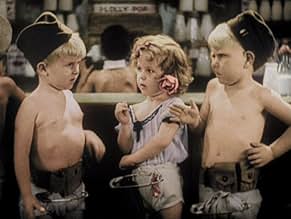
A group of soldiers in a café watch a dancer as she entertains them, but later two of them become rivals over her.A group of soldiers in a café watch a dancer as she entertains them, but later two of them become rivals over her.A group of soldiers in a café watch a dancer as she entertains them, but later two of them become rivals over her.



Ted Frye
- Violin Player
- (as Teddy Frye)

Georgie Billings
- Soldier
- (uncredited)

Eugene Butler
- Sgt. Quirt
- (uncredited)

Philip Hurlic
- Black Boy
- (uncredited)

Georgie Smith
- Capt. Flagg
- (uncredited)
Featured reviews
[I saw this movie once late on a public tv station, so I don't know if it's on video or not.]
This is one of the "Baby Burlesks" (sic) that Shirley Temple did in the early 1930s. It is hard to believe that anyone would let their daughter be in this racy little film which today might just be considered this side of "kiddie porn".
Shirley Temple stars in a cast which probably has an average age of 5. They are all in diapers, and are in a saloon which serves milk instead of alcohol. The "cash" is in the form of lollipops.
Shirley playing a "femme fatale" sashays up to the bar and talks to soldiers who make suggestive comments about her (!). But Shirley doesn't need really their lollipops/cash because her purse is full of ones from other "men".
Meanwhile a little black boy does a suggestive dance on a nearby table (!).
What a strange film . . . infants using racy dialogue playing adult roles in a saloon. Who thought up this stuff any way?
This is one of the "Baby Burlesks" (sic) that Shirley Temple did in the early 1930s. It is hard to believe that anyone would let their daughter be in this racy little film which today might just be considered this side of "kiddie porn".
Shirley Temple stars in a cast which probably has an average age of 5. They are all in diapers, and are in a saloon which serves milk instead of alcohol. The "cash" is in the form of lollipops.
Shirley playing a "femme fatale" sashays up to the bar and talks to soldiers who make suggestive comments about her (!). But Shirley doesn't need really their lollipops/cash because her purse is full of ones from other "men".
Meanwhile a little black boy does a suggestive dance on a nearby table (!).
What a strange film . . . infants using racy dialogue playing adult roles in a saloon. Who thought up this stuff any way?
This is a peculiar and rather uncomfortable feature from the early days of Shirley Temple's career. It's rather strange to see such a complete contrast between the innocent, almost syrupy tone of her best-known full-length movies and the risqué, often rather inappropriate nature of many of her early short features. If nothing else, it provides some interesting examples of how the perspectives of the time differed from those of today.
Temple, at four years of age, is part of a cast consisting entirely of equally young children (as was also the case in many of her earliest short movies). She plays a dancer who entertains a group of soldiers in a café, soon becoming the source of a rivalry between two of them. Besides the basic story line, there are a lot of isolated gag ideas, many of them using milk in one way or another.
The children are depicted as thoroughly amoral characters, leading to a lot of situations that the vast majority of today's viewers would find uncomfortable or even disturbing. Certainly, no film-maker today could film such material using children without suffering irrevocable consequences to his or her career. Setting aside whatever one's personal feelings may be, it points out some very different attitudes or sensitivities - and of course, there are things that are routinely accepted in today's movies that would have provoked nearly universal outrage in the 1940s.
If you can set aside the uncomfortable nature of the material, there are probably a handful of amusing moments. The intent was obviously to use the children to satirize adult behavior, and on occasion it works. But, to be painfully honest, it's just not really a very good movie anyway. Besides the racy behavior of the child actors, they threw in some racial stereotypes, apparently just for good measure, and then the constant emphasis on milk is a bit odd in itself.
One thing, though, that does stand out is that Temple has an obvious energy and screen presence that transcends both her character and the nature of the material. It's no surprise that she could be spotted and groomed for stardom even while performing in things like this. What's a little less expected is to see such a complete contrast between the movies for which she is usually remembered and the movies that gave her a start.
Temple, at four years of age, is part of a cast consisting entirely of equally young children (as was also the case in many of her earliest short movies). She plays a dancer who entertains a group of soldiers in a café, soon becoming the source of a rivalry between two of them. Besides the basic story line, there are a lot of isolated gag ideas, many of them using milk in one way or another.
The children are depicted as thoroughly amoral characters, leading to a lot of situations that the vast majority of today's viewers would find uncomfortable or even disturbing. Certainly, no film-maker today could film such material using children without suffering irrevocable consequences to his or her career. Setting aside whatever one's personal feelings may be, it points out some very different attitudes or sensitivities - and of course, there are things that are routinely accepted in today's movies that would have provoked nearly universal outrage in the 1940s.
If you can set aside the uncomfortable nature of the material, there are probably a handful of amusing moments. The intent was obviously to use the children to satirize adult behavior, and on occasion it works. But, to be painfully honest, it's just not really a very good movie anyway. Besides the racy behavior of the child actors, they threw in some racial stereotypes, apparently just for good measure, and then the constant emphasis on milk is a bit odd in itself.
One thing, though, that does stand out is that Temple has an obvious energy and screen presence that transcends both her character and the nature of the material. It's no surprise that she could be spotted and groomed for stardom even while performing in things like this. What's a little less expected is to see such a complete contrast between the movies for which she is usually remembered and the movies that gave her a start.
I tried to see it with open hard. And it was imposible. Because the children rights, the embarassing situations, a parody with touch of grotesque and strange situations.
Few little children in a cafe. References to army, rivalry in love for a presumed French dancer, a dog stealing underware, a kid and an imitation of cow, two blach children in stereotypical situations and some flirt, sweet candy, a lot of milk and some embarassment for viewer.
Sure, reflection of studio interests and a so young Shirley Temple as only feminine presence. But, after 90 years , difficult to be more than intrigued by this short film.
Few little children in a cafe. References to army, rivalry in love for a presumed French dancer, a dog stealing underware, a kid and an imitation of cow, two blach children in stereotypical situations and some flirt, sweet candy, a lot of milk and some embarassment for viewer.
Sure, reflection of studio interests and a so young Shirley Temple as only feminine presence. But, after 90 years , difficult to be more than intrigued by this short film.
Okay, Shirley Temple plays a singer in this film short during wartime. Her skirt is ultra short and inappropriate now and wonder why the censors didn't notice it then. Also, the boys are supposed to be soldiers but they don't wear shirts. I know they're supposed to act like adults as children but I felt uncomfortable seeing the children exposed in an unhealthy manner. The boys and girls acted like adults even though they were small children but still I can't believe that the censors allowed the children to be dressed in such a manner to expose them to the world audience. Maybe they didn't notice it then about the negative reaction, I know I would never allow my son to go shirtless at a young age or my daughter to wear a short skirt to the thigh. I was a little disturbed by it all and I'm glad that it's not aired on television anymore.
I remember my grandmother giving me this tape when I was a child, because she was going to throw it away. It contained Dora's Dunking Donuts and War Babies. Thinking back, I had to take the tape with me, whenever I spent the night at a friend's or a relative's. My favorite scene in War Babies was with the dog. Shirley Temple's character marches up to the dog, who in turn, barks at her. She runs back to the little boy and says, "I'm afraid!" And when another little boy goes to chase the dog away, the dog ends up chasing him out, but returns with the child's diaper. This tape has been passed back and forth between me and my sister over the years. I recently came across it in a storage box in my closet and gave it to my sister to keep.


Did you know
- TriviaIn her 1988 book. Child Star: An Autobiography, Shirley Temple described the Baby Burlesks series as "a cynical exploitation of our childish innocence." She also explained that if any of the preschool age children misbehaved on set, they were locked in a windowless booth called the "punishment box" and be forced to sit on a solid block of ice for extended periods of time. Temple was sent to the "punishment box" several times but claimed it did "no lasting damage" to her psyche. Temple described these production sets having a very strong, present, "time is money" attitude. This led to her being forced to work while injured on multiple occasions, one time working a single day after a serious eardrum operation.
- Quotes
Captain Flagg: What are you doing?
Sergeant Quirt: I been sayin' goodbye to my baby.
Captain Flagg: [showing Charmaine's flower] Oh, yeah? Your baby? Says you!
Sergeant Quirt: [showing Charmaine's diaper pin] Yeah, says me!
- ConnectionsFeatured in DTV: Pop & Rock (1984)
Details
- Runtime
- 11m
- Color
- Aspect ratio
- 1.37 : 1
Contribute to this page
Suggest an edit or add missing content