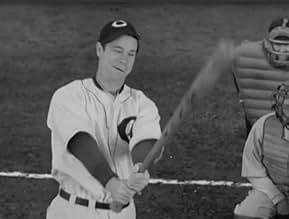
Country bumpkin Elmer Kane joins the Chicago Cubs as the greatest hitter in baseball. His skill with a bat takes the team to the World Series, but on the way to the championship he has to de... Read allCountry bumpkin Elmer Kane joins the Chicago Cubs as the greatest hitter in baseball. His skill with a bat takes the team to the World Series, but on the way to the championship he has to deal with gamblers and crooked pitchers.Country bumpkin Elmer Kane joins the Chicago Cubs as the greatest hitter in baseball. His skill with a bat takes the team to the World Series, but on the way to the championship he has to deal with gamblers and crooked pitchers.
- Director
- Writers
- Stars
Preston Foster
- Dave Walker
- (as Preston S. Foster)
Sterling Holloway
- Nick Kane
- (as Sterling Halloway)
Charles C. Wilson
- Mr. Wade
- (as Charles Wilson)
J. Carrol Naish
- Jerry
- (as J. Carroll Naish)
Maurice Black
- Dice Dealer
- (uncredited)
Don Brodie
- Casino Employee
- (uncredited)
George Chandler
- Cubs Player
- (uncredited)
Phyllis Crane
- Gentryville Journal Reporter
- (uncredited)
Douglass Dumbrille
- Stillman
- (uncredited)
- Director
- Writers
- All cast & crew
- Production, box office & more at IMDbPro
6.1655
1
2
3
4
5
6
7
8
9
10
Featured reviews
Period Piece
Sure it's cornball, and in many respects it seems hopelessly naive, and Joe E. Brown's persona is in some respects pretty insufferable, but it's clear that the makers of this picture knew all that. For some reason, Joe really resonated with American society of the 1930s, and that's what the producers gave to the public. I doubt if folks back then could have related to Johnny Depp, either.
While "Elmer the Great" is certainly no masterwork, if you just take it on its own terms, the film is quite likable. It's particularly atmospheric in the earlier scenes set in Gentryville, Indiana. And there's some nice moments of pathos here, too.
I would rank all three of JEB's baseball trilogy as about equally good.
All Runners Batted In
ELMER, THE GREAT home run hitter doesn't want to leave his pretty boss in Gentryville, Indiana, to play ball for the Chicago Cubs.
Rubber-limbed comic Joe E. Brown scores big in this fine little comedy. Without even trying, the fellow could be funny - his huge grin and mischievous eyes a sure catalyst for laughter. In his first scenes, the mere act of his putting on his socks or eating his breakfast is a riot. The film also gives him a chance to suffer from unrequited love and face the abuse heaped on him for his yokel ways as he tries to deal with professional ballplayers and dangerous gamblers. Brown carries it all off with natural aplomb.
A sturdy cast lends fine support: pretty Patricia Ellis as Brown's conflicted boss; sweet Emma Dunn as his loving mother; goofy Sterling Holloway, perfectly cast, as Brown's baseball-mad younger brother (notice that Holloway's name is spelled incorrectly in the credits). Blustery Berton Churchill plays the owner of the Cubs, Preston Foster is the manager. Genial Frank McHugh plays the Cubs catcher. Claire Dodd has a mysterious role; she seems to be a chum of the ballplayers and little else - but at least she's easy on the eyes and the plot doesn't try to set up a silly romance between her and Brown. Casino hoodlum J. Carrol Naish plays the film's villain.
Movie mavens will recognize an uncredited Jessie Ralph as Brown's plain speaking, softhearted housekeeper.
The early scenes in Gentryville have a delightfully homespun, nostalgic charm which the later Chicago sequences can't match. Notice the fine use the minimal soundtrack makes of just two songs: Take Me Out To The Ball Game' & On The Banks Of The Wabash.'
Brown's use of a four-letter word near the film's climax underscores the film's pre-Code status. Also of interest, in the last inning of the final World Series game, the plot has the catcher & pitcher of the New York Yankees deliberately and maliciously cheat in an attempt to win. One wonders what Babe Ruth & Lou Gehrig must have thought of that...
ELMER, THE GREAT was the second of Brown's baseball trilogy,' the other films being FIREMAN, SAVE MY CHILD (1932) & ALIBI IKE (1935).
Rubber-limbed comic Joe E. Brown scores big in this fine little comedy. Without even trying, the fellow could be funny - his huge grin and mischievous eyes a sure catalyst for laughter. In his first scenes, the mere act of his putting on his socks or eating his breakfast is a riot. The film also gives him a chance to suffer from unrequited love and face the abuse heaped on him for his yokel ways as he tries to deal with professional ballplayers and dangerous gamblers. Brown carries it all off with natural aplomb.
A sturdy cast lends fine support: pretty Patricia Ellis as Brown's conflicted boss; sweet Emma Dunn as his loving mother; goofy Sterling Holloway, perfectly cast, as Brown's baseball-mad younger brother (notice that Holloway's name is spelled incorrectly in the credits). Blustery Berton Churchill plays the owner of the Cubs, Preston Foster is the manager. Genial Frank McHugh plays the Cubs catcher. Claire Dodd has a mysterious role; she seems to be a chum of the ballplayers and little else - but at least she's easy on the eyes and the plot doesn't try to set up a silly romance between her and Brown. Casino hoodlum J. Carrol Naish plays the film's villain.
Movie mavens will recognize an uncredited Jessie Ralph as Brown's plain speaking, softhearted housekeeper.
The early scenes in Gentryville have a delightfully homespun, nostalgic charm which the later Chicago sequences can't match. Notice the fine use the minimal soundtrack makes of just two songs: Take Me Out To The Ball Game' & On The Banks Of The Wabash.'
Brown's use of a four-letter word near the film's climax underscores the film's pre-Code status. Also of interest, in the last inning of the final World Series game, the plot has the catcher & pitcher of the New York Yankees deliberately and maliciously cheat in an attempt to win. One wonders what Babe Ruth & Lou Gehrig must have thought of that...
ELMER, THE GREAT was the second of Brown's baseball trilogy,' the other films being FIREMAN, SAVE MY CHILD (1932) & ALIBI IKE (1935).
Forgotten Gem
Joe E. Brown is largely forgotten today and it's too bad. He made a string of fine little films for Warner Brothers in the early to mid 1930s. Ironically he has the final riotous line in the American Film Institute's no. 1 comedy, from their 100 Greatest Comedies list, "Some Like It Hot". Regarding "Elmer the Great," this film recaptures a wonderful era in baseball as well as a nostalgic feel for small town America. Its story is told with the Warner Brothers' successful no frills approach to movie making at that time. There is plenty of warm humor throughout especially from the always wonderful Joe E. Brown as the cantankerous, egoist Elmer Kane, still likable in spite of these character flaws. I wish Joe E. Brown's WB movies were available on DVD. A single packaged trilogy release could be made of his 3 baseball films: "Fireman Save My Child" (WB 1932), "Elmer the Great" (WB 1933) and "Alibi Ike" (WB 1935).
borderline comedy
Elmer Kane (Joe E. Brown) is a simple small town ballplayer with small town girl Nellie Poole. He is recruited by the Chicago Cubs, but he hates the big city. Nellie convinces him to go. His teammates hate him even though he hits loads of homers. He loses Nellie and gets entangled by criminal gamblers.
The character is frustratingly dumb. He's not actually dumb. His idiocy comes from arrogance. It's a particular character and I struggle to like him all the time. I don't buy the teammates especially after they are winning. Winning solves all problems in the clubhouse. This movie is oscillating between pass fail and ultimately wins me over.
Silly sports comedy cliche
Nothing much to say. A lot like Adam Sandler's The Waterboy. To tell the truth, Sandler is the latter-day Brown. If you love Sandler, you'll like beown. I've a suspiscion his fans were kids and junior high school kids because his films play to that level of humor. You may call them family films. Movie is about a small-town boy who joins the Cubs and helps them win the penant. There are gangsters, bribes and bets that go awry. It has a very good and realistic baseball finale.
Did you know
- TriviaThe long shots from the World Series are film from the 1932 World Series between the New York Yankees and Chicago Cubs.
- GoofsUnder the rules of baseball, once a player has been removed from the game, he cannot re-enter it.
- Quotes
Elmer Kane: Warm up? Hell, I ain't been cool since February!
- ConnectionsFollowed by Alibi Ike (1935)
- SoundtracksTake Me Out to the Ball Game
(1908) (uncredited)
Music by Albert von Tilzer
Played during the opening credits and often in the score
- How long is Elmer, the Great?Powered by Alexa
Details
- Release date
- Country of origin
- Language
- Also known as
- Элмер Великий
- Filming locations
- Avalon, Santa Catalina Island, Channel Islands, California, USA(Chicago Cubs Training Grounds)
- Production company
- See more company credits at IMDbPro
- Runtime
- 1h 12m(72 min)
- Color
- Sound mix
- Aspect ratio
- 1.37 : 1
Contribute to this page
Suggest an edit or add missing content