Release calendarTop 250 moviesMost popular moviesBrowse movies by genreTop box officeShowtimes & ticketsMovie newsIndia movie spotlight
    What's on TV & streamingTop 250 TV showsMost popular TV showsBrowse TV shows by genreTV news
    What to watchLatest trailersIMDb OriginalsIMDb PicksIMDb SpotlightFamily entertainment guideIMDb Podcasts
    OscarsBest Of 2025Holiday Watch GuideGotham AwardsCelebrity PhotosSTARmeter AwardsAwards CentralFestival CentralAll events
    Born todayMost popular celebsCelebrity news
    Help centerContributor zonePolls
For industry professionals
  • Language
  • Fully supported
  • English (United States)
    Partially supported
  • Français (Canada)
  • Français (France)
  • Deutsch (Deutschland)
  • हिंदी (भारत)
  • Italiano (Italia)
  • Português (Brasil)
  • Español (España)
  • Español (México)
Watchlist
Sign in
  • Fully supported
  • English (United States)
    Partially supported
  • Français (Canada)
  • Français (France)
  • Deutsch (Deutschland)
  • हिंदी (भारत)
  • Italiano (Italia)
  • Português (Brasil)
  • Español (España)
  • Español (México)
Use app
  • Cast & crew
  • User reviews
  • Trivia
IMDbPro

Playing at Love

Original title: Liebelei
  • 1933
  • Not Rated
  • 1h 28m
IMDb RATING
7.5/10
1.6K
YOUR RATING
Magda Schneider in Playing at Love (1933)
GermanDramaRomance

Vienna in the beginning of the twentieth century. Cavalry Lieutenant Fritz Lobheimer is about to end his affair with Baroness Eggerdorff when he meets the young Christine, the daughter of an... Read allVienna in the beginning of the twentieth century. Cavalry Lieutenant Fritz Lobheimer is about to end his affair with Baroness Eggerdorff when he meets the young Christine, the daughter of an opera violinist. Baron Eggerdorff however soon hears of his past misfortune...Vienna in the beginning of the twentieth century. Cavalry Lieutenant Fritz Lobheimer is about to end his affair with Baroness Eggerdorff when he meets the young Christine, the daughter of an opera violinist. Baron Eggerdorff however soon hears of his past misfortune...
  • Director
    • Max Ophüls
  • Writers
    • Curt Alexander
    • Max Ophüls
    • Felix Salten
  • Stars
    • Wolfgang Liebeneiner
    • Carl Esmond
    • Magda Schneider
  • See production info at IMDbPro
  • IMDb RATING
    7.5/10
    1.6K
    YOUR RATING
    • Director
      • Max Ophüls
    • Writers
      • Curt Alexander
      • Max Ophüls
      • Felix Salten
    • Stars
      • Wolfgang Liebeneiner
      • Carl Esmond
      • Magda Schneider
    • 15User reviews
    • 17Critic reviews
  • See production info at IMDbPro
  • See production info at IMDbPro
  • Photos6

    View Poster
    View Poster
    View Poster
    View Poster
    View Poster
    View Poster

    Top Cast13

    Edit
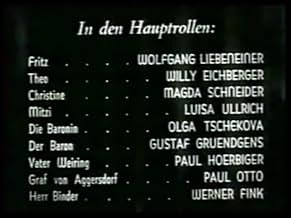
    Wolfgang Liebeneiner
    Wolfgang Liebeneiner
    • Leutnant Fritz Lobheimer
    Carl Esmond
    Carl Esmond
    • Oberleutnant Theo Kaiser
    • (as Willi Eichberger)
    Magda Schneider
    Magda Schneider
    • Christine Weiring
    Luise Ullrich
    Luise Ullrich
    • Mitzi Schlager
    • (as Luisa Ullrich)
    Olga Tschechowa
    Olga Tschechowa
    • Baronin von Aggersdorf
    • (as Olga Tschekova)
    Gustaf Gründgens
    Gustaf Gründgens
    • Baron von Aggersdorf
    • (as Gustaf Gruendgens)
    Paul Hörbiger
    Paul Hörbiger
    • Vater Weiring
    • (as Paul Hoerbiger)
    Paul Otto
    Paul Otto
    • Graf von Aggersdorf
    Ekkehard Arendt
    Ekkehard Arendt
    • Leutnant von Lensky
    • (uncredited)
    Werner Finck
    Werner Finck
    • Binder, Cellist
    • (uncredited)
    Ossy Kratz-Corell
    • Der Zugführer
    • (uncredited)
    Hans Moser
    Hans Moser
      Werner Pledath
      • Oberst Placzek
      • (uncredited)
      • Director
        • Max Ophüls
      • Writers
        • Curt Alexander
        • Max Ophüls
        • Felix Salten
      • All cast & crew
      • Production, box office & more at IMDbPro

      User reviews15

      7.51.6K
      1
      2
      3
      4
      5
      6
      7
      8
      9
      10

      Featured reviews

      9frankde-jong

      A simple story beautifully told

      "Liebelei" is generally considered to be the highlight of the German period of Max Ophuls.

      The story is rather simple. Two friends (Fritz and Theo) are meeting two girls (Christine and Mizzi). From this meeting two relationships emerge. One relationship (between Theo and Mizzi) is just for the fun while the other (between Fritz and Christine) runs much deeper.

      The story resembles "Letter to Brezhnev" (1985, Chris Bernard). This film is however about two working girls and two sailors, while "Liebelei" is situated in the 19th century world of military officers with their code of honor. In "Letter to Brezhnev" the threat to the relationship was the departure of the sailors. In "Liebelei" it is a duel for which Fritz has been challenged. The world of "Liebelei" is also the world of Alexander Pushkin in his short story "The gunshot", in which also a duel comes at a time when a man is least prepared for it (also due to a love affair).

      The story of "Liebelei" is relatively simple, but it is beautifully told. The scene where Fritz meets Christine for the first time, the scene of the duel and the scene in which the outcome of the duel is told to Christine are all magnificent. The duel scene is in no way inferior to the duel scene in "Barry Lyndon" (1975, Stanley Kubrick) and the despair of Christine equals the despair of Cloris Leachman in the most intense scene of "The last picture show" (1971, Peter Bogdanovich).

      For this film Max Ophuls wanted four upcoming talents in the leading roles and some experienced actors in supporting roles. This casting strategy works out perfectly. The role of Christine is played by Magda Schneider. Twenty two years later her daughter Romy Schneider would play the same character in "Christine" (1958, Pierre Gaspard-Huit).
      10brogmiller

      "I've met love."

      This is Max Ophul's fifth film, his first major success and the first to characterise his inimitable style. The use of Mozart and Beethoven is appropriate here as this film is more classical than his later baroque masterpieces whilst the theme of love as a vicious circle is one that he was to develop to such masterly effect.

      Less ironic and more romantic than Schnitzler's original, it also casts a critical eye on the military mentality and Theo's impassioned 'Any shot that is not fired in self defense is murder' would have been sure to rattle a few cages in the Germany of 1933. The director, his art designer and cinematographer have skilfully recreated Imperial Vienna and Ophuls had to wait fifteen years before revisiting the city built on the backlot of Universal for 'Letter from an unknown Woman' which holds the unique distinction of being the only film made in Hollywoodland that is completely European!

      A fascinating cast includes some whose careers were to thrive under the Third Reich but whether the adherence of Wolfgang Liebeneiner and Gustaf Gruendgens in particular was genuine or based on sheer opportunism is debatable. Leibeneiner directed the notorious 'Ich Klage an', which promoted the T4 Euthanasia Programme but redeemed himself by later making 'Liebe '47' which showed how 'good people' had been conned by Nazi ideology. The life and career of the classy and mysterious Olga Tschechowa would make a film in itself!

      The role of Christine had been played on stage by the superlative Paula Wessely but she was not considered photogenic enough. Ophuls has elicited a magnificent performance from the enchanting Magda Schneider whose utter desolation in her final two minute close-up is one of the most moving on film and years ahead of its time. The remake from 1960 reminds us that Romy Schneider inherited her mother's capacity to tug at the heartstrings.

      Ophuls and his family had already fled Germany before the premiere in Berlin with both his name and that of Schnitzler's missing from the titles and the film was subsequently banned by the Allied Commission. Despite these setbacks its brilliance still shone through and in the director's words, " The film was born under a lucky star."
      a_morti

      true, a great film, but try the book too...

      This is truly an excellent film, and it's production values totally belie the date of release.

      If you like it, take time out to read the play Liebelei by Arthur Schnitzler. The guy above me misspelled his name, so you won't find it by searching that way! I think it's been translated into English as 'Flirtations'. You will discover that this is one of the earliest examples of a good story being taken (granted these days it's done by Hollywood) and mutated to fit the dramatic formula. For instance, our two protagonists are not cavalry officers, but members of the 'fin de siecle' bourgeois class who have bought they're way in as reserves at the officer level, they only train 3 or 4 times a year. The love story portrayed in the film is not in the book in the same way, and we never meet the woman Fritz is having an affair with, we don't even learn her name.

      Still, this is a good film worth watching if you have the time to seek it out.
      10J. Steed

      IS IT FILM OR SHEER POETRY?

      Some films cannot be sufficiently qualified by superlatives, and this superb, tranquil, poetic masterpiece is one of them. This film is not just to be watched and enjoyed, but to be felt with all the senses.

      Without ever becoming sentimental it tells a very moving love story, but there is a deeper meaning in it (of course already conceived by Arthur Schitzler). We see an artificial Vienna and rigid social rules, but what really is shown is a universal and timeless theme: misplaced (male) honour.

      This "misplaced honour" is shown through various male characters, but the most devilish of them is Gustaf Gründgens (absolutely brilliant): was there ever a cigarette smoked as by Gründgens, concentrating all his anger and hate in his smoking. And here we have only one example of Ophüls' idea of letting the image speak: not by dialogue alone (sometimes unintelligible, but this is on purpose!), but by body and camera movement, lightning, editing, sets, the meaning of a scene is told.

      This film is superb on all levels, but this is not the place to analyze further (and there are people who are much more capable to do that than I am). I just want to refer to the final sequence (starting with Beethoven's 5th): see how Ophüls, just by perfectly arranging Ullrich, Eichberger and Hörbiger opposite Schneider, gets an image that shows emotional desolation: the party is over, life is over (one must have seen the film to understand this remark) . This culminates in the long, extreme close up of Magda Schneider realizing and trying to come to terms with what has happened; one must have a heart of stone not to get tears into one's eyes or at least a lump in the throat, when seeing this scene. This scene was her moment of triumph; was she ever again as outstanding as in this scene?

      Liebelei premiered after the Nazi take-over; it was banned, then - by popular demand - quickly showing was allowed again but only after the names of the jewish contributors were removed. It amazes to know that in 1945 it was banned by the Allies.
      TheFerryman

      capturing as classic music

      A wonderful picture that shows how early in his career Ophuls mastered melodrama. As melodrama indicates, it's drama with music, and from the start Ophuls sets in motion an operistic, artificial mood. Every performance is self-conscious, aware of being representing; all sets are shown thoroughly, characters leave the scene and the camera remains a few seconds in the empty decor; even the way the snows falls from the sky appears to be fake. Still the film has an admirable freshness and engages the audience in an almost hypnotic trip, to which Ophuls' floating camera and his modern, dramatic use of the score contribute big time. Max Ophuls can be paralleled with Douglas Sirk as a director that purposely breaks up with any trace of reality in order to convey a truth that is purely cinematic.

      More like this

      La Ronde
      7.4
      La Ronde
      Everybody's Woman
      7.3
      Everybody's Woman
      Le Plaisir
      7.5
      Le Plaisir
      Caught
      7.0
      Caught
      The Reckless Moment
      7.1
      The Reckless Moment
      Lola Montès
      7.2
      Lola Montès
      There's No Tomorrow
      7.3
      There's No Tomorrow
      Letter from an Unknown Woman
      7.8
      Letter from an Unknown Woman
      Wild Boys of the Road
      7.5
      Wild Boys of the Road
      From Mayerling to Sarajevo
      6.7
      From Mayerling to Sarajevo
      The Earrings of Madame De...
      7.9
      The Earrings of Madame De...
      Heroes for Sale
      7.4
      Heroes for Sale

      Related interests

      Peter Lorre in M (1931)
      German
      Naomie Harris, Mahershala Ali, Janelle Monáe, André Holland, Herman Caheej McGloun, Edson Jean, Alex R. Hibbert, and Tanisha Cidel in Moonlight (2016)
      Drama
      Ingrid Bergman and Humphrey Bogart in Casablanca (1942)
      Romance

      Storyline

      Edit

      Did you know

      Edit
      • Trivia
        Magda Schneider as a gay musical comedy star had originally been cast for Mizi but Ophuls was inspired to have her exchange roles with the other lead actress and have Luise Ullrich instead play the more light hearted part.
      • Goofs
        Although the action takes place well before World War I, the actresses' costumes and hairdos are in the style of 1933.
      • Connections
        Alternate-language version of A Love Story (1933)

      Top picks

      Sign in to rate and Watchlist for personalized recommendations
      Sign in

      Details

      Edit
      • Release date
        • February 27, 1936 (United States)
      • Country of origin
        • Germany
      • Language
        • German
      • Also known as
        • Ljubimkanje
      • Filming locations
        • Berlin, Germany
      • Production company
        • Elite-Tonfilm-Produktion GmbH
      • See more company credits at IMDbPro

      Box office

      Edit
      • Gross worldwide
        • $852
      See detailed box office info on IMDbPro

      Tech specs

      Edit
      • Runtime
        • 1h 28m(88 min)
      • Color
        • Black and White
      • Aspect ratio
        • 1.19 : 1

      Contribute to this page

      Suggest an edit or add missing content
      • Learn more about contributing
      Edit page

      More to explore

      Recently viewed

      Please enable browser cookies to use this feature. Learn more.
      Get the IMDb App
      Sign in for more accessSign in for more access
      Follow IMDb on social
      Get the IMDb App
      For Android and iOS
      Get the IMDb App
      • Help
      • Site Index
      • IMDbPro
      • Box Office Mojo
      • License IMDb Data
      • Press Room
      • Advertising
      • Jobs
      • Conditions of Use
      • Privacy Policy
      • Your Ads Privacy Choices
      IMDb, an Amazon company

      © 1990-2025 by IMDb.com, Inc.