
Polio breaks out in Rio de Janeiro, the serum is in Santiago and there's only one way to get the medicine where it's desperately needed: flown in by daring pilots who risk the treacherous we... Read allPolio breaks out in Rio de Janeiro, the serum is in Santiago and there's only one way to get the medicine where it's desperately needed: flown in by daring pilots who risk the treacherous weather and forbidding peaks of the Andes.Polio breaks out in Rio de Janeiro, the serum is in Santiago and there's only one way to get the medicine where it's desperately needed: flown in by daring pilots who risk the treacherous weather and forbidding peaks of the Andes.
- Director
- Writers
- Stars
- Awards
- 4 wins total


- Nightclub Manager
- (uncredited)
- Director
- Writers
- All cast & crew
- Production, box office & more at IMDbPro
Featured reviews
Breathtakingly Beautiful!
What may seem conventional today, these elements were new in 1933. The use of silence - a ticking clock at a dramatic moment. A wonderful score, exceptional photography in the air and on the ground. The texture of rich background characters and extras. Exceptional editing! Death in the air is made so beautiful, romantic and horrifying all at the same time!
It's easy to laugh, but these were the days pilots were ALLOWED to bring alcohol along in the cockpit! This was little understood risky and dangerous work. And not only shown from one perspective. Each character has his own.
Reviews at the time noted all I've said and the public appreciated this and ate it up!
So if you can rise above your modern day aesthetics, I think you'll discover and amazing 1930s film! You know, they ain't making them anymore!
Romantic View Of Aviation
The story is based on a novel written by Antoine St. Exupery and the plot is similar to what American aviator and writer Frank Wead wrote in Ceiling Zero. The location in Wead's play is strictly American whereas this film has a French aviation company located in South America.
If you read what I wrote about Ceiling Zero it did not transfer well to the screen. But having not been a play on Broadway Night Flight did not have that burden to overcome. The air scenes are much better done here and filled with romance. There is also a paucity of dialog in those air scenes, it was almost like a return to the silent screen.
Clark Gable and Robert Montgomery's roles for the big name stars they were at the time, are rather small. Gable barely speaks at all. Montgomery only has a couple of scenes, including one with Lionel Barrymore after a tough flight where they're partying. William Gargan has a bit more dialog with wife Myrna Loy. Helen Hayes is married to Gable, both women sit on pins and needles waiting for their men to come home.
John Barrymore is the martinet general manager of the air company who I think goes overboard. I do not believe an American company would for one minute tolerate his methods. Brother Lionel with qualms is the man in charge with enforcing John's strict edicts. The film is mostly carried by the brothers.
Night Flight wears better than Ceiling Zero, but not nearly as good as Only Angels Have Wings which has a similar location and plot. Night Flight goes overboard into the melodramatic, but still holds the interest. And the special effects with the air scenes are still breathtaking. The highlight of the film shows the tragedy that unfolds for one of the fliers and is done without words, but with a great music score by Herbert Stothart, MGM's house composer.
Delivery of mail for those of us who use it in these days of the personal computer is taken for granted. Back in the days before advances in navigation and safety, before instrument flying, taking to the skies could be dangerous, but it was romantic in those days. An American pilot named Charles Lindbergh got his start flying in planes just like the ones seen here delivering mail. This review is dedicated to all those brave pioneers of aviation that you see depicted here in a story written by one of them.
Trouble in the Air
In Rio de Janeiro, bedridden Buster Phelps may die because his hospital has run out of the serum needed to keep the little boy alive. The desperately needed medicine is to be flown in from a hospital in Santiago, Chile. The first leg of the trip is given to pilot Robert Montgomery (as Auguste Pellerin), who encounters dangerous flying conditions. Rookie pilot Clark Gable (as Jules Fabian) also treads dangerous airwaves, while wife Helen Hayes frets over dinner. Another wife, Myrna Loy, worries the last leg of the trip could kill husband William Gargan. On the ground, the mission is controlled by hard-nosed Trans-Andean Airlines director John Barrymore (as Riviere), who must also keep itchy airline inspector Lionel Barrymore (as Robineau) at bay...
This star-studded offering from MGM, David O. Selznick and Clarence Brown must have disappointed many contemporary viewers. There are some exciting sequences, but narrative and characterizations are weak...
Antoine de Saint-Exupery, who wrote the original 1931 book, disliked this adaptation enough to prevent its distribution until Turner Classic Movies (TCM) obtained permission to screen "Night Flight" during their 2011 "TCM Classic Film Festival". It was also released on home video and had a world premiere showing on the TCM TV channel August 10, 2012. While not a great film, banishing "Night Flight" for this length of time was far too harsh.
****** Night Flight (10/6/33) Clarence Brown ~ John Barrymore, Helen Hayes, Lionel Barrymore, Clark Gable
when it was pioneering to fly at night
The story concerns mail flights at night, an innovative thing at that time. Both the Barrymore men are quite robust here and delivered strong acting. John is the tough, hard-nosed head of the service, and Lionel (sans wheelchair which his arthritis would send him to later on) plays an assistant. I would have rather seen them together in something else, though they were both very good.
In the beginning, we're shown a little boy in South America with infantile paralysis waiting for a serum that will be rushed to the doctor from Chile via the new night mail service.
There's not a tremendous amount of dialogue in "Night Flight," but there is a lot of very powerful music by Herbert Stothart and some magnificent footage of planes going through the clouds. It's very atmospheric. What dialogue there is today seems very melodramatic but is handled well by John Barrymore and Helen Hayes. Hayes in the film is married to a pilot played by Clark Gable. Gable is very handsome with such a warm smile, and he shows his character's real love of flying. Montgomery plays a playboy pilot who likes a good time as well as flying.
It's amazing how with a film so old, with those archaic planes, how one can get drawn into a story, yet somehow I did. I had a few problems - first of all, I couldn't figure out the countries and the different plane connections. It seemed like the service originated in France - I kind of had to let that go.
During a storm, Gable sends down flares that ride on little parachutes - it was early days for special effects. These looked a little cartoonish but were interesting nonetheless as they floated down to the water.
Some people don't care for Clarence Brown, but I think he was able to really set a mood in his films, this and The Rains Came being good examples.
"Night Flight" is one reason why I love classic films. We've come so far in aviation; eighty-plus years ago, it was unheard of to fly at night. And when you look at the planes, it's a wonder they got off the ground day or night. Maybe it was my mood or the Stothart music, but it was something to think about.
A must see for vintage aviation enthusiasts.
The film is strangely like a series of monologues or at best two shots. All of the characters and the drama are supposed to be tied together by John Barrymore, the hard driving managing director of the Trans Andean European AirMail. The original novel was based on St. Expury's experiences as a flyer, and later, a manager, with Aeropostale, the pioneering French Air Mail line later merged into Air France. Using Buenos Aries as a center, Aeropostale developed South American airoutes south to Patagonia, to the oil fields near Tierra del Fuego. The chief of station and one of Aeropostale's founders, Didier Daurat, (Riviere in the film) became legendary for his single minded drive to get the mail through, an early example of existential ethics. Another route was forged north across the River Plate and Uruguay to and through Paraguay to Bolivia and another, most spectacularly, across the Andes to Santiago, Chile.
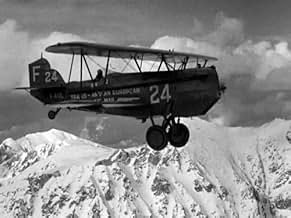
Heros were produced which electrified France and the world. Mermoz pioneered the Dakar - Natal route across the South Atlantic as well as the Buenos Aries to Natal route. Henri Guillaumet flew across the Andes 396 times. The Andes were too high to be overflown even by the latest improved models used by Aeropostale and pilots had to fly their way around and through the mountains rather than over them, something which is shown in the film. For enthusiasts of vintage aviation the film is priceless with maybe three quarters of the flying done for real. John Barrymore unfortunately has begun his decline by the time this film was made and does his `eyebrow' thing to excess, signalling that he was either unhappy with his role or his domestic arrangements or both. Gable, just beginning his reign as the King of Hollywood, is almost unrecognizable in his pilot's outfit. Robert Montgomery manages to have scenes with the most co-stars in the picture, except for maybe John Barrymore. Helen Hayes is effective as the wife as far as that goes. Myrna Loy has a role usually described as `thankless'. Produced by David Selznick, it never appeared on his extensive resume and now can be seen as a very atypical Selznick project, beyond the accumulation of the talent. Undoubtedly the literary inclined Selznick was attracted to the book's having won the prestigious Prix Femina in 1931, though he was more sympathetic to period pieces (Dickens, GWTW) then contemporary drama. Perhaps he had been thinking of his associate at RKO (King Kong) , Air Corps pilot and airline executive Merian C. Cooper. Clarence Brown, who directed Garbo, was one of MGM's most romantic directors, always setting an atmosphere where love either triumphed or ended tragically. One wonders what would have happened if a more consciously `machine age' director like William Wellman or Howard Hawks had shaped the material.
The worst that might be said about NIGHT FLIGHT is to lament what might have been. Narrative techniques common today (and, ironically, during the silent era) would have rendered a more interesting film, though not one suitable for audiences of the time. In other words, a disappointment but not a terrible film by any means. The real curiosity is why it's never revived on Turner Classics which presumably owns both a print and the rights. I suspect that there may be a question as to the underlying rights to St. Expury's Vol de Nuit that might be responsible.


Did you know
- TriviaIt was originally planned to show Clark Gable's character parachuting from his abandoned plane at an altitude of 25,000 feet. However, stuntman Ivan Unger, who was doubling for Gable, passed out at 20,000 feet due to lack of oxygen and the shot was never captured.
- GoofsAt about the 10-minute mark, the shadow of the Patagonia biplane (the one piloted by J. Fabian, played by Clark Gable) is shown over various parts of the pasture-lands of Argentina. The shadows cast over the horse and herd of cattle below are that of a biplane, but the shadow going over the flock of sheep is clearly that of a monoplane, not a biplane.
- Quotes
Wife of Brazilian Pilot: What's it all for? Just so somebody in Paris can get a postcard on Tuesday instead of Thursday?
- Crazy creditsDuring opening credits, the film title is done as "sky writing" by an airplane, and the plane is just finishing the last "T" on "flight".
- ConnectionsFeatured in Maltin on Movies: Super 8 (2011)
Details
- Runtime
- 1h 24m(84 min)
- Color
- Aspect ratio
- 1.37 : 1