IMDb RATING
7.0/10
2.6K
YOUR RATING


A multimillionaire decides to boycott "filthy" forms of entertainment such as Broadway shows.A multimillionaire decides to boycott "filthy" forms of entertainment such as Broadway shows.A multimillionaire decides to boycott "filthy" forms of entertainment such as Broadway shows.
- Directors
- Writers
- Stars
- Awards
- 1 win total


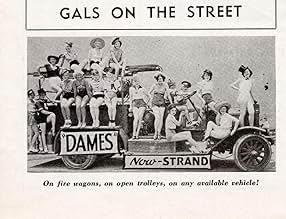
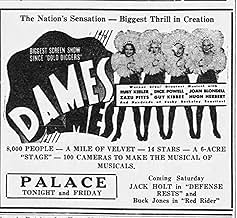


Avis Adair
- Chorus Girl
- (uncredited)
Marvelle Andre
- Chorus Girl
- (uncredited)

Loretta Andrews
- Chorus Girl
- (uncredited)
Cecil Arden
- Chorus Girl
- (uncredited)
- Directors
- Writers
- All cast & crew
- Production, box office & more at IMDbPro
7.02.6K
1
2
3
4
5
6
7
8
9
10
Featured reviews
Inspired Hokum
Busby fans have to wait until the last part for their guy to do his stuff. But then it's a real eye-popper. The dames keep comin' at yah one after another, blondes, brunettes, and in- betweens. What a line-up of 30's cuties. Then there's Berkeley's trademark: feminine geometry. That's enough to give Freud analytic overload and others x-rated dreams. Good thing those fluid figures were too abstract for the censors to erase. Speaking of blue- noses, '34 was the first year of Code enforcement. So, wouldn't be surprised the plot was jabbing at our watchdogs of public morality. After all, ridding the city of stage shows is the millionaire's (Hugh Herbert) favorite hobby. It's a winning cast, even if Powell mugs it up faster than a Ferrari's RPM's. True, Keeler's hoofing may be on the clunky side, still she's got the sweetest smile this side of Hollywood and Vine. Too bad the real dame, Blondell, was hobbled by six months of motherly gestation. Working her camera angles must have been a real challenge. I know a lot of folks don't especially like these antique concoctions. But in my book, they're inspired combinations of artistry, pizazz, and sheer Hollywood hokum.
8B24
In the Depth of the Great Depression
No one who lived through the Great Depression could possibly take seriously negative comments on the quality and content this film written by youngsters with no sense of its historical context. To lament its silliness or find fault with what seem now to be crude mechanical cinematographic devices just begs the question.
This movie could not be recreated in the twenty-first century even in the smallest part. In the first place, musicals are now passé. The drag parody of the title number "Dames" in 1988's film Torch Song Trilogy is proof of that. Moreover, its stock characters (Hugh Herbert, Guy Kibbee, Zasu Pitts) were simply reprising common comedic roles of the day, completely unsuited to the harsher and more cynical models now in vogue. And Ruby Keeler's numbers lack totally the athleticism of our contemporary dancers.
What we can appreciate about the movie is how it fits nicely into the Busby Berkeley oeuvre. After his huge successes of 1933, this example is a fitting continuation to his development as a moviemaker. The catastrophic effects of the Great Depression like mass unemployment, hunger, wholesale uprooting of communities, and abject poverty affecting the lives of millions of ordinary Americans could be forgotten for a few pennies spent in the local movie house. It played to the needs of its time.
Interestingly, the packaging of female pulchritude in the film also fits with that time. What today seems borderline pornographic or insulting to women was accepted without much fuss in 1934. Indeed, any student of Freud could have a field day deconstructing some of the Berkeley images.
As to the music, it is simply classic. Dick Powell's phrasing is a model of tenor sensibility in an age of Big Band baritones. One has to accept that continuity or theatrical presentation is not a factor. Each number stands or falls entirely on its own as seen through the lens of the camera. As an early prototype of the Hollywood musical, Dames was and is a smash hit.
This movie could not be recreated in the twenty-first century even in the smallest part. In the first place, musicals are now passé. The drag parody of the title number "Dames" in 1988's film Torch Song Trilogy is proof of that. Moreover, its stock characters (Hugh Herbert, Guy Kibbee, Zasu Pitts) were simply reprising common comedic roles of the day, completely unsuited to the harsher and more cynical models now in vogue. And Ruby Keeler's numbers lack totally the athleticism of our contemporary dancers.
What we can appreciate about the movie is how it fits nicely into the Busby Berkeley oeuvre. After his huge successes of 1933, this example is a fitting continuation to his development as a moviemaker. The catastrophic effects of the Great Depression like mass unemployment, hunger, wholesale uprooting of communities, and abject poverty affecting the lives of millions of ordinary Americans could be forgotten for a few pennies spent in the local movie house. It played to the needs of its time.
Interestingly, the packaging of female pulchritude in the film also fits with that time. What today seems borderline pornographic or insulting to women was accepted without much fuss in 1934. Indeed, any student of Freud could have a field day deconstructing some of the Berkeley images.
As to the music, it is simply classic. Dick Powell's phrasing is a model of tenor sensibility in an age of Big Band baritones. One has to accept that continuity or theatrical presentation is not a factor. Each number stands or falls entirely on its own as seen through the lens of the camera. As an early prototype of the Hollywood musical, Dames was and is a smash hit.
It may not be as grand as Gold Diggers of 1933, 42nd Street and Footlight Parade but Dames is still super fun
Anybody who loved those three films, or anything involving Busby Berkeley, will find plenty to be delighted by in Dames. The plot is very slight and can be painfully contrived as well (not that that is a surprise, there are a lot of musicals where the story is the weak point) and Hugh Herbert was for me annoying, as another reviewer says he was an acquired taste. Dames is very well-made and still holds up beautifully now, the highlight being the kaleidoscopic photography in I've Only Got Eyes For You which has a real dream-like quality. Even when not at his best or most dazzling, like in My Forgotten Man from Gold Diggers of 1933 and By the Waterfall from Footlight Parade, Berkeley still delivers on the spectacle front. The costumes and sets are sumptuous to say the least. The songs are great, especially the infectious title number and the sublime I've Only Got Eyes For You, and the choreography has a lot of spirit and pizazz (in the case of I've Only Got Eyes For You it's imaginative too, where else would you find a whole chorus of Ruby Keelers?), so on the musical and choreographic front Dames is pretty sensational. The script has a lot of sparkling wit and the film has a lot of energy that rarely lulls. The direction is efficient and not too overblown or static, if more in the production numbers than the more dramatic parts. The cast mostly are great, especially from a terrifically funny Joan Blondell and a hilariously wacky ZaSu Pitts. Ruby Keeler may not have ever been the greatest dancer or actress(singer as well) and doesn't have a lot to do here, she also overdoes some of the drama at times, but she is still immensely charming and adorable with a smile that can make one's heart melt and brings a lot of enthusiasm to her role. Believe it or not, this film features some of her best dancing as well. Dick Powell is handsome and just as charming, he sings with a very pleasant tone too. On the whole, not Busby Berkeley at his best but still super fun and definitely well worth seeing. 8/10 Bethany Cox
They're what you see a show for
One of the nice things about those Warner Brothers Depression musicals is that you can forget some of the sillier aspects of the plot and just enjoy the wonderful nonsense created.
Dames certainly classifies as wonderful nonsense. A wacky millionaire who's a sideline puritan is going to leave a bequest to a cousin and her family providing that they are of good moral character by his ideas. The wacky millionaire is Hugh Herbert and the cousin is Zasu Pitts, her husband Guy Kibbee and her daughter Ruby Keeler. There's another distant cousin Dick Powell who's already out of the will because he's an actor.
Back then theatrical folk were held in some disdain by polite society, though that's hard to believe now. Also some eyebrows might have been raised with Dick's involvement with Ruby. But then again the president of the United States was married to his fifth cousin. I'm sure the brothers Warner knew that full well when Dames was released.
Dames of course is remembered for those wonderful Busby Berkeley numbers and one of the biggest movie songs ever in I Only Have Eyes For You. Introduced by Dick Powell it was never commercially recorded by him though dozens of our best singers have done so. It's a favorite of mine for sure.
Last but not least Dames features the always captivating Joan Blondell who's not above a little blackmail to achieve her ends. A girl's gotta do what a girl's gotta do. She's featured in the Girl at the Ironing Board number, a great piece of Berkeley magic.
We can't forget the title song because as Dick Powell sings, it's what you see the show for. And in that finale they're sure enough of them to satisfy any red blooded male.
Dames certainly classifies as wonderful nonsense. A wacky millionaire who's a sideline puritan is going to leave a bequest to a cousin and her family providing that they are of good moral character by his ideas. The wacky millionaire is Hugh Herbert and the cousin is Zasu Pitts, her husband Guy Kibbee and her daughter Ruby Keeler. There's another distant cousin Dick Powell who's already out of the will because he's an actor.
Back then theatrical folk were held in some disdain by polite society, though that's hard to believe now. Also some eyebrows might have been raised with Dick's involvement with Ruby. But then again the president of the United States was married to his fifth cousin. I'm sure the brothers Warner knew that full well when Dames was released.
Dames of course is remembered for those wonderful Busby Berkeley numbers and one of the biggest movie songs ever in I Only Have Eyes For You. Introduced by Dick Powell it was never commercially recorded by him though dozens of our best singers have done so. It's a favorite of mine for sure.
Last but not least Dames features the always captivating Joan Blondell who's not above a little blackmail to achieve her ends. A girl's gotta do what a girl's gotta do. She's featured in the Girl at the Ironing Board number, a great piece of Berkeley magic.
We can't forget the title song because as Dick Powell sings, it's what you see the show for. And in that finale they're sure enough of them to satisfy any red blooded male.
The voluptuous expression of a loving heart
Advertised by Warners as Gold Diggers for '34, it's another film in that backstage cycle that traces the efforts of youth restless with creativity to seduce with love cynical hearts hardened by money and rigid morals. It is again a film about the makings of a show, the show we're meant to be watching.
So very much in line with Gold Diggers '33 and Footlight Parade, except a little less wondrous this time, a little less seductive in all the circumstances surrounding the stage, the burlesque of trials and tribulations in fighting to stage a vision.
But it is again Busby Berkeley who is staging the vision that we have come to see. So once more an astonishing panorama of Hollywood dazzle, but with all the frill and gaudiness of the musical working beneath the dazzle to address the circumstances of its making; so we have a number where a woman romances empty shirts on a hangwire but which are animated by invisible strings from above, implying the fates that seem to be in control, another number with the author of the whole thing singing about the face that inspired the vision with the ardor of love, and the final number addressing us from our position as viewers. Of course we have come to be seduced by the dames, nothing else mattered.
The show is so intoxicating that those cynical hearts watching from the balcony are completely soused by the end of it!
So what was from the outset seemingly controlled by the fates, by a woman chancing to sleep on the wrong bed in a train compartment, is gradually revealed to have been shaped all this time around a center with clearly reflected purpose; the author's effort to announce his passion for music and this woman he sings about, and so approach within his art the face behind the cardboard image of social appearances, as the middle number reveals.
As with the other films in this cycle, even if a little less accomplished, it is overall more than potent stuff on the ardor of a loving heart to transform anxieties of a chaotic modern life that we also know into a pattern that seduces love out of both participants and viewers.
It is enjoyable to watch, brisk with dance, the disposition dreamy, but with the small hint of a shadow at the heart of this dream. The choreography maps to the contours of that internal heart wishing to beat truthfully.
So very much in line with Gold Diggers '33 and Footlight Parade, except a little less wondrous this time, a little less seductive in all the circumstances surrounding the stage, the burlesque of trials and tribulations in fighting to stage a vision.
But it is again Busby Berkeley who is staging the vision that we have come to see. So once more an astonishing panorama of Hollywood dazzle, but with all the frill and gaudiness of the musical working beneath the dazzle to address the circumstances of its making; so we have a number where a woman romances empty shirts on a hangwire but which are animated by invisible strings from above, implying the fates that seem to be in control, another number with the author of the whole thing singing about the face that inspired the vision with the ardor of love, and the final number addressing us from our position as viewers. Of course we have come to be seduced by the dames, nothing else mattered.
The show is so intoxicating that those cynical hearts watching from the balcony are completely soused by the end of it!
So what was from the outset seemingly controlled by the fates, by a woman chancing to sleep on the wrong bed in a train compartment, is gradually revealed to have been shaped all this time around a center with clearly reflected purpose; the author's effort to announce his passion for music and this woman he sings about, and so approach within his art the face behind the cardboard image of social appearances, as the middle number reveals.
As with the other films in this cycle, even if a little less accomplished, it is overall more than potent stuff on the ardor of a loving heart to transform anxieties of a chaotic modern life that we also know into a pattern that seduces love out of both participants and viewers.
It is enjoyable to watch, brisk with dance, the disposition dreamy, but with the small hint of a shadow at the heart of this dream. The choreography maps to the contours of that internal heart wishing to beat truthfully.


Did you know
- TriviaIn the "Dames" number, Dick Powell as a Broadway producer doesn't want to see composer George Gershwin, but when asked by his secretary about seeing Miss Dubin, Miss Warren and Miss Kelly, he lets them enter his office. This is an inside joke, referring to Al Dubin and Harry Warren, who wrote the music for this film, and Orry-Kelly, who was the costume designer.
- GoofsWhile Joan Blondell is singing "The Girl at the Ironing Board", a stage hand is seen in the background hanging a clothesline.
- ConnectionsEdited into Musical Memories (1946)
- SoundtracksDames
(1934) (uncredited)
Music by Harry Warren
Lyrics by Al Dubin
Danced by Ruby Keeler at rehearsal
Sung by Dick Powell and chorus in the show
Played as background music often
- How long is Dames?Powered by Alexa
Details
Box office
- Budget
- $779,000 (estimated)
- Runtime
- 1h 31m(91 min)
- Color
- Sound mix
- Aspect ratio
- 1.37 : 1
Contribute to this page
Suggest an edit or add missing content