

The idyllic life of Tarzan and Jane is challenged by men on safari who come seeking ivory, and come seeking Jane as well.The idyllic life of Tarzan and Jane is challenged by men on safari who come seeking ivory, and come seeking Jane as well.The idyllic life of Tarzan and Jane is challenged by men on safari who come seeking ivory, and come seeking Jane as well.
- Awards
- 2 wins & 1 nomination total





George Barrows
- Gorilla
- (uncredited)

Everett Brown
- Bearer
- (uncredited)

Ray Corrigan
- Gorilla
- (uncredited)

Yola d'Avril
- Madame Feronde
- (uncredited)


Paul Porcasi
- Monsieur Feronde
- (uncredited)

Desmond Roberts
- Henry Van Ness
- (uncredited)
William Stack
- Tom Pierce
- (uncredited)
7.25.9K
1
2
3
4
5
6
7
8
9
10
Featured reviews
The best film of the entire "Tarzan" film series.
Maureen O'Sullivan turns in a stunning performance as "Jane", Tarzan's love interest. O'Sullivan's Jane set a new standard for female lead characters - strong, independent, intelligent, and not afraid to accept new challenges and face new dangers. This is remarkable given that, at the time the film was made, the typical American view was that a woman's place was in the kitchen, yet here we see an attractive, diminutive, well-bred Englishwoman living in the jungle under harsh conditions and loving every minute of it. Several times during the film, a band of explorers try to convince Jane to return to civilization and conform to society's standards, and part of the film's plot revolves around her decision as to whether or not she should leave Tarzan and the jungle life and return to America, which has led some to draw parallels between women deciding between the workplace (a man's world at the time) and the home (a woman's world at the time) and the film's world of the jungle and then-modern society.
Johnny Weismuller is cast perfectly for this role. The fact that he's an Olympic swimmer lends credibility to his role as a muscular he-man living with the apes. While some people have criticized his lack of acting ability (confusing his limited lines to be equivalent with limited acting ability), I've come to the conclusion that he's a natural actor - one who can express a range of emotion with very few words - which is exactly what Tarzan should be. As an athlete, Weismuller is used to expressing himself physically - Weismuller's Tarzan is a man of few words and limited grammar, but his eyes and body language express exactly what he's feeling and thinking. While Jane is the speaker who does, Tarzan is the doer who speaks. Jane is the civilized communicator who is not afraid to dive into a crocodile-infested river. Tarzan is the noble savage who dives into a river and only speaks to clarify what his eyes and hands are saying.
The plot is basically this: a band of explorers venture into the jungle to search for the legendary elephant graveyard to find their fortune in ivory elephant tusks. They meet Jane and befriend her, hoping that she and Tarzan will help them in their search. She convinces Tarzan to guide the hunters, although Tarzan does not feel comfortable with the venture, believing that the hunters should not be violating the sanctity of the animals' graveyards (and the unspoken law of the jungle). Indeed, at one point the hunters wound an innocent animal to track it to a grave. Tarzan decides that the hunters are evil and leaves their safari, though Jane continues on as the hunters provide her with a taste of the civilized life she left behind.
We see the conflict in Tarzan between his love for Jane and his love for the animals. We see the conflict in Jane between her love of Tarzan and her memories of civilization. The decisions that the two must make as the movie progresses have been interpreted by some as having hidden meanings and that the film producers were using the Tarzan vehicle to make statements about modern society. But I'll let you watch the film yourself and make your own decisions.
One last thing: this is the only film in the series (other than the "Tarzan" film made by John Derek and starring Bo Derek) in which Jane wears a two-piece leather costume. It's also the only installment (other than the "Tarzan" film by the Dereks) in which Jane becomes nude (but in a non-sexual scene). Trying to persuade Jane to return to civilization, the hunters give Jane a formal evening gown, which she wears to dinner and all through the night. The next morning, as she climbs out of bed still wearing it, Tarzan picks her up and carries her out onto a tree limb over the river. He dumps her into the water while holding onto the dress, so that she falls into the river naked. Tarzan makes no long soliloquy here - he's just expressed his opinion on the whole matter of civilized society quite succinctly.
See the film. It's the only "Tarzan" film worth watching (well, in addition to "Greystoke" with Christopher Lambert).
Johnny Weismuller is cast perfectly for this role. The fact that he's an Olympic swimmer lends credibility to his role as a muscular he-man living with the apes. While some people have criticized his lack of acting ability (confusing his limited lines to be equivalent with limited acting ability), I've come to the conclusion that he's a natural actor - one who can express a range of emotion with very few words - which is exactly what Tarzan should be. As an athlete, Weismuller is used to expressing himself physically - Weismuller's Tarzan is a man of few words and limited grammar, but his eyes and body language express exactly what he's feeling and thinking. While Jane is the speaker who does, Tarzan is the doer who speaks. Jane is the civilized communicator who is not afraid to dive into a crocodile-infested river. Tarzan is the noble savage who dives into a river and only speaks to clarify what his eyes and hands are saying.
The plot is basically this: a band of explorers venture into the jungle to search for the legendary elephant graveyard to find their fortune in ivory elephant tusks. They meet Jane and befriend her, hoping that she and Tarzan will help them in their search. She convinces Tarzan to guide the hunters, although Tarzan does not feel comfortable with the venture, believing that the hunters should not be violating the sanctity of the animals' graveyards (and the unspoken law of the jungle). Indeed, at one point the hunters wound an innocent animal to track it to a grave. Tarzan decides that the hunters are evil and leaves their safari, though Jane continues on as the hunters provide her with a taste of the civilized life she left behind.
We see the conflict in Tarzan between his love for Jane and his love for the animals. We see the conflict in Jane between her love of Tarzan and her memories of civilization. The decisions that the two must make as the movie progresses have been interpreted by some as having hidden meanings and that the film producers were using the Tarzan vehicle to make statements about modern society. But I'll let you watch the film yourself and make your own decisions.
One last thing: this is the only film in the series (other than the "Tarzan" film made by John Derek and starring Bo Derek) in which Jane wears a two-piece leather costume. It's also the only installment (other than the "Tarzan" film by the Dereks) in which Jane becomes nude (but in a non-sexual scene). Trying to persuade Jane to return to civilization, the hunters give Jane a formal evening gown, which she wears to dinner and all through the night. The next morning, as she climbs out of bed still wearing it, Tarzan picks her up and carries her out onto a tree limb over the river. He dumps her into the water while holding onto the dress, so that she falls into the river naked. Tarzan makes no long soliloquy here - he's just expressed his opinion on the whole matter of civilized society quite succinctly.
See the film. It's the only "Tarzan" film worth watching (well, in addition to "Greystoke" with Christopher Lambert).
one of the best adventure films then and now
As noted by other reviewers this is one of the best Tarzan movies. Unlike others however, I like the beginning of the film as it feels like a pretty accurate depiction of what a trading post must have been like. Plus the exposition is needed so we know why Harry wants to go back into the jungle. In addition the beginning of the film contains one of the most thrilling and terrifying chase sequences ever made.This occurs when Harry's safari group has to outrun a tribe of cannibals. The pre-censorship production values add a lot of realism, genuinely depicting the terrible dangers that awaited Europeans going into the jungle. The film also offers, though perhaps antecedently, an accurate account of how horribly treated the native Africans were by their white employers. In addition sexy Jane, thousands of elephants , some great sets and two chetas! Not to be missed an adventure classic.
Maureen O'Sullivan is irresistible as Jane!
It feels weird saying this as a young black man of 29, but Maureen O'Sullivan engenders/embodies a flirty sexuality unequaled in today's movies. She plays tomboyish, but is so flirty at the same time that renders her simply irresistible as Jane. I'm also surprised that Tarzan is still so rough with her and that that was acceptable back in the day. I mean, it's cute, but a tad ungentlemanly.
Since I need to write at least ten lines, I'll continue on...
It's actually really refreshing, the irrelevance of the shame of nudity in this film. Here we are, in 1934, with a man undressing for a bath in the same room with his friend. Jane's naked silhouette tempting the imaginations of every red-blooded American. It's just so natural and alluring in its unabashedness. The skinny-dipping scene is a beautiful ballet of light, water, and skin. It's not pornographic, simply playful and free.
As a black man, I'd love if there was some way the treatment of blacks in this film weren't so harsh, as though all they are are beasts of burden, but I suppose it was a sign of the times. It's darned near slavery. But then again, I never traveled on safari in Africa in the 30s.
Since I need to write at least ten lines, I'll continue on...
It's actually really refreshing, the irrelevance of the shame of nudity in this film. Here we are, in 1934, with a man undressing for a bath in the same room with his friend. Jane's naked silhouette tempting the imaginations of every red-blooded American. It's just so natural and alluring in its unabashedness. The skinny-dipping scene is a beautiful ballet of light, water, and skin. It's not pornographic, simply playful and free.
As a black man, I'd love if there was some way the treatment of blacks in this film weren't so harsh, as though all they are are beasts of burden, but I suppose it was a sign of the times. It's darned near slavery. But then again, I never traveled on safari in Africa in the 30s.
The Best of All Tarzan Films
It's interesting how movies slumped after the censors got their out of joint noses involved. Our Puritan foundation really diminished a lot of film for many years (in some ways, it's still happening today). Like "Bride of Frankenstein" surpassing the original, "Tarzan and His Mate" is superior to the first Weissmuller film. Maureen O'Sullivan is incredible to look at, but has all the feistiness and self esteem to hold her own with the big guy. But most importantly, the producers and writers asked themselves what a true depiction of these two, living in the jungle, should be like. They went for the rawness. In addition to the recognition of the sexuality in this film, it is filled with well crafted adventures and close calls. Efforts are still being made by the Westerners to try to reclaim the beautiful young woman. These movies were much more fundamental than the silly stuff that came later, as professional body builders and football players got into the mix. When filmmakers had to work with less, they often had to resort to creativity and imagination.
A Tarzan for the Ages
Plot-- Two money-hungry Englishmen organize a safari to Africa to bring back prizes of elephant ivory and a reluctant Jane Parker. Trouble is she seems to prefer an apeman, a loincloth, and a cave to city sophisticates, evening gowns and country mansions. In the safari process, however, they overlook that even the jungle has its laws.
Thanks TCM for showing the movie's uncensored version. I expect the morality watchdogs must have overdosed on 1934 viewing. But there's a heckuva lot more to the movie than bared female skin and two unmarried people living together. O'Sullivan's absolutely enchanting as Jane. Her charm even outshines herds of stampeding elephants and bands of chattering chimps. More importantly, I think I've got her bare hips memorized. Then too, add a man of few words, the lean and lithe Weismuller, to the movie mix. He's perfect as lord of the jungle, more at home in the wilds than in the city, traveling by swinging vine instead of clogged freeway.
Then too, I detect a topical allegory lurking in the subtext. Something about living in harmony with nature rather than trying to plunder it. Sure, nature here is a creation of studio wizards at MGM, and not the real Africa. Still, the results are impressive as heck, even with backscreen projection and liberal use of matte. But since when did I go to adventure movies expecting documentary realism. That I'll leave to the textbooks and PBS. Actually, my favorite movie moment is when thoughtless chimp Cheetah decides to tease three baby lions, only to find that a muscular mother doesn't quite understand. It's an amusing little touch. Anyhow, if there's a better Tarzan movie, I haven't seen it, even if this one is an antique. Meanwhile, I'm off to the jungle with visions of loincloth Jane dancing in my head. Okay, maybe not, but it's still a big thanks to this great movie.
Thanks TCM for showing the movie's uncensored version. I expect the morality watchdogs must have overdosed on 1934 viewing. But there's a heckuva lot more to the movie than bared female skin and two unmarried people living together. O'Sullivan's absolutely enchanting as Jane. Her charm even outshines herds of stampeding elephants and bands of chattering chimps. More importantly, I think I've got her bare hips memorized. Then too, add a man of few words, the lean and lithe Weismuller, to the movie mix. He's perfect as lord of the jungle, more at home in the wilds than in the city, traveling by swinging vine instead of clogged freeway.
Then too, I detect a topical allegory lurking in the subtext. Something about living in harmony with nature rather than trying to plunder it. Sure, nature here is a creation of studio wizards at MGM, and not the real Africa. Still, the results are impressive as heck, even with backscreen projection and liberal use of matte. But since when did I go to adventure movies expecting documentary realism. That I'll leave to the textbooks and PBS. Actually, my favorite movie moment is when thoughtless chimp Cheetah decides to tease three baby lions, only to find that a muscular mother doesn't quite understand. It's an amusing little touch. Anyhow, if there's a better Tarzan movie, I haven't seen it, even if this one is an antique. Meanwhile, I'm off to the jungle with visions of loincloth Jane dancing in my head. Okay, maybe not, but it's still a big thanks to this great movie.


Did you know
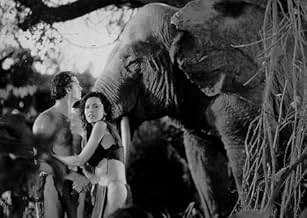
- TriviaThe "African" elephants were actually Indian elephants fitted with prosthetic tusks and ears, as MGM already owned several Indian elephants and considered them easier to handle. During the crocodile wrestling scene, a mechanical Nile crocodile, equipped with nigrosine dye sacks to simulate blood, was used. For the elephants vs. lions battle traveling matte shots were used to depict lions leaping up and holding on to elephants, who then seized them with their trunks and hurled them down, or crushed them beneath their feet.
- GoofsAfter a bearer gets shot, Martin, Harry, and the other carriers hide behind a thicket. One bearer has two shotguns on his right shoulder. In the following shot, he appears with one shotgun on each shoulder.
- Quotes
Jane Parker: The best weapon a woman has is a man's imagination.
- Alternate versionsIn the UK, the 2002 DVD release was cut by 12 secs by the BBFC to remove shots of lions being genuinely tripped to simulate a shooting and a spear killing. The 2005 release features the extended version, but these scenes were pre-cut before submission to the classification board.
- ConnectionsEdited into Tarzan Escapes (1936)
- SoundtracksVoo-Doo Dance
(1932) (uncredited)
Music by George Richelavie
Arranged by Paul Marquardt & Fritz Stahlberg
Played during main title
- How long is Tarzan and His Mate?Powered by Alexa
Details
Box office
- Budget
- $1,279,142 (estimated)
- Runtime
- 1h 44m(104 min)
- Aspect ratio
- 1.37 : 1
Contribute to this page
Suggest an edit or add missing content