

The idyllic life of Tarzan and Jane is challenged by men on safari who come seeking ivory, and come seeking Jane as well.The idyllic life of Tarzan and Jane is challenged by men on safari who come seeking ivory, and come seeking Jane as well.The idyllic life of Tarzan and Jane is challenged by men on safari who come seeking ivory, and come seeking Jane as well.
- Awards
- 2 wins & 1 nomination total





George Barrows
- Gorilla
- (uncredited)

Everett Brown
- Bearer
- (uncredited)

Ray Corrigan
- Gorilla
- (uncredited)

Yola d'Avril
- Madame Feronde
- (uncredited)


Paul Porcasi
- Monsieur Feronde
- (uncredited)

Desmond Roberts
- Henry Van Ness
- (uncredited)
William Stack
- Tom Pierce
- (uncredited)
7.25.9K
1
2
3
4
5
6
7
8
9
10
Featured reviews
one of the best adventure films then and now
As noted by other reviewers this is one of the best Tarzan movies. Unlike others however, I like the beginning of the film as it feels like a pretty accurate depiction of what a trading post must have been like. Plus the exposition is needed so we know why Harry wants to go back into the jungle. In addition the beginning of the film contains one of the most thrilling and terrifying chase sequences ever made.This occurs when Harry's safari group has to outrun a tribe of cannibals. The pre-censorship production values add a lot of realism, genuinely depicting the terrible dangers that awaited Europeans going into the jungle. The film also offers, though perhaps antecedently, an accurate account of how horribly treated the native Africans were by their white employers. In addition sexy Jane, thousands of elephants , some great sets and two chetas! Not to be missed an adventure classic.
A Tarzan for the Ages
Plot-- Two money-hungry Englishmen organize a safari to Africa to bring back prizes of elephant ivory and a reluctant Jane Parker. Trouble is she seems to prefer an apeman, a loincloth, and a cave to city sophisticates, evening gowns and country mansions. In the safari process, however, they overlook that even the jungle has its laws.
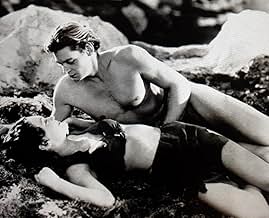
Thanks TCM for showing the movie's uncensored version. I expect the morality watchdogs must have overdosed on 1934 viewing. But there's a heckuva lot more to the movie than bared female skin and two unmarried people living together. O'Sullivan's absolutely enchanting as Jane. Her charm even outshines herds of stampeding elephants and bands of chattering chimps. More importantly, I think I've got her bare hips memorized. Then too, add a man of few words, the lean and lithe Weismuller, to the movie mix. He's perfect as lord of the jungle, more at home in the wilds than in the city, traveling by swinging vine instead of clogged freeway.
Then too, I detect a topical allegory lurking in the subtext. Something about living in harmony with nature rather than trying to plunder it. Sure, nature here is a creation of studio wizards at MGM, and not the real Africa. Still, the results are impressive as heck, even with backscreen projection and liberal use of matte. But since when did I go to adventure movies expecting documentary realism. That I'll leave to the textbooks and PBS. Actually, my favorite movie moment is when thoughtless chimp Cheetah decides to tease three baby lions, only to find that a muscular mother doesn't quite understand. It's an amusing little touch. Anyhow, if there's a better Tarzan movie, I haven't seen it, even if this one is an antique. Meanwhile, I'm off to the jungle with visions of loincloth Jane dancing in my head. Okay, maybe not, but it's still a big thanks to this great movie.
Thanks TCM for showing the movie's uncensored version. I expect the morality watchdogs must have overdosed on 1934 viewing. But there's a heckuva lot more to the movie than bared female skin and two unmarried people living together. O'Sullivan's absolutely enchanting as Jane. Her charm even outshines herds of stampeding elephants and bands of chattering chimps. More importantly, I think I've got her bare hips memorized. Then too, add a man of few words, the lean and lithe Weismuller, to the movie mix. He's perfect as lord of the jungle, more at home in the wilds than in the city, traveling by swinging vine instead of clogged freeway.
Then too, I detect a topical allegory lurking in the subtext. Something about living in harmony with nature rather than trying to plunder it. Sure, nature here is a creation of studio wizards at MGM, and not the real Africa. Still, the results are impressive as heck, even with backscreen projection and liberal use of matte. But since when did I go to adventure movies expecting documentary realism. That I'll leave to the textbooks and PBS. Actually, my favorite movie moment is when thoughtless chimp Cheetah decides to tease three baby lions, only to find that a muscular mother doesn't quite understand. It's an amusing little touch. Anyhow, if there's a better Tarzan movie, I haven't seen it, even if this one is an antique. Meanwhile, I'm off to the jungle with visions of loincloth Jane dancing in my head. Okay, maybe not, but it's still a big thanks to this great movie.
Action! Romance! Heroic Monkeys!
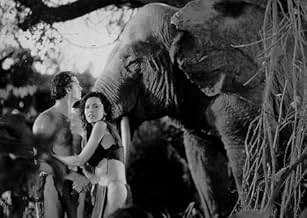
I often half-jokingly refer to "Tarzan and His Mate" as the "T2" of the 1930s, simply because it's packed with special effects, action, and spectacle of the big budget variety that I usually associate with modern films. Sure, some of the visuals look duff now - there's heavy use of rear screen projection and rubber animals - but there's also amazing sights like elephant stampedes, monkeys fighting tigers, hapless people tumbling off cliffs, and a huge elephant graveyard that must rank among the most memorable movie sets of all time.
Never mind the spectacle, though; the best part is the script. Maureen O'Sullivan has a surprisingly wonderful role as Jane. In fact, she carries the movie, since all Tarzan can really do is yodel and swing. She has to fend off the advances of two unsavory ivory hunters who want to lure her back to civilization. Tarzan is doubly threatened by these seedy guys - they want to kill his elephants AND they want his woman. This dual conflict keeps the movie cooking.
There's an amazing amount of violence in the film, including some spectacular battles with nasty tribesmen and knife fights with huge beasties. You'll even get to see a corpse with an arrow through its forehead and bugs crawling all over it. There's a bit of nudity as well, but don't get too excited as it's not really Maureen O'Sullivan swimming in the buff (but it is still swimming in the buff, so feel free to get excited anyway!). Amazing, isn't it, that "Tarzan and His Mate" is such a visceral viewing experience...especially when compared to the much tamer films that followed after Hollywood instituted a strict moral code.
Romantic, sexy, exciting, exotic - in short, all you could expect from a Tarzan movie. And the heroic monkeys are just the cutest thing ever. Once you make it past a rather dry first scene, this movie rocks all the way through.
Never mind the spectacle, though; the best part is the script. Maureen O'Sullivan has a surprisingly wonderful role as Jane. In fact, she carries the movie, since all Tarzan can really do is yodel and swing. She has to fend off the advances of two unsavory ivory hunters who want to lure her back to civilization. Tarzan is doubly threatened by these seedy guys - they want to kill his elephants AND they want his woman. This dual conflict keeps the movie cooking.
There's an amazing amount of violence in the film, including some spectacular battles with nasty tribesmen and knife fights with huge beasties. You'll even get to see a corpse with an arrow through its forehead and bugs crawling all over it. There's a bit of nudity as well, but don't get too excited as it's not really Maureen O'Sullivan swimming in the buff (but it is still swimming in the buff, so feel free to get excited anyway!). Amazing, isn't it, that "Tarzan and His Mate" is such a visceral viewing experience...especially when compared to the much tamer films that followed after Hollywood instituted a strict moral code.
Romantic, sexy, exciting, exotic - in short, all you could expect from a Tarzan movie. And the heroic monkeys are just the cutest thing ever. Once you make it past a rather dry first scene, this movie rocks all the way through.
The Adventures of Tarzan and Jane
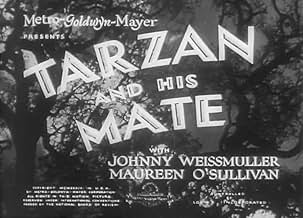
TARZAN AND HIS MATE (Metro-Goldwyn-Mayer, 1934), directed by Jack Conway (credited to MGM art director Cedric Gibbons), a sequel to the successful TARZAN THE APE MAN (1932), remains a highly acclaimed entry in the series. As with its predecessor, the character of Tarzan (and now Jane) do not appear until late into the story, in this instance 23 minutes from the start of the movie. Hailed by many as the best of the entire series, it's noted solely not only for its action and adventure, but for its sexual innuendos, Jane's two-piece jungle wear, as well as the most eye-opening sequence of all, the underwater swimming of Tarzan (still sporting his loincloth) with Jane, in long shot and shown from her back, completely in the nude. This now famous sequence which was later removed, especially from commercial television, has amazingly survived over the years and now restored, elevating the standard 93 minute print back up to its near theatrical length of 105 minutes. Johnny Weissmuller, the Olympic swimming champion chosen to play Edgar Rice Burrough's literary jungle hero, reprises his role, with an added bonus with mono-syllable ideologue. Unlike his co-star, Maureen O'Sullivan, Weissmuller's movie career became limited solely to playing Tarzan while O'Sullivan ventured in other screen roles without losing her identity as Jane.
In the conclusion of TARZAN THE APE MAN, Jane's father (C. Aubrey Smith) dies in Mutia Escartment, Harry Holt (Neil Hamilton) returns to England without his love, Jane, who has chosen to remain in the jungle with Tarzan. The sequel opens with Harry returning to Africa, accompanied by his assistant, Marlin Arlington (Paul Cavanaugh), to secure the ivory fortune at the elephant burial ground. En-route through the jungle, their safari meets up with danger as they are attacked by murderous natives and gorilla tribes. In time the safari is saved by the jungle call of Tarzan, who then escorts Harry to his mate, Jane. While Harry's intentions are honorable, with the hope of having Jane return home to England with him, Arlington's is not, plotting to do away with Tarzan and causing trouble for everyone concerned.
The supporting players consist of Forrester Harvey reprising his role as Beamish; Doris Lloyd, who also appeared in TARZAN THE APE MAN, assuming another part, that of Madame Feronde; Paul Porcasi as Monsieur Gironde; Desmond Roberts as Henry Van Ness; William Stack as Pierce; and Nathan Curry as Saidi.
The behind the scenes look to the making of TARZAN AND HIS MATE is as interesting as the movie itself. According to sources, there were complications during production, former silent screen matinée idol Rod LaRocque was replaced by Paul Cavanaugh, Jack Conway took over for Cedric Gibbons in the director's chair, having to film much of the movie all over again, as well as technical problems and script revisions. In spite of everything, it finally was completed, being the classic is has become.
A pre-code movie if ever there was one, TARZAN AND HIS MATE was obviously made for the adult masses. It would be another decade before the Tarzan films reverted more to the appeal of children like a Saturday afternoon matinée. Villains are the main factor in much of the series, and Paul Cavanaugh's performance, which might have gone to resident MGM bad guy John Miljan, plays a convincing one. His evilness speaks through his shifty eyes, especially on how he looks at the carefree Jane in her most abbreviated jungle attire as she sucks out snake poison from his forearm. He even forces his intentions on Jane by kissing her on the lips. Another interesting mention is the death of Tarzan's pet monkey, Cheta, midway through the story, while attempting to save Tarzan from a vicious rhinoceros. However, Cheta's offspring, mourning for its mother, is then adopted by Jane, who calls this one Cheta, too.
Action scenes are plentiful, bringing out many highlights, including some well constructed ones including Tarzan's battle against a 14-foot crocodile, he defeating the natives, and leading elephant stampedes. Jane also shows off her courage and skill while facing the dangers of the jungle as she plays dead while being surrounded by lions. Besides the recognized Tarzan yell, Jane gives out her jungle call as well, normally as a distress signal, in the more operatic sounding level, along with Jane's leap from the tree-top into the arms of Tarzan below - acrobatic style. With much of these ingredients and fast pace action, TARZAN AND HIS MATE is in many ways close to being superior to TARZAN THE APE MAN.
TARZAN AND HIS MATE, along with the remaining post 1934 MGM films in the series, were distributed on video cassette during the 1990s, then onto DVD in 2004. This along with the other Tarzan adventures played on the American Movie Classics cable channel from 1997 to 2000, and beginning in 2004, Turner Classic Movies picked up the option in airing the duration of the MGM/ Weissmuller series (1934-1942), making this second entry the most televised thus far. (***1/2) Next installment: TARZAN ESCAPES (1936).
In the conclusion of TARZAN THE APE MAN, Jane's father (C. Aubrey Smith) dies in Mutia Escartment, Harry Holt (Neil Hamilton) returns to England without his love, Jane, who has chosen to remain in the jungle with Tarzan. The sequel opens with Harry returning to Africa, accompanied by his assistant, Marlin Arlington (Paul Cavanaugh), to secure the ivory fortune at the elephant burial ground. En-route through the jungle, their safari meets up with danger as they are attacked by murderous natives and gorilla tribes. In time the safari is saved by the jungle call of Tarzan, who then escorts Harry to his mate, Jane. While Harry's intentions are honorable, with the hope of having Jane return home to England with him, Arlington's is not, plotting to do away with Tarzan and causing trouble for everyone concerned.
The supporting players consist of Forrester Harvey reprising his role as Beamish; Doris Lloyd, who also appeared in TARZAN THE APE MAN, assuming another part, that of Madame Feronde; Paul Porcasi as Monsieur Gironde; Desmond Roberts as Henry Van Ness; William Stack as Pierce; and Nathan Curry as Saidi.
The behind the scenes look to the making of TARZAN AND HIS MATE is as interesting as the movie itself. According to sources, there were complications during production, former silent screen matinée idol Rod LaRocque was replaced by Paul Cavanaugh, Jack Conway took over for Cedric Gibbons in the director's chair, having to film much of the movie all over again, as well as technical problems and script revisions. In spite of everything, it finally was completed, being the classic is has become.
A pre-code movie if ever there was one, TARZAN AND HIS MATE was obviously made for the adult masses. It would be another decade before the Tarzan films reverted more to the appeal of children like a Saturday afternoon matinée. Villains are the main factor in much of the series, and Paul Cavanaugh's performance, which might have gone to resident MGM bad guy John Miljan, plays a convincing one. His evilness speaks through his shifty eyes, especially on how he looks at the carefree Jane in her most abbreviated jungle attire as she sucks out snake poison from his forearm. He even forces his intentions on Jane by kissing her on the lips. Another interesting mention is the death of Tarzan's pet monkey, Cheta, midway through the story, while attempting to save Tarzan from a vicious rhinoceros. However, Cheta's offspring, mourning for its mother, is then adopted by Jane, who calls this one Cheta, too.
Action scenes are plentiful, bringing out many highlights, including some well constructed ones including Tarzan's battle against a 14-foot crocodile, he defeating the natives, and leading elephant stampedes. Jane also shows off her courage and skill while facing the dangers of the jungle as she plays dead while being surrounded by lions. Besides the recognized Tarzan yell, Jane gives out her jungle call as well, normally as a distress signal, in the more operatic sounding level, along with Jane's leap from the tree-top into the arms of Tarzan below - acrobatic style. With much of these ingredients and fast pace action, TARZAN AND HIS MATE is in many ways close to being superior to TARZAN THE APE MAN.
TARZAN AND HIS MATE, along with the remaining post 1934 MGM films in the series, were distributed on video cassette during the 1990s, then onto DVD in 2004. This along with the other Tarzan adventures played on the American Movie Classics cable channel from 1997 to 2000, and beginning in 2004, Turner Classic Movies picked up the option in airing the duration of the MGM/ Weissmuller series (1934-1942), making this second entry the most televised thus far. (***1/2) Next installment: TARZAN ESCAPES (1936).
The Best of All Tarzan Films
It's interesting how movies slumped after the censors got their out of joint noses involved. Our Puritan foundation really diminished a lot of film for many years (in some ways, it's still happening today). Like "Bride of Frankenstein" surpassing the original, "Tarzan and His Mate" is superior to the first Weissmuller film. Maureen O'Sullivan is incredible to look at, but has all the feistiness and self esteem to hold her own with the big guy. But most importantly, the producers and writers asked themselves what a true depiction of these two, living in the jungle, should be like. They went for the rawness. In addition to the recognition of the sexuality in this film, it is filled with well crafted adventures and close calls. Efforts are still being made by the Westerners to try to reclaim the beautiful young woman. These movies were much more fundamental than the silly stuff that came later, as professional body builders and football players got into the mix. When filmmakers had to work with less, they often had to resort to creativity and imagination.


Did you know
- TriviaThe "African" elephants were actually Indian elephants fitted with prosthetic tusks and ears, as MGM already owned several Indian elephants and considered them easier to handle. During the crocodile wrestling scene, a mechanical Nile crocodile, equipped with nigrosine dye sacks to simulate blood, was used. For the elephants vs. lions battle traveling matte shots were used to depict lions leaping up and holding on to elephants, who then seized them with their trunks and hurled them down, or crushed them beneath their feet.
- GoofsAfter a bearer gets shot, Martin, Harry, and the other carriers hide behind a thicket. One bearer has two shotguns on his right shoulder. In the following shot, he appears with one shotgun on each shoulder.
- Quotes
Jane Parker: The best weapon a woman has is a man's imagination.
- Alternate versionsIn the UK, the 2002 DVD release was cut by 12 secs by the BBFC to remove shots of lions being genuinely tripped to simulate a shooting and a spear killing. The 2005 release features the extended version, but these scenes were pre-cut before submission to the classification board.
- ConnectionsEdited into Tarzan Escapes (1936)
- SoundtracksVoo-Doo Dance
(1932) (uncredited)
Music by George Richelavie
Arranged by Paul Marquardt & Fritz Stahlberg
Played during main title
- How long is Tarzan and His Mate?Powered by Alexa
Details
Box office
- Budget
- $1,279,142 (estimated)
- Runtime
- 1h 44m(104 min)
- Aspect ratio
- 1.37 : 1
Contribute to this page
Suggest an edit or add missing content