IMDb RATING
6.5/10
1.1K
YOUR RATING
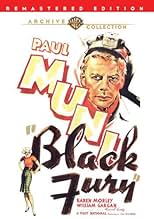
An immigrant coal miner finds himself in the middle of a bitter labor dispute between the workers and the mine owners.An immigrant coal miner finds himself in the middle of a bitter labor dispute between the workers and the mine owners.An immigrant coal miner finds himself in the middle of a bitter labor dispute between the workers and the mine owners.
- Nominated for 1 Oscar
- 2 wins & 2 nominations total
John Qualen
- Mike
- (as John T. Qualen)
J. Carrol Naish
- Steve
- (as J. Carroll Naish)
Joseph Crehan
- Farrell
- (as Joe Crehan)
Sara Haden
- Sophie Shemanski
- (as Sarah Haden)
G. Pat Collins
- Lefty - Company Policeman
- (as George Pat Collins)
6.51.1K
1
2
3
4
5
6
7
8
9
10
Featured reviews
Black Fury- Incisive Labor Film ***
The fabulous Paul Muni gives another wonderful performance in this 1935 film.
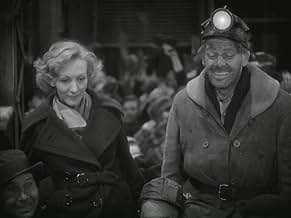
With a genuine Slavic accent, Muni is superb as a coal miner who loses his girl (Karen Morley) to a company Policeman and goes on a drinking binge as a result. It is at this point that a gangster organization tries to create chaos within the union and Muni becomes their perfect foil.
J. Carrol Naish is excellent as the worker who works for this unholy organization.
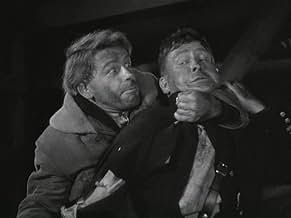
Naturally, Muni's best friend is killed in a clash with company police and Muni, now sober, vows revenge.
Morley returns to Muni just in time as he goes down into the mine and starts blowing the place up. It's at this point that the film starts to go down, but with Muni's performance and the problems shown of what the coal miners had to endure plus the dishonesty in trying to break the union, all make for a very good film.
With a genuine Slavic accent, Muni is superb as a coal miner who loses his girl (Karen Morley) to a company Policeman and goes on a drinking binge as a result. It is at this point that a gangster organization tries to create chaos within the union and Muni becomes their perfect foil.
J. Carrol Naish is excellent as the worker who works for this unholy organization.
Naturally, Muni's best friend is killed in a clash with company police and Muni, now sober, vows revenge.
Morley returns to Muni just in time as he goes down into the mine and starts blowing the place up. It's at this point that the film starts to go down, but with Muni's performance and the problems shown of what the coal miners had to endure plus the dishonesty in trying to break the union, all make for a very good film.
Classic Paul Muni FILM
Never realized that Paul Muni, (Joe Radek) played in a film concerning miners in Pennsylvania and gave such an outstanding performance beyond anything I realized he had accomplished in his long career on the silver screen. In this film Joe Radek is an immigrant to this country, however, he is very clever in many ways and seeks justice for his fellow workers in the coal mine in which the town people work. Karen Morley,(Anna Novak) gives a great supporting role to this film and really loves Joe Radek and what he is trying to accomplish. The town is controlled by the coal mine owners and Barton MacLane,( McGree )along with William Gargan,(Slim Johnson/Company Police bully the people in the town along with J Carrol Nash,(Steve Croner) who all work against the miners and control their living conditions. There is a big problem trying to establish a Labor Union and there is a constant battle between the very poor and rich people of the community. Paul Muni gave the best performance I have ever seen in this Classic 1935 film, don't miss this picture.
10kcfl-1
Best film of year
Let's look at 1935: I don't think there's anyone reviewing now who went to the movies that year, so we have to rely on video. I've seen about 100 films from that year; many have not been preserved. "The Informer"won the Oscar, and a worthy film it was. "A Night at the Opera," "ChinaSeas," "The Good Fairy" "Lives of a Bengal lancer," "Naughty Marietta,"and "The Devil Is a Woman" also came out that year, all great films. "Black Fury" was better than any of them. It's gripping from the first frame to the last. It's as realistically set, and politically sensitive, as any Hollywood film. The closest political thriller I've seen to it is "Massacre" (1934). I loved it for the big factors, like digging itself into an impossible hole, then managing to escape, and Muni's performance. Also for the small ones, like all the supporting performances and the fact that the union happens to be integrated.
Enjoyable and well made...but I cannot see what folks saw in Muni's performance.
Paul Muni was one of the most acclaimed and respected actors of his era...so much so that he nearly won the Oscar for Best Actor...as a write-in candidate! And, I must admit that when Muni is on, he's great. But occasionally I see a performance and wonder why it was so beloved...such as his over-the-top Eastern European-American, Joe Radek, in "Black Fury". Now I am not saying it's a bad film...just his performance.
As for the story, it's an interesting tale of both a union and management being manipulated into striking....and Joe is an unwitting dupe in the process. But, being a decent sort of guy at heart, he does what anyone would do in this situation...blow up the mine! Well, at least that's the crazy message you get in this picture!
Overall, an engaging and interesting film with many flaws...including its leading man's performance and the crazy vigilante message it promotes. A genuinely odd but entertaining picture.
As for the story, it's an interesting tale of both a union and management being manipulated into striking....and Joe is an unwitting dupe in the process. But, being a decent sort of guy at heart, he does what anyone would do in this situation...blow up the mine! Well, at least that's the crazy message you get in this picture!
Overall, an engaging and interesting film with many flaws...including its leading man's performance and the crazy vigilante message it promotes. A genuinely odd but entertaining picture.
How Green Was My Screenplay
Paul Muni, David Thomson once wrote, was the '30s' idea of a great actor: He never looked the same twice. Here he's a hail-fellow-well-met Eastern European immigrant coal miner in a dreary Pennsylvania burg, deceived by union busters and weighed down by a ten-ton accent. Indeed the screenplay seldom rises above a fifth-grade literacy level, the better to illustrate the goodheartedness of these poor but honest laborers. But five minutes of Muni, and you've seen the whole performance -- a Zorba-the-miner "life force" who yells all his lines and sounds unfortunately like Steve Martin's wild-and-crazy-guy character from Saturday Night Live in the '70s.
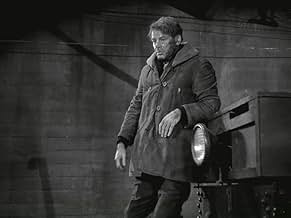
Warners does come up with a convincingly grimy set and a capable stock-company supporting cast, but the dramaturgy is connect-the-dots. One miner shouts and sways the whole crowd, then another, then another -- what a gullible bunch this must be. The evil cops and management figures are so absurdly evil that nuance is lost. The third act does whip up to an exciting blow-up-the-mine climax, but then it's resolved in headline montages, as if Warners suddenly ran out of money, or film. And Michael Curtiz -- I didn't think this fine director was capable of this -- stages the crowd scenes clumsily, shifting point of view confusingly and slapping the mise-en-scene together hard, with loud music. Certainly the studio is on the side of the angels, arguing for a fair day's pay for a fair day's work, and as a '30s sociological curio the movie is not without interest. But Muni's monotonous bluster and an elementary script combine to create a cinematic cave-in.
Did you know
- TriviaThough it received no official Oscar nominations, the Academy permitted write-in candidates this year and when the voting order was announced it turned out that Paul Muni had come in second in the balloting, narrowly behind winner Victor McLaglen but ahead of any of the other nominated actors.
- GoofsAt c. 24 minutes Joe is counting out his money, but he is inconceivably inaccurate. After counting to 68 dollars he places two further bills on the table and counts "73" out loud. A few moments later he counts up to 75 dollars, but, after four more bills have been placed in front of him he announces "76" dollars as his total.
- ConnectionsFeatured in Hollywood and the Stars: The Angry Screen (1964)
- SoundtracksWhy Do I Dream Those Dreams?
(1934) (uncredited)
Music by Harry Warren
Played on piano in bar during scene where men challenge Radek
Details
- Release date
- Country of origin
- Language
- Also known as
- Black Hell
- Filming locations
- Warner Ranch, Calabasas, California, USA(mine shaft scenes)
- Production company
- See more company credits at IMDbPro
- Runtime
- 1h 34m(94 min)
- Color
- Sound mix
- Aspect ratio
- 1.37 : 1
Contribute to this page
Suggest an edit or add missing content