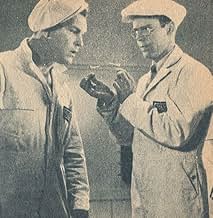
The crew of the Pioneer Zephyr diesel train has only a few hours to deliver an iron lung to an injured man at the Boulder Dam construction site.The crew of the Pioneer Zephyr diesel train has only a few hours to deliver an iron lung to an injured man at the Boulder Dam construction site.The crew of the Pioneer Zephyr diesel train has only a few hours to deliver an iron lung to an injured man at the Boulder Dam construction site.
- Director
- Writers
- Stars
Theodore von Eltz
- Ed Tyler
- (as Theodor Von Eltz)
Guinn 'Big Boy' Williams
- Higgins
- (as Guinn Williams)
Harry Allen
- McGregor aka Mac
- (uncredited)
Stanley Blystone
- Detective
- (uncredited)
James Bradbury Jr.
- Ed Lowery - Train Engineer
- (uncredited)
Lynton Brent
- Brent
- (uncredited)
Mary Carr
- Mother on Train
- (uncredited)
Eddy Chandler
- Trainman
- (uncredited)
Dick Curtis
- Boulder Dam Foreman
- (uncredited)
- Director
- Writers
- All cast & crew
- Production, box office & more at IMDbPro
6.5252
1
2
3
4
5
6
7
8
9
10
Featured reviews
Quite entertaining for train buffs
While this movie is no less corny than others of it's time, the fact that most of the story takes place on a new streamlined high speed train is of interest to us train buffs. Most of the action is obviously speeded up in the camera just like the westerns of the time, it is still 70 min. of innocent fun. I recommend it.
Will appeal only to railroad buffs
I just watched this movie because I am a railroad buff. The Zephyr train (now preserved in Chicago's Museum of Science and Industry) is the true star of this flick, especially because the other actors in the movie were little-known even in the 1930s.
As other reviewers have pointed out, the acting is poor, the film is too rushed, the characters are not developed enough and the storyline is quite predictable and lacks any dramatic tension.
Even those who do not care for political correctness will be sickened by the stereotypical portrayal of an African-American -- Sam, the train's chef played by Ray Turner. This was the only type of role that he could get in 1930s Hollywood.
As other reviewers have pointed out, the acting is poor, the film is too rushed, the characters are not developed enough and the storyline is quite predictable and lacks any dramatic tension.
Even those who do not care for political correctness will be sickened by the stereotypical portrayal of an African-American -- Sam, the train's chef played by Ray Turner. This was the only type of role that he could get in 1930s Hollywood.
Historically Appealing and Entertaining
In a peculiar and somewhat unexpected way, this movie manages to exceed the sum of its fairly mundane and often mediocre parts, and become something that's actually appealing. This is due almost solely to the star of this film, which in this case is not an actor (despite Sally Blane receiving top billing), but a remarkable for its time train known as the Burlington Zephyr.
This is in many respects a technological tour de force circa 1934. The technology and achievements highlighted in this film become even more remarkable when you consider all of this took place in some of the darkest days of the great depression. Much of what is highlighted in this film would be considered remarkable in our current time, and this film is now less than a decade shy of being one hundred years old.
I'm not going to address specifics in the story line or plot. It's both predictable and cliched. Think of it as a story about a character that gets a rough start in life but ends up being celebrated and making good. Except in this case that central character is a train and not a person.
The real value here (and that value is significant) is that the film offers a view of a time almost one hundred years ago. And what a time it was. Many of the scenes are shot at Hoover Dam while it's under construction. You'll see some truly remarkable scenes from the Chicago World's Fair. There is one scene of two couples listening to a news radio broadcast in a home- something not possible just a short decade before this film. And finally, and certainly not least, is the Burlington Zephyr itself.
The Zephyr was an aluminum train capable of attaining sustained speeds in excess of one hundred miles an hour, and transporting passengers in comfort not known before its creation. It would by every definition compare favorably to most of the trains we have in service today.
This movie is a prism into the past. It's also about hope and achievement. If it illustrates anything at all, the message is that even in the darkest times people can dream big and achieve great things. If you approach the film with that in mind I think you'll get a kick out of this one.
This is in many respects a technological tour de force circa 1934. The technology and achievements highlighted in this film become even more remarkable when you consider all of this took place in some of the darkest days of the great depression. Much of what is highlighted in this film would be considered remarkable in our current time, and this film is now less than a decade shy of being one hundred years old.
I'm not going to address specifics in the story line or plot. It's both predictable and cliched. Think of it as a story about a character that gets a rough start in life but ends up being celebrated and making good. Except in this case that central character is a train and not a person.
The real value here (and that value is significant) is that the film offers a view of a time almost one hundred years ago. And what a time it was. Many of the scenes are shot at Hoover Dam while it's under construction. You'll see some truly remarkable scenes from the Chicago World's Fair. There is one scene of two couples listening to a news radio broadcast in a home- something not possible just a short decade before this film. And finally, and certainly not least, is the Burlington Zephyr itself.
The Zephyr was an aluminum train capable of attaining sustained speeds in excess of one hundred miles an hour, and transporting passengers in comfort not known before its creation. It would by every definition compare favorably to most of the trains we have in service today.
This movie is a prism into the past. It's also about hope and achievement. If it illustrates anything at all, the message is that even in the darkest times people can dream big and achieve great things. If you approach the film with that in mind I think you'll get a kick out of this one.
Zeit-Gheist Movie for the 30's
This movie really echoes the spirit of it's time. Everything then was progress & technology. The plot is the worst part of the film. It is terribly predictable & hackneyed. The film is also way short; 72 minutes for the version I have (barely 5 reels). The scenes at Hoover Dam could easily have been expanded to develop atmosphere & the brother/friend's character. The dam scenes are very interesting & show a human side to the massive project. Rail fans such as myself seek out this film (getting it is not easy) for the footage of the famous Pioneer Zephyr. This train is the forerunner of the French GTV & the Japanese Super Trains among many others. It was a technological marvel of it's time. The train has survived & is on display (magnificently restored) at The Chicago Museum of Science & Industry in a specially built vault below street level. There is an excellent use of montage early in the film as the father sees the history of railroading in his mind's eye. It is very well integrated into the story & not as 'In Your Face' as most montages are. The acting style has that curiously stiff feel of many of the early sound films. I think it has more to do with the director's uncertainty in the new technology than with the cast's talent. None of the cast were ever big time but they are attractive & reasonably well suited for their parts. I was pleasantly surprised to find it watchable. I had thought I would have to fast forward to the train footage that I bought the film to get.
It takes a Lot to Laugh, It Takes a Train to Cry
At a board of directors meeting, handsome railroad engineer Charles Starrett (as Tom Caldwell) presents his plan for a modern, high-speed train called "The Silver Streak". The conservative board of directors considers Mr. Starrett's progressive plan preposterous. They reject his design. Starrett resigns and goes to work for another locomotive company, which is secretly arranged by his beautiful girlfriend Sally Blane (as Ruth Dexter). She is also the daughter of William Farnum (as Barney "BJ" Dexter), chairman at the railroad firm Starrett left. The diesel-powered train is built, but runs into some trouble. "You can't beat steam," is what the old guard says, but the industry is faltering and needs to attract a new generation of travelers...
While dull, this production has a few good reasons to watch...
William Farnum was one of the first movie "super-stars" and gets a featured, late career role. He even gets to kiss Ms. Blane (Loretta Young's lovely sister). Adventurous engineer Hardie Albright (as Allan Dexter) does well with the most dramatic supporting role. Arthur Lake and Guinn "Big Boy" Williams (as Crawford and Higgins) are an effective comic relief team (one wishes the material were better). There are many recognizable players in small roles - from veteran character actress Mary Carr as the weepy train passenger to attractive newcomer Dave O'Brien as a telephone clerk. The actual train is shown to great effect - but the climax is rendered unexciting by showy reaction shots, a superfluous Russian spy and a general poor pace.
***** The Silver Streak (12/10/34) Tommy Atkins ~ Charles Starrett, Sally Blane, William Farnum, Hardie Albright
While dull, this production has a few good reasons to watch...
William Farnum was one of the first movie "super-stars" and gets a featured, late career role. He even gets to kiss Ms. Blane (Loretta Young's lovely sister). Adventurous engineer Hardie Albright (as Allan Dexter) does well with the most dramatic supporting role. Arthur Lake and Guinn "Big Boy" Williams (as Crawford and Higgins) are an effective comic relief team (one wishes the material were better). There are many recognizable players in small roles - from veteran character actress Mary Carr as the weepy train passenger to attractive newcomer Dave O'Brien as a telephone clerk. The actual train is shown to great effect - but the climax is rendered unexciting by showy reaction shots, a superfluous Russian spy and a general poor pace.
***** The Silver Streak (12/10/34) Tommy Atkins ~ Charles Starrett, Sally Blane, William Farnum, Hardie Albright
Did you know
- TriviaThe train in the film was the Chicago, Burlington, & Quincy RR's "Pioneer Zephyr" passenger train. After the train was retired from service in 1960 it was donated to the Museum of Science and Industry in Chicago where it is still on display.
- GoofsOne of the repairmen on the Silver Streak (Higgins) tosses away a cigarette that he was holding in a wrench, but in the very next instant he has another fully lit cigarette.
- Crazy credits[At the bottom of the list of players] Burlington Zephyr as 'The Silver Streak'.
- ConnectionsReferenced in Victorious: Jade Dumps Beck (2010)
Details
- Release date
- Country of origin
- Language
- Also known as
- Серебряная стрела
- Filming locations
- Galesburg, Illinois, USA(Burlington switch yards)
- Production company
- See more company credits at IMDbPro
- Runtime
- 1h 12m(72 min)
- Color
- Aspect ratio
- 1.37 : 1
Contribute to this page
Suggest an edit or add missing content