

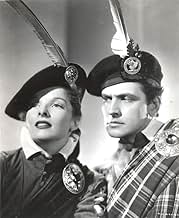
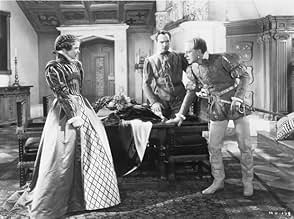
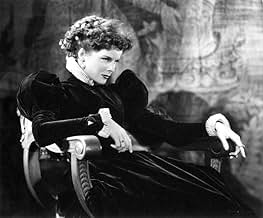
The recently widowed Mary Stuart returns to Scotland to reclaim her throne but is opposed by her half-brother and her own Scottish lords.The recently widowed Mary Stuart returns to Scotland to reclaim her throne but is opposed by her half-brother and her own Scottish lords.The recently widowed Mary Stuart returns to Scotland to reclaim her throne but is opposed by her half-brother and her own Scottish lords.
- Directors
- Writers
- Stars
- Awards
- 3 wins & 1 nomination total


- Directors
- Writers
- All cast & crew
- Production, box office & more at IMDbPro
6.32.9K
1
2
3
4
5
6
7
8
9
10
Featured reviews
Radiant Hepburn in overlong historical drama from Maxwell Anderson play...
The complicated historical background involved in MARY OF Scotland is such that unless you know something about British monarchs you'll have a hard time knowing where the truth lies in this epic historical romance. But it's clear that KATHARINE HEPBURN gives a radiant performance as Mary, Queen of Scots--the only drawback being that she never ages a bit over a twenty-five year span. When she goes to her execution, she looks just as young as she did in the opening scene.
It's a pleasure to report that FREDRIC MARCH breathes a lot of life into his portrayal of Bothwell. Too bad he didn't exhibit this kind of gusto when he played the title role in ANTHONY ADVERSE the same year. He's all bravado and robust athletic grace and looks good in his period costumes. Maybe we owe his strong performance to John Ford, but whatever it is, he's much better here than he was as Anthony Adverse.
JOHN CARRADINE seemed an unusual choice to play Rizzo, the Italian secretary who happens to be a troubadour of sorts, but it's nice to see him in a more sympathetic role for a change. DONALD CRISP, ALAN MOBRAY, DOUGLAS WALTON and FRIEDA INESCOURT are interesting in supporting roles.
Walton is another actor who shines here, rather than remaining colorless in the background of many a film. He gives a flamboyant performance as Lord Darnley and it's probably among the best roles he ever had.
FLORENCE ELDRIDGE makes an interesting Queen Elizabeth, less showy in the role than Bette Davis or Flora Robson but still with the right amount of regal spirit.
John Ford directs the first half of the film with his usual authority but things get a little too repetitious and slow-moving in the second half when tedium really settles in before Mary's final walk to the execution block.
Summing up: A mixed bag, some strong performances, a few strong scenes but overall result is disappointing. Here's an historical romance that cried out for Technicolor. It manages to look drab in B&W despite the lavish costumes and good photography.
It's a pleasure to report that FREDRIC MARCH breathes a lot of life into his portrayal of Bothwell. Too bad he didn't exhibit this kind of gusto when he played the title role in ANTHONY ADVERSE the same year. He's all bravado and robust athletic grace and looks good in his period costumes. Maybe we owe his strong performance to John Ford, but whatever it is, he's much better here than he was as Anthony Adverse.
JOHN CARRADINE seemed an unusual choice to play Rizzo, the Italian secretary who happens to be a troubadour of sorts, but it's nice to see him in a more sympathetic role for a change. DONALD CRISP, ALAN MOBRAY, DOUGLAS WALTON and FRIEDA INESCOURT are interesting in supporting roles.
Walton is another actor who shines here, rather than remaining colorless in the background of many a film. He gives a flamboyant performance as Lord Darnley and it's probably among the best roles he ever had.
FLORENCE ELDRIDGE makes an interesting Queen Elizabeth, less showy in the role than Bette Davis or Flora Robson but still with the right amount of regal spirit.
John Ford directs the first half of the film with his usual authority but things get a little too repetitious and slow-moving in the second half when tedium really settles in before Mary's final walk to the execution block.
Summing up: A mixed bag, some strong performances, a few strong scenes but overall result is disappointing. Here's an historical romance that cried out for Technicolor. It manages to look drab in B&W despite the lavish costumes and good photography.
John Ford's look at royal history
Katharine Hepburn plays the young queen in this John Ford version of the rivalry between Mary of Scots and her cousin, Elizabeth I (played by Florence Eldridge; whose husband Fredric March plays a jaunty Lord Bothwell). Cut back to the bare bones, and squarely on the differences between the two women, it isn't altogether successful.
John Knox rants his Protestant spiel, Bothwell appears with a retinue of pipers (at several points); Darnley's murder is glossed over, as is his smallpox. John Carradine has a well-defined role as the ill-fated David Rizzio, while Mary's parasitical court of Lords are quirkily represented and dismissed.
Hepburn isn't as bad as one would fear, but it wasn't really a suitable role for her, nor, one would expect, was the material enough for tough director Ford to make much of. So this film remains a misfire, with some interesting sequences and some strong performances, but as a whole, it just doesn't work.
John Knox rants his Protestant spiel, Bothwell appears with a retinue of pipers (at several points); Darnley's murder is glossed over, as is his smallpox. John Carradine has a well-defined role as the ill-fated David Rizzio, while Mary's parasitical court of Lords are quirkily represented and dismissed.
Hepburn isn't as bad as one would fear, but it wasn't really a suitable role for her, nor, one would expect, was the material enough for tough director Ford to make much of. So this film remains a misfire, with some interesting sequences and some strong performances, but as a whole, it just doesn't work.
An utter bore
Don't let my summary get you upset, I would never mean to do that--but although I do love this film--in short it is a bit boring. I loved the period costumes and sets and the acting, but the storyline lacked any real excitement!! Hepburn was fine but any real passion in the acting department has to go to Fredric March. The supporting players were also very good in their parts, especially Florence Eldridge as Queen Elizabeth. I saw somewhere that Ginger Rogers tried out secretly for the role of Elizabeth and almost had it until she was found out by the director!! Would have loved to have seen that one--LOL But it is a nice film, but just a tad too long and boring!!
Pretty dull costume drama
The life story of Mary, Queen of Scots is a thoroughly engaging one. I recommend anyone who wants to know more about the history while being entertained at the same time to check out the two Jean Plaidy books, ROYAL ROAD TO FOTHERINGAY and its sequel, THE CAPTIVE QUEEN OF SCOTS - two great little novels that tell you all there is to know.
MARY OF Scotland is an all-too Hollywoodised version of the story that suffers from an exceptionally overlong running time, unfortunately. It's strange, because some parts of the production are exceptionally slow and boring, while 19 years of history is condensed into about five minutes. There are a few eventful bits but for the most part this is a drag.
The director is none other than John Ford, but despite the presence of such a cinematic luminary, he seems uninterested in the material which is lifeless as a result. Katharine Hepburn is also a disappointment as Mary herself, singularly failing to make the queen sympathetic in any way. Fredric March does what he can as Bothwell, and there are nice little roles for John Carradine and Moroni Olsen, but it's not enough.
I particularly disliked the way that some good little bits of history are omitted or simplified for no apparent reason. For instance, Douglas Walton's final scene didn't happen that way at all and much more drama could have been made of it. Instead all the focus is on the talk and its incessant and goes nowhere. The definitive story of Mary, Queen of Scots this certainly isn't.
MARY OF Scotland is an all-too Hollywoodised version of the story that suffers from an exceptionally overlong running time, unfortunately. It's strange, because some parts of the production are exceptionally slow and boring, while 19 years of history is condensed into about five minutes. There are a few eventful bits but for the most part this is a drag.
The director is none other than John Ford, but despite the presence of such a cinematic luminary, he seems uninterested in the material which is lifeless as a result. Katharine Hepburn is also a disappointment as Mary herself, singularly failing to make the queen sympathetic in any way. Fredric March does what he can as Bothwell, and there are nice little roles for John Carradine and Moroni Olsen, but it's not enough.
I particularly disliked the way that some good little bits of history are omitted or simplified for no apparent reason. For instance, Douglas Walton's final scene didn't happen that way at all and much more drama could have been made of it. Instead all the focus is on the talk and its incessant and goes nowhere. The definitive story of Mary, Queen of Scots this certainly isn't.
Mary meets Elizabeth!
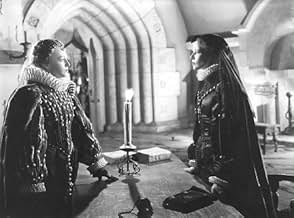
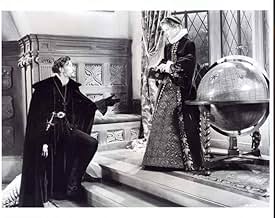
The directors cannot refrain from showing the two queens together in one scene.Charles Jarrot -whose movie is inferior to John Ford's- did the same in 1972.And however,they never met ,not a single time during Mary's captivity.But John Ford's scene is useful for people who know little about the Virgin Queen.It's sure that Mary's childhood in France was a nice one even though her reign was short as king François II's wife.On the other hand,Elizabeth lived in fear when she was a child for her bloody sister wanted to get rid of her.
The first past begins in Scotland ,and France is only evoked in Mary's memories.This first part is the most satisfying historically speaking:Darnley's and Ricci's murders are well directed by Ford,and the town criers who ,every ten minutes announce "It's eight'o clock!All is fine!" shows his sense of humor.Biggest flaw is the little part of James Stuart, aka"the bastard" aka Maurey:This man is really the stringman,who plays a prominent part in the queen's downfall,holding Mary like a puppet on a string,travelling to France when rebellion begins -he was not here when Mary was imprisoned in Lochleven-,just coming back to reap the benefits (regency he had lost when his sister came back).
Frederic March is a fine actor,but his Bothwell is not credible.Bothwell was a hairy brute ,not the romantic chivalrous fair knight we see here.Mary's abduction remains a mysterious part because the historians have no documents of what really happened.Mary's captivity in Lochleven-where she at last understood how James Stuart fooled her -and her extraordinary escape -worthy of Hitchcock's suspense-lasts barely 30 seconds on the screen.
Ditto for Mary's captivity in England.When she arrived,she was in what we would call "under house arrest" today.Only during her last year,when they discovered a plot,she was taken to the fortress of Fotheringay (a wonderful Fairport Convention song by the way),she was really a prisoner in the modern sense of the term.And she had a whole floor for herself though.
The trial is unsatisfying.At the time,Mary did not care for Bothwell anymore,she was longing to become a martyr of the Catholic cause.She did not know that the pope did not take her seriously .The scene with Donald is pure romantic fiction.
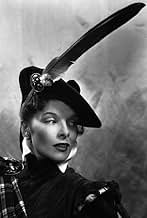
All in all ,and even if the things fall apart a bit in the second part,the movie is magnificently enhanced by Hepburn's presence and Ford -they said they had a love affair on the set- lovingly films her.I've been told that the scene between Bothwell and the queen on the tower was filmed by KH herself.
The first past begins in Scotland ,and France is only evoked in Mary's memories.This first part is the most satisfying historically speaking:Darnley's and Ricci's murders are well directed by Ford,and the town criers who ,every ten minutes announce "It's eight'o clock!All is fine!" shows his sense of humor.Biggest flaw is the little part of James Stuart, aka"the bastard" aka Maurey:This man is really the stringman,who plays a prominent part in the queen's downfall,holding Mary like a puppet on a string,travelling to France when rebellion begins -he was not here when Mary was imprisoned in Lochleven-,just coming back to reap the benefits (regency he had lost when his sister came back).
Frederic March is a fine actor,but his Bothwell is not credible.Bothwell was a hairy brute ,not the romantic chivalrous fair knight we see here.Mary's abduction remains a mysterious part because the historians have no documents of what really happened.Mary's captivity in Lochleven-where she at last understood how James Stuart fooled her -and her extraordinary escape -worthy of Hitchcock's suspense-lasts barely 30 seconds on the screen.
Ditto for Mary's captivity in England.When she arrived,she was in what we would call "under house arrest" today.Only during her last year,when they discovered a plot,she was taken to the fortress of Fotheringay (a wonderful Fairport Convention song by the way),she was really a prisoner in the modern sense of the term.And she had a whole floor for herself though.
The trial is unsatisfying.At the time,Mary did not care for Bothwell anymore,she was longing to become a martyr of the Catholic cause.She did not know that the pope did not take her seriously .The scene with Donald is pure romantic fiction.
All in all ,and even if the things fall apart a bit in the second part,the movie is magnificently enhanced by Hepburn's presence and Ford -they said they had a love affair on the set- lovingly films her.I've been told that the scene between Bothwell and the queen on the tower was filmed by KH herself.


Did you know
- TriviaKatharine Hepburn credited John Ford with saving her life one day on the set. They were shooting a scene of Hepburn on horseback when the horse she was riding kept going unexpectedly. Ford yelled at Hepburn to duck just before she was about to collide with a low branch.
- GoofsMary's execution takes place outdoors. It actually took place in the great hall of Fotheringay Castle.
- Quotes
Mary, Queen of Scots: [to Queen Elizabeth I] I might have known you'd come to gloat like this - stealthily, under cover of night.
- Crazy creditsOpening credits: "Like two fateful stars, Mary Stuart and Elizabeth Tudor appeared in the sixteenth century, to reign over two great nations in the making ... They were doomed to a life-and-death struggle for supremacy, a lurid struggle that still shines across the pages of history ... But today, after more than three centuries, they sleep side by side, at peace, in Westminster Abbey."
ENGLAND
- Alternate versionsExists in a computer-colorized version.
- ConnectionsFeatured in The Costume Designer (1950)
Details
- Release date
- Country of origin
- Language
- Also known as
- María Estuardo, reina de Escocia
- Filming locations
- Production company
- See more company credits at IMDbPro
- Runtime
- 2h 3m(123 min)
- Color
- Aspect ratio
- 1.37 : 1
Contribute to this page
Suggest an edit or add missing content