IMDb RATING
6.7/10
1.5K
YOUR RATING


Steve Raleigh aims for Broadway; with backer Herman and leading lady Sally, he faces challenges as Sally trains a horse to finance the production.Steve Raleigh aims for Broadway; with backer Herman and leading lady Sally, he faces challenges as Sally trains a horse to finance the production.Steve Raleigh aims for Broadway; with backer Herman and leading lady Sally, he faces challenges as Sally trains a horse to finance the production.
- Director
- Writers
- Stars
- Awards
- 3 wins total






King Baggot
- Magazine Stand Proprietor
- (uncredited)

- Director
- Writers
- All cast & crew
- Production, box office & more at IMDbPro
6.71.4K
1
2
3
4
5
6
7
8
9
10
Featured reviews
A nice tribute to Clark Gable
My suspicions are running high that the lavish budget and extravagance of "Broadway Melody of 1938" were practice made in order to disguise the age old Judy Garland and Mickey Rooney premise "Come on, let's put on a show!", away from the typical country town backyard setting, for Broadway itself in a dressed up version of a simplified recyclable plot.
It's hard to believe that Judy Garland, a dark brunette starry eyed fifteen year old as a supporting novelty prop, hence the almost non-explained entrance into the "Melody" movie, later became a threat to Eleanor Powell, the female equivalent of Fred Astaire. Despite her lack of purpose, as the daughter of a boarding house proprietress for struggling actors, Judy manages to sing up a storm with her first big hits, "Dear Mr Gable", originally sung to the King himself before its inclusion in the film, "Everybody Sing", so popular that one of her films the following year was renamed after the song, sing a bit of "Yours and Mine" in the opening credits, and a dance in a toilet roll crinoline white dress with Buddy Ebsen.
However, "Broadway Melody of 1938" was Judy Garland's earliest feature film foray at MGM, and not surprisingly for a dynamic triple threat performer of her talents, steals the show.
Horses, gambling bets, sneezing experts, owners of a frighteningly large number of dogs and simply a hell of a lot of people with budding talent all contribute to the movie's conflicting story and the famous show business line, "The show must go on" in order for Robert Taylor's Broadway producer character to finance his latest hit production, called ironically enough, "Broadway Melody".
As a dancing spectacular showcase for the brilliant talents of Eleanor Powell, the routines featured are no disappointment, notably "Follow in my footsteps", in the company of the champion racehorse on a traveling train, and the sensational George Murphy/Powell dance "I'm Feeling Like a Million". Finally, the charismatic cast is rounded up by Sophie Tucker, as Judy's mother, singing a great rendition of her special song "Some of these days".
In all, like all the movies in the "Melody" series, this isn't exactly "Singin' in the Rain", but it certainly did a lot for the audiences of the Depression era, hungry for the lavish, fun musicals, and is certainly quite a surprising pleasant musical piece for your own enjoyment.
Rating: 8/10
It's hard to believe that Judy Garland, a dark brunette starry eyed fifteen year old as a supporting novelty prop, hence the almost non-explained entrance into the "Melody" movie, later became a threat to Eleanor Powell, the female equivalent of Fred Astaire. Despite her lack of purpose, as the daughter of a boarding house proprietress for struggling actors, Judy manages to sing up a storm with her first big hits, "Dear Mr Gable", originally sung to the King himself before its inclusion in the film, "Everybody Sing", so popular that one of her films the following year was renamed after the song, sing a bit of "Yours and Mine" in the opening credits, and a dance in a toilet roll crinoline white dress with Buddy Ebsen.
However, "Broadway Melody of 1938" was Judy Garland's earliest feature film foray at MGM, and not surprisingly for a dynamic triple threat performer of her talents, steals the show.
Horses, gambling bets, sneezing experts, owners of a frighteningly large number of dogs and simply a hell of a lot of people with budding talent all contribute to the movie's conflicting story and the famous show business line, "The show must go on" in order for Robert Taylor's Broadway producer character to finance his latest hit production, called ironically enough, "Broadway Melody".
As a dancing spectacular showcase for the brilliant talents of Eleanor Powell, the routines featured are no disappointment, notably "Follow in my footsteps", in the company of the champion racehorse on a traveling train, and the sensational George Murphy/Powell dance "I'm Feeling Like a Million". Finally, the charismatic cast is rounded up by Sophie Tucker, as Judy's mother, singing a great rendition of her special song "Some of these days".
In all, like all the movies in the "Melody" series, this isn't exactly "Singin' in the Rain", but it certainly did a lot for the audiences of the Depression era, hungry for the lavish, fun musicals, and is certainly quite a surprising pleasant musical piece for your own enjoyment.
Rating: 8/10
Not one of the best Broadway Melodies, but it has some great numbers!
What we have here is one of those none-too-inspired screenplays which the players are forced to pep up by shouting their lines at the top of their voices! Alas! Only Billy Gilbert can get away with this sort of stratagem. The others just seem ridiculous. However, never mind the silly story (this is one of the very few musicals with a horse-racing background), the movie's chief assets are its song and dance numbers, including a box-car dance with Eleanor Powell, George Murphy and Buddy Ebsen, two songs by Judy Garland (including the justly famous, "You Made Me Love You"), and. topping them all, a very lively and vastly amusing romp in the rain by Powell and Murphy. The movie was choreographed by the vastly under-rated Dave Gould and attractively photographed in black-and-white by William Daniels (although I understand Ray June worked on the film too).
Honest Indian -- What A Great Cast
Broadway Melody of 1938 is one of those pure escapist type films that folks in the Thirties paid their money to see. It's a nice film combining both a backstage and a racetrack story with one of the most eclectic casts ever assembled for a film.
What can you say when you've got dancing covered by Eleanor Powell, George Murphy and Buddy Ebsen, the varied singing styles of Judy Garland, Sophie Tucker, and Igor Gorin and such incredible character actors as Raymond Walburn, Charley Grapewin, Billy Gilbert, and Robert Benchley. All of them such great performers and such vivid personalities there's no way that the film could be bad.
Almost lost in the shuffle are Robert Taylor and Binnie Barnes who don't sing or dance and aren't colorful. But Binnie Barnes is one fine actress and she's the villain of the piece as Raymond Walburn's wife who was once part of the chorus, but wants not to be reminded of from where she came. She's jealous of Eleanor Powell and has a thing for Taylor.
As did half the young women in America in 1937. Though the part doesn't call for any kind of real acting, Robert Taylor shows every bit as to why he was such a screen heart throb that year. He's the nice guy producer/director who gets caught in a crunch between his financial backer Raymond Walburn and his wife and the girl of his dreams, Eleanor Powell. Walburn is in the role that Guy Kibbee had in 42nd Street and he does it well with his own avuncular touches.
Powell is not just an ambitious hoofer as are Ebsen and Murphy. She's also the owner of race horse upon whose performance everyone's future eventually rides. Just how the racetrack and backstage are woven into the same plot you have to see the film for.
Vocal highlights are provided by Judy Garland who sings her famous Dear Mr. Gable version of that old Al Jolson song, You Made Me Love You. She also sings Everybody Sing which is a number I personally like a whole lot better. Honest Indian.
Sophie Tucker is her mother who owns and operates a theatrical boarding house where half the cast lives. She's an old trooper herself and of course she gets to sing her famous theme, Some of These Days.
Other material that the MGM songwriting team of Arthur Freed and Nacio Herb Brown did not provide for this film are a couple operatic arias sung by the great concert singer Igor Gorin. He sings Largo Al Factotum from The Barber of Seville and the Toreador Song from Carmen. I'd venture a guess that Louis B. Mayer signed Gorin for this as an effort to keep his other two singers Nelson Eddy and Allan Jones in line. In fact Eddy and Mayer did not get along and Jones would be leaving MGM the following year. Gorin is in fine voice, but did not have much screen presence and has very few spoken lines. I don't think that was an accident.
Broadway Melody of 1938 is one of MGM's best musicals from the Thirties and how can you not like a film with as much talent as this one is loaded with, honest Indian.
What can you say when you've got dancing covered by Eleanor Powell, George Murphy and Buddy Ebsen, the varied singing styles of Judy Garland, Sophie Tucker, and Igor Gorin and such incredible character actors as Raymond Walburn, Charley Grapewin, Billy Gilbert, and Robert Benchley. All of them such great performers and such vivid personalities there's no way that the film could be bad.
Almost lost in the shuffle are Robert Taylor and Binnie Barnes who don't sing or dance and aren't colorful. But Binnie Barnes is one fine actress and she's the villain of the piece as Raymond Walburn's wife who was once part of the chorus, but wants not to be reminded of from where she came. She's jealous of Eleanor Powell and has a thing for Taylor.
As did half the young women in America in 1937. Though the part doesn't call for any kind of real acting, Robert Taylor shows every bit as to why he was such a screen heart throb that year. He's the nice guy producer/director who gets caught in a crunch between his financial backer Raymond Walburn and his wife and the girl of his dreams, Eleanor Powell. Walburn is in the role that Guy Kibbee had in 42nd Street and he does it well with his own avuncular touches.
Powell is not just an ambitious hoofer as are Ebsen and Murphy. She's also the owner of race horse upon whose performance everyone's future eventually rides. Just how the racetrack and backstage are woven into the same plot you have to see the film for.
Vocal highlights are provided by Judy Garland who sings her famous Dear Mr. Gable version of that old Al Jolson song, You Made Me Love You. She also sings Everybody Sing which is a number I personally like a whole lot better. Honest Indian.
Sophie Tucker is her mother who owns and operates a theatrical boarding house where half the cast lives. She's an old trooper herself and of course she gets to sing her famous theme, Some of These Days.
Other material that the MGM songwriting team of Arthur Freed and Nacio Herb Brown did not provide for this film are a couple operatic arias sung by the great concert singer Igor Gorin. He sings Largo Al Factotum from The Barber of Seville and the Toreador Song from Carmen. I'd venture a guess that Louis B. Mayer signed Gorin for this as an effort to keep his other two singers Nelson Eddy and Allan Jones in line. In fact Eddy and Mayer did not get along and Jones would be leaving MGM the following year. Gorin is in fine voice, but did not have much screen presence and has very few spoken lines. I don't think that was an accident.
Broadway Melody of 1938 is one of MGM's best musicals from the Thirties and how can you not like a film with as much talent as this one is loaded with, honest Indian.
Just Plain Nice People
This is like the other "Broadway Melody" films in that it is fun, likable and lightweight with a story that mixes music, comedy and romance. Included in the comedy are two odd-ball characters who have single-scene routines, one of them (the man who analyzes sneezes) a repeat from the BM of 1936 film.
Everyone's character is nice in this movie except for Binnie Barnes' role of "Caroline Whipple." Eleanor Powell and George Murphy sing and dance and a young Judy Garland sings - just what we'd all except. I didn't find any of the songs in here that good but they weren't awful, either.
This may be a musical but the music wasn't the appeal for me: it was the nice characters in the film that made you feel good just watching them.
Everyone's character is nice in this movie except for Binnie Barnes' role of "Caroline Whipple." Eleanor Powell and George Murphy sing and dance and a young Judy Garland sings - just what we'd all except. I didn't find any of the songs in here that good but they weren't awful, either.
This may be a musical but the music wasn't the appeal for me: it was the nice characters in the film that made you feel good just watching them.
Musical History Unfolds
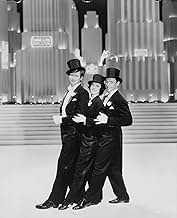
Eleanor Powell dances in a tuxedo to "Broadway Rhythm," Judy Garland sings "You Made Me Love You" to a photograph of Clark Gable, and Sophie Tucker sings her signature song, "Some of These Days." Then Tucker joins Garland for "Everybody Sing," and we hear that "Happy Days Are Here Again." This is another history lesson in the famous tunes of the times and the unforgettable performers who gave them to us in song and dance. --Musicals on the Silver Screen, American Library Association, 2013


Did you know
- TriviaThe song "Dear Mr. Gable" was a birthday present for Clark Gable's 36th birthday. Composer and arranger Roger Edens adapted the old song "You Made Me Love You" by James V. Monaco. It was sung at Gable's studio birthday party by a young Judy Garland. Studio head Louis B. Mayer was so impressed by it, that he gave orders to let Garland sing it again in the next great musical MGM was going to produce.
- GoofsIn the number "Follow in My Footsteps" Sally Lee puts her guitar on the bunk, nobody takes it but it can't be seen after the cut.
- Quotes
Alice Clayton: Is he deaf?
Jerry Jason: Well, he was the last time when I asked him for a raise.
- ConnectionsEdited into Grand Central Murder (1942)
- SoundtracksBroadway Melody
(1929) (uncredited)
Music by Nacio Herb Brown
Lyrics by Arthur Freed
Sung by an offscreen chorus during the opening credits
Reprised by the cast in the finale
- How long is Broadway Melody of 1938?Powered by Alexa
Details
- Release date
- Country of origin
- Languages
- Also known as
- The Broadway Melody of 1937
- Filming locations
- Production company
- See more company credits at IMDbPro
Box office
- Gross US & Canada
- $4,118,020
- Gross worldwide
- $6,204,280
- Runtime
- 1h 50m(110 min)
- Color
- Aspect ratio
- 1.37 : 1
Contribute to this page
Suggest an edit or add missing content